August 2, 2026
META’s Options Market Is Sending a Signal
What the volatility collapse after earnings reveals about the real trade.
First a note from Profits Run
You know the nightmare that’s kept you on the sidelines.
The one where a beginner wipes out their account on trade #1.
Here’s what nobody tells you: You can deal with that fear before you ever place a trade – with a pen.
It’s called the walk-away number.
One figure, chosen with a simple test, written down in ink. Get it right, keep your first position small, and your worst case is capped at a number you already decided you could live with.
I walk you through it inside Your First Trade Playbook – along with every other step between “never traded” and ready for your first options trade.
One sitting. Normally $29.97. Free today.
Good Trading,
Bill Poulos
P.S. Most beginners try to control the market. Smart ones control one number instead. It’s in the playbook – grab it free.
META’s Options Market Is Sending a Signal
META’s Options Market Is Sending a Signal
The options market knew something was off before anyone finished reading the earnings release.
Heading into Meta’s July 29 report, the at-the-money implied volatility for the July 31 weekly expiration was sitting near 99% — against roughly 53% for August contracts. That gap is the earnings premium: the price the market charges for holding through the event. It collapses the moment results hit the wire, and what happens in the hours immediately after tells you more than the move itself does.
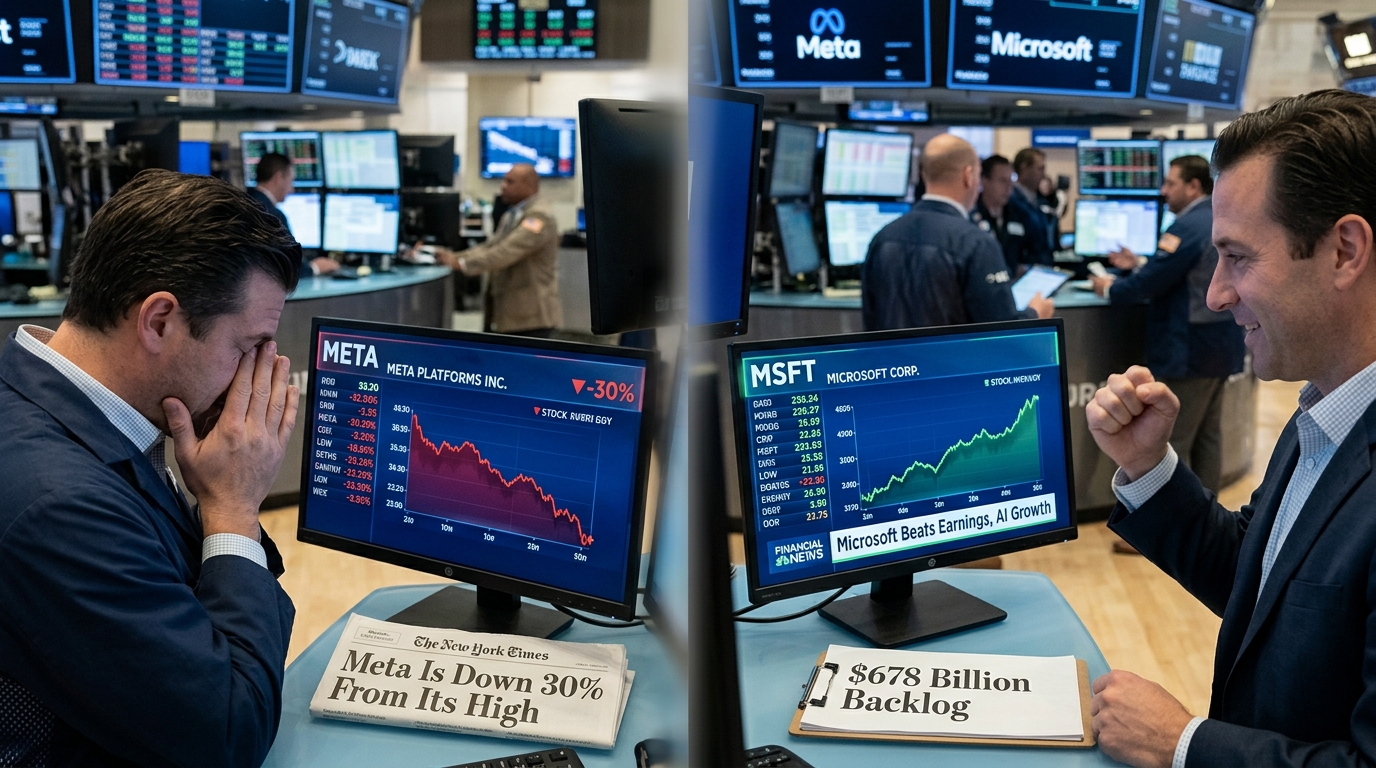
What happened: Meta fell roughly 10% after hours. The implied move the options market had priced for the event was in the 8% range. The stock outran it — again. Over the past 16 earnings cycles, Meta’s average actual move on earnings day has been approximately 11.8%, and the stock has outrun the implied move in 6 of its last 8 reports. The market has consistently underpriced this name’s post-earnings range, in both directions.
That pattern matters. It is one of the more repeatable signals in large-cap options — a stock that routinely exceeds what volatility sellers are pricing. And now, in the days following the selloff, there is a different and arguably more interesting signal emerging.
The Signal
Options volume in META ran at more than double its three-month average in the sessions surrounding the July 29 report. Before the event, the put-to-call ratio on July 31 contracts sat at 0.66 — meaning calls were outpacing puts heading into earnings, with open interest skewed toward the upside. January 2027 calls showed a call-to-put dominance ratio of approximately 5.59x, a positioning spread that signals long-side conviction extending well beyond the near-term event.
That is the first thing to hold onto. The options market was not positioned defensively into earnings. Sophisticated participants were leaning bullish across longer-dated expiries, even as the stock had already shed roughly 16% over the prior year and was entering the report near $585.
Then the results came out. EPS of $6.18 against a consensus that ranged from $7.19 to $7.40 — a miss of roughly 14%, snapping a six-consecutive-quarter streak of EPS beats. The stock dropped to the low $520s at the depth of the after-hours move before closing down approximately 7.5% to around $542.
What happens next in the options market is the question worth asking. When a name with this level of call-side open interest takes a 10% hit on earnings, there are two distinct forces at work: the fundamental reaction to the miss, and the mechanical repositioning of those call positions. Both matter for understanding where volatility goes from here.
You’re Being LIED To About The Iran War
Forget EVERYTHING you’ve heard about the Iran war.
Especially the reasons why we’re bombing the country.
Why It Matters
Here is what the activity is revealing. Large institutional participants had positioned for a rally into earnings using longer-dated calls. The event produced the opposite result. That means a wave of call positions is now deep out of the money, delta has collapsed on those strikes, and the question of whether those positions get rolled, extended, or abandoned over the next several weeks will show up in open interest changes.
At the same time, the realized move exceeded the implied move. That is historically a situation where implied volatility resets higher in the near term — the market recalibrates its expectation for how much this stock can move, particularly in a period where earnings-related charges, capex guidance revisions, and legal proceedings can land with little warning.
Slight tangent, but it matters here: the put-to-call reset that tends to follow a major earnings miss is not simply fear. It is portfolio managers adjusting hedge ratios. When a stock drops 10% on a single event, institutions that own it do not always sell it — they buy puts against it instead, particularly if they still believe in the medium-term thesis. That put buying, in the days following a sharp decline, often looks like bearish sentiment. It frequently is not.
The practical implication: IV in shorter-dated META options will likely stay elevated relative to its pre-earnings baseline. The forward options market is now pricing a more volatile Meta than it was two weeks ago. Whether that elevated premium is justified — or represents an opportunity on one side or the other — depends almost entirely on what you believe about the company behind the signal.
The Company Behind the Signal
Start with what is not broken. Meta’s advertising business generated $59.4 billion in Q2 revenue, up 27% year over year. Ad impressions increased 14% and the global average price per ad rose 12%. Family daily active people averaged 3.60 billion for June 2026. Instagram crossed 2.0 billion daily actives. Threads crossed 500 million monthly actives. The ad engine is not malfunctioning. It is, by most measures, accelerating.
What collapsed was everything below revenue. Total costs and expenses reached $42.03 billion, a 55% increase from the prior year. Tucked inside that number: $2.40 billion in legal charges and $1.18 billion in severance tied to a roughly 8,000-employee headcount reduction that began in May. Operating margin compressed from 43% to 31%. Net income fell 14% to $15.85 billion. Free cash flow — the number that options traders use to triangulate the risk of a dividend cut, buyback slowdown, or balance sheet deterioration — shrank to $784 million from $8.55 billion in the year-ago quarter. Capital expenditures of $31.08 billion in a single quarter are what drove that compression.
The forward guidance did not help. Meta raised the lower end of its full-year 2026 capital expenditure outlook, narrowing the range to $130 to $145 billion. Full-year expenses were guided to $165 to $169 billion, reflecting the $2.4 billion legal charge. Q3 revenue guidance came in at $61 to $64 billion — which, depending on the analyst model, was at or slightly below consensus on the midpoint.
On the same day as earnings, the company also announced a $14 billion data center venture with BlackRock in El Paso, Texas, structured with BlackRock funds owning 80% of the project. The structure is notable: Meta is using third-party capital to fund infrastructure, which is a direct response to the criticism that the company has no mechanism to monetize its AI buildout beyond its own ad targeting. Zuckerberg framed it as part of the broader Meta Compute strategy, pairing Meta’s infrastructure expertise with outside capital to move faster without fully destroying free cash flow.
Analysts noted the tension clearly. As one senior equity analyst put it, the scale of spending raises valid questions about cash flow, future operating costs, and investment returns — particularly given that Meta does not currently have a cloud business selling spare capacity to external customers.
Market Expectations: What Was Priced, What Was Not
The options market had priced roughly an 8% move into earnings. The stock delivered nearly double that at the low. So the implied move was wrong — not directionally, but in magnitude.
What the market had not priced was the combination of three overlapping negatives arriving simultaneously: a legal charge of $2.4 billion that crushed reported EPS, a capex guidance revision that raised the lower bound of a number already causing concern, and a Q3 revenue guide that failed to provide an upside cushion. Any one of those could be absorbed. All three together, in a single report, overwhelmed the genuine revenue beat.
What is interesting is that the January 2027 call positioning described earlier suggests a cohort of participants still believes in the medium-term recovery. The thesis, broadly, is this: the legal charges are discrete and lumpy, not recurring in the same magnitude; the capex ramp will eventually produce either improving ad economics or a nascent external revenue stream; and a stock trading at roughly 18-19x forward earnings against a business growing revenue at 28% year over year is not obviously expensive.
But the near-term options market is telling a different story. Elevated short-dated IV reflects genuine uncertainty about whether the next event — legal, regulatory, or capex-related — arrives before the stock has time to recover. That uncertainty is what creates the options opportunity, in either direction.
He Doesn’t Buy Gold. He “Skims” It.
A former hedge fund manager ranked in the top 1% by Barron’s has developed a three-step strategy to profit from gold – without buying a single ounce.
His followers have had the chance to collect $2,975… $3,781… and even $6,786 at a time. With a 73% win rate.
He calls it “Gold Skimming.” And he’s just revealed the full strategy for the first time.
Strategic Considerations
Three distinct situations deserve attention here, depending on how you read the signal.
If you believe the selloff overshot and the ad business remains the dominant factor: The elevated IV environment following the earnings drop creates a defined-risk structure worth considering. A bull put spread — selling a put at or near current support (around $520 to $540) and buying a lower-strike put for protection — allows a trader to collect premium while the market’s elevated fear is still priced into shorter-dated contracts. The thesis is that the stock stabilizes and the premium collected as IV normalizes represents the edge. The risk is a continuation of the selloff on new negative catalysts — additional legal charges, further capex revisions, or a Q3 guide-down.
If you believe the structural concerns are unresolved and the market has more repricing to do: A long put debit spread targeting the $480 to $520 zone over a 30 to 45-day horizon captures the bear case with defined risk. Free cash flow at $784 million on $60.8 billion in revenue is a ratio that is difficult to defend to institutions running dividend screens or buy-back models. If another legal charge or a capex upward revision surfaces in the next quarter, the selling pressure has a clear continuation path. The cost of the spread is known at entry; the risk is time decay if the stock simply stabilizes at current levels without breaking further.
If you are neutral on direction but believe volatility stays elevated: The calendar spread structure deserves attention. Selling near-dated elevated IV while buying longer-dated implied volatility at a lower price captures the expected collapse of the front-month earnings premium while maintaining exposure if a second event arrives. This structure is most effective when IV between short and long expirations is meaningfully dislocated — which, given the 99% front-month IV against 53% for August pre-earnings, was clearly the case heading into the event. Post-earnings, the spread between terms should compress, but the reset baseline for META options is higher than it was in early July. The calendar remains worth evaluating if front-month IV has not yet fully collapsed to the longer-dated term level.
One structural note across all three: position sizing relative to the underlying’s recent realized volatility matters. A stock that moved nearly 10% on a single session, and has a historical earnings-day average move of approximately 11.8%, is not a low-volatility instrument. Defined-risk structures exist precisely for this situation — they cap the downside of being wrong without requiring a stop-loss decision under pressure.
What to Watch
The open interest changes in META options over the next two weeks are the primary signal. If institutional participants who held January 2027 calls into earnings begin rolling those positions down in strike — or out in expiry — that suggests the long-side conviction is intact but the near-term entry is being reassessed. If those positions are closed without replacement, it tells a different story about institutional appetite.
Beyond options positioning, the following developments could confirm or challenge the thesis in either direction:
- Any updates to the legal proceedings that generated the $2.40 billion Q2 charge. Meta disclosed ongoing legal exposure that can produce large, lumpy charges on short notice. A second charge of comparable scale would break the bull case for free cash flow recovery.
- Q3 capex actuals relative to the $130 to $145 billion full-year guidance range. If the Q3 number implies the company is trending toward the top of that range — or above it — free cash flow goes negative on a full-year basis, and the debate over balance sheet sustainability accelerates.
- Any progress on external monetization of the Meta Compute infrastructure. Zuckerberg signaled during the earnings call that the company is evaluating pathways to generate returns on invested capital beyond its own apps. A concrete announcement of an external cloud or compute offering would shift the investment calculus meaningfully.
- The BlackRock El Paso data center partnership is the first visible step toward off-balance-sheet infrastructure financing. Watch for additional announcements of similar structures — if Meta accelerates this model, the free cash flow compression may be viewed as a temporary accounting artifact rather than a signal of structural deterioration.
- Technical levels: $520 has been cited as the immediate support, with $480 the next level below. On the upside, the gap between approximately $608 and $627 left by the post-earnings drop is the first target for any recovery attempt.
The options market priced an 8% move. The stock gave you 10%. That gap — the recurring pattern of META outrunning implied volatility around earnings — is the single most durable signal this name produces. What sophisticated participants do with their January 2027 call books over the next two weeks will tell you whether they believe that pattern repeats to the upside from a lower base, or whether the structural concerns around free cash flow and capex have finally started to matter in a lasting way.
The answer is not obvious. That is exactly when the options market is worth paying attention to.
Options Trading Report