
August 15, 2026
WOLF: 47% Short Interest, 932% Borrow Fee
August 19 earnings will settle the most expensive short-side bet in the semiconductor sector.
First a note from Banyan Hill Research
Dear Reader,
Something strange is happening.
A few of the most powerful states in the country are scrambling to stop Elon Musk.
New York is moving to ban his latest innovation. So is Massachusetts.
Senator Elizabeth Warren is fighting it tooth and nail.
Meanwhile… Musk is rolling his project out to millions of Americans… with the full blessing of President Trump and the U.S. Treasury.
When it goes live – as soon as this summer – nothing will ever be the same.
And the folks who understand why could make a fortune.
Regards,
Ian King
Chief Strategist, Strategic Fortunes
WOLF: 47% Short Interest, 932% Borrow Fee. August 19 Is the Referendum.

There is a specific kind of asymmetry that only exists when two groups of market participants are using fundamentally different clocks. Institutional short sellers in Wolfspeed (NYSE: WOLF) are running on a fundamental clock: losses are real, debt is real, profitability is years away. Retail buyers are running on a financing clock: at 932.81% annualized borrow fees, the short side does not have years. It barely has weeks.
That gap is the trade. Not the revenue, not the gross margin, not the $519.6 million trailing twelve-month net loss. The trade is whether the financing clock runs out before or after the fundamental thesis proves correct. August 19 is the next hard data point. Wolfspeed reports fiscal Q4 2026 earnings after the close, and the question on the call is not whether the company is profitable. It is whether the AI data center pipeline CEO Robert Feurle has been building is converting into contracted, recurring revenue.
This is not a comfortable stock to analyze. The bear case is airtight on paper. The bull case is speculative but structurally reinforced by one of the most punishing borrow environments in the semiconductor sector. Both camps are right about something. The question is which truth resolves first.
Macro and Sector Context
The broader semiconductor environment has grown hostile to loss-making names. The iShares Semiconductor ETF fell nearly 20% from its early-June peak, and median short interest across S&P 500 constituents reached roughly 3.0% of market cap, the highest level since late 2011 according to Goldman Sachs data cited by Robinhood. Institutional short selling has become a consensus trade in an sector where AI enthusiasm had previously suppressed that impulse.
Grid Emergency: 100X More Blackouts by 2030?
The Department of Energy warns blackouts could increase 100 times by 2030. Elon Musk and Sam Altman are already moving “off-grid” – and their next move could reward early investors most.
Inside that institutional unwind, individual names with concentrated short positions face a specific problem: catalysts become violent. When a heavily shorted stock receives a positive surprise, covering is not orderly. WOLF is operating inside that dynamic in real time, with 24.41 million shares sold short representing 46.98% of shares outstanding. The days-to-cover ratio on a name with that kind of short interest means any sustained buying program forces a prolonged covering sequence, not a single session flush.
The Federal Reserve’s posture has softened slightly against the macro bears. Recent inflation and labor data reduced the near-term probability of additional tightening, which cuts against one of the cleaner arguments institutional shorts have been using against rate-sensitive, cash-burning semiconductor names all summer. The 10-year Treasury yield trading in the high 4% range is still a headwind for any company with $1.83 billion in debt. But it is a known headwind. The borrow fee is a compounding one.
Silicon carbide itself sits at the intersection of two competing forces. The EV slowdown nearly destroyed Wolfspeed in 2025, sending the company into Chapter 11. The AI data center power buildout may be what resurrects it. Those two forces are not moving at the same speed. AI infrastructure spending is accelerating; EV adoption timelines keep slipping. Which revenue stream dominates the Q4 call will tell traders which force is winning.
The LITEON Qualification: Why August 6 Changed the Framework
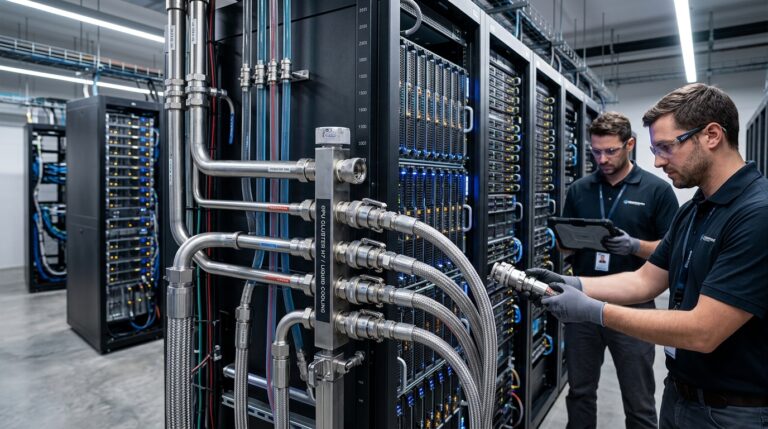
On August 6, Wolfspeed and LITEON Technology announced a strategic partnership targeting 800 VDC power architectures for next-generation AI data centers. LITEON successfully qualified Wolfspeed’s silicon carbide devices for use in its 800 VDC sidecar power and compute rack power supply platforms, which are being targeted at leading hyperscale customers. The platforms are designed for broader adoption across multiple cloud service provider deployments.
The structural point that most commentary missed: this is not a letter of intent. LITEON qualified the devices. Qualification is the gatekeeping step. It runs 12 to 24 months in hyperscale power components, involves rigorous reliability and thermal testing, and is a prerequisite to any volume purchase order. Wolfspeed did not announce a design win in progress. It announced a design win that already cleared the hardest technical hurdle.
The physics argument for 800 VDC architectures is not speculative. AI data centers running power-dense GPUs around the clock rely on power delivery systems where every conversion stage wastes energy as heat. An 800 VDC architecture dramatically reduces those conversion stages, meaning less waste, less heat, and lower operating costs at scale. As rack power requirements rise from 100 kW today toward 600 kW by 2028 and 1 MW by 2029 to 2030 per industry projections, the efficiency premium of silicon carbide compounds. LITEON is positioning to capture that transition with Wolfspeed’s 200mm manufacturing platform supplying the device layer.
Wolfspeed’s 200mm silicon carbide manufacturing platform at Mohawk Valley is a structural differentiator competitors ON Semiconductor and STMicroelectronics do not fully replicate. LITEON explicitly chose to leverage that platform for supply chain resilience and scalable volume production. The qualification announcement transforms the AI data center angle from a talking point into a contracted technical relationship with hyperscaler exposure. That distinction matters enormously heading into August 19.
Financial Data: What the Numbers Say and What They Miss
The trailing twelve-month revenue is $712.50 million. Net loss over the same period is $519.60 million. Loss per share is $9.46. Those are the numbers bears cite, and they are accurate.
What those numbers do not capture is the sequential trajectory. In Q2 fiscal 2026, reported February 4, Wolfspeed delivered $168.5 million in revenue, with AI data center revenue growing 50% quarter over quarter. Q3 fiscal 2026 came in at $150 million, in line with the midpoint of guidance, with power revenue of approximately $100 million and materials revenue of approximately $50 million. Power revenue composition was 90% from the Mohawk Valley 200mm device fab and 10% from last-time buys of 150mm inventory. The Durham 150mm fab shutdown was completed one month ahead of schedule. Q4 guidance is $140 million to $160 million, with consensus analyst estimates around $156.9 million. Non-GAAP gross margin remains negative, at negative 20.6% in Q3, with no profitability expected in Q4.
The balance sheet tells a more complicated story than the income statement does. Total debt stands at $1.83 billion. Cash and equivalents are approximately $1.16 billion. Net cash position is roughly negative $665.7 million. However, the current ratio is 7.03, a figure that does not belong on a company described by bears as cash-starved. A current ratio above 7 means short-term assets cover short-term liabilities by a factor of 7. That is a liquidity buffer, not a crisis.
Earlier this year, Wolfspeed received approximately $700 million in Section 48D cash tax refunds and applied $175 million toward retiring long-term debt. In March, the company closed a private placement that redeemed approximately $475.9 million of outstanding Senior Secured Notes, reducing total debt by approximately $97 million and lowering annual interest expense by approximately $62 million. Capital expenditures are down 90% year over year, falling to $30 million in Q2 from over $437 million previously. The company has said liquidity is projected to be sufficient for at least the next 12 months. That projection is more credible after three consecutive quarters of debt reduction actions.
Q4 consensus EPS estimate is negative $2.45. Last quarter’s EPS was negative $3.78 against an expectation of negative $3.26, a miss on the loss line. The Q4 call is not about EPS. It is about two questions: whether AI data center revenue continued its sequential growth from Q2’s 50% quarter-over-quarter expansion, and whether the LITEON relationship is the first of several hyperscaler-adjacent wins or a standalone event.
One Date – November 27 – Could Reset the American Economy for Good
A $10 TRILLION shift is moving through Washington, D.C. Forensic accountant Joel Litman believes those who understand it before November 27 have a rare opportunity to avoid disaster and get positioned early.
Price Action and Technical Framework
Wolfspeed emerged from Chapter 11 on September 29, 2025, with new shares issued at restructured terms. From late April 2026, the stock traded in the $25 to $26 range before sprinting to a high of $80.82 on May 22, a near-tripling in fewer than four weeks. That move was a textbook squeeze: fundamentally challenged name, elevated short interest, AI-adjacent catalyst, retail buying amplified by forced covering. Year-to-date as of that peak, WOLF was up 273.64%.
The stock has since retraced from those highs, trading in the low $30s in early-to-mid August, most recently near $32.87. That represents a pull of roughly 59% from the May peak. The retracement is where both camps are now positioned. Long holders who bought the squeeze at $50 to $60 are sitting on losses and may have limited tolerance for another miss. Short sellers who entered near the May highs have unrealized gains but are paying 932.81% annually to keep them.
Standard moving average analysis breaks down in a post-bankruptcy re-listing with annualized historical volatility above 100%. The relevant anchors are structural, not technical. The $25 to $26 zone is the base from which the May squeeze launched. Current price in the low $30s is above that base but well below the squeeze peak. The $45 to $50 range marks the lower end of where momentum buyers piled in during May, meaning short sellers who entered on breakout momentum have their most concentrated inventory in that zone. A close above $50 on volume would reactivate mechanical covering pressure.
The borrow fee is the dominant technical indicator in a name like this, and 932.81% is not a deterrent to shorts. It is a daily income statement entry. At that annualized rate, a 90-day short position costs roughly 230% of the position size in financing alone, independent of any price movement. The math only works for bears if the stock collapses in days, not weeks. Every session where WOLF holds the low $30s, the financing clock advances against the short side.
Options Market Analysis
At-the-money implied volatility in WOLF has been cited above 138% in recent options chain data, consistent with a name that tripled in four weeks and is now approaching a binary earnings event. That IV level prices in extreme expected moves around August 19.
For context: a 138% IV on a $32 stock implies an annualized standard deviation of roughly $44. On a 30-day basis, the one-standard-deviation expected move is approximately $12.50 in either direction. That means the options market is pricing WOLF somewhere between $20 and $45 as a one-standard-deviation outcome over the next 30 days. Around an earnings catalyst, the near-term implied move is tighter but still substantial, likely 15% to 20% intraday in either direction based on the May price action pattern.
With IV this elevated, selling premium looks attractive in isolation. It is not, for two reasons. First, WOLF has demonstrated the capacity to move 3x to 4x its implied range when a genuine catalyst arrives, as it did from April into May. Second, the bid-ask spread across the options chain is wide, with average spreads reported above 17%. Wide spreads erode theoretical edge on every entry and exit. Defined-risk structures that limit spread exposure to a single leg on each side are more tractable than naked premium sales in this environment.
Put-call flow behavior in high-short-interest names with elevated borrow fees tends toward call buying as retail participants express the squeeze thesis through leveraged upside rather than stock ownership. Watch for unusual deep out-of-the-money call sweeps in the days before August 19 as a positioning signal. Large call sweeps in that environment typically precede short-covering windows, not follow them.
Scenario Modeling
Bull Case
Q4 revenue prints at or above the $160 million guidance ceiling. CEO Robert Feurle expands on the LITEON partnership with disclosure of additional hyperscaler design win activity, and AI data center revenue shows a third consecutive quarter of sequential growth following the 50% expansion in Q2. Management raises the forward revenue trajectory explicitly or provides a long-range financial target update. In this environment, short sellers paying 932.81% annually face a binary choice: cover in the low $30s or risk re-entering the May squeeze zone. Price target on a full squeeze retest: $70 to $80, requiring sustained volume above 20 million shares per session. A defined-risk long structure with a tight downside cap preserves exposure to that move without requiring precise timing.
Base Case
Q4 revenue prints near the midpoint of guidance, approximately $150 million, matching Q3’s result. Management confirms the LITEON pipeline is progressing but does not announce incremental hyperscaler wins. Non-GAAP gross margin remains negative but narrows modestly from Q3’s negative 20.6%. Liquidity guidance is reiterated for the next 12 months. The stock drifts in a $28 to $38 range as institutional shorts slowly reduce exposure due to borrow cost erosion, and retail positioning holds without a fresh catalyst. The AI data center angle is validated but not yet monetized at a scale that changes the forward model materially. Most probable 30-day range: $28 to $38.
Bear Case
Q4 revenue misses the $140 million guidance floor. Management commentary on automotive qualification delays extends into fiscal 2027, the LITEON partnership produces no incremental hyperscaler color, and guidance for fiscal Q1 2027 implies no acceleration. The AI pivot thesis loses credibility as a near-term revenue driver, and the stock retests $20 to $22, roughly the pre-squeeze base from early April. The most acute downside catalyst in this scenario would be a secondary equity offering to fund Mohawk Valley ramp costs, given the dilution history of the restructuring. Defined-risk short structures or put spreads below the $27 support zone would be consistent with this framework for traders expecting that outcome.
Structured Trade Framework
WOLF is not a trade for passive accounts. The combination of 138%+ implied volatility, 47% short interest, a 932.81% borrow fee, and a confirmed binary catalyst on August 19 creates gap risk in both directions that demands explicit position sizing before entry at any price.
For traders expecting the bull case: the August 19 earnings event is the defined catalyst. Position sizing should reflect a realistic 15% to 20% intraday swing in either direction based on historical earnings volatility for this name. A long call spread, structured below the current ATM strike to reduce premium outlay, captures upside exposure with a defined maximum loss equal to the net debit paid. The spread width should reflect the expected move, not a conservative guess about where the stock might settle. Wide spreads in the options chain mean sizing conservatively is not optional; it is a mathematical requirement to protect net P&L on entries and exits.
SpaceX was the biggest IPO in history. Yet there’s some investors who are losing money and some that are not. Here’s why.
SpaceX just taught investors a brutal lesson.
Everyone who bought shares on IPO day is losing money after the stock fell 40% from its high.
Meanwhile, Pre-IPO investors are still sitting on gains.
The real money is made BEFORE the stock starts trading.
Anthropic and OpenAI are next. Both filed with the SEC in June. That’s why I’m claiming my pre-IPO stake right now.
I’d like to send you important details inside this special report:
Inside the Anthropic and OpenAI Pre-IPOs
For traders expecting the base case: the borrow fee environment makes outright short exposure economically irrational beyond a very short holding period. A put calendar spread, buying a longer-dated put and selling a shorter-dated put at the same strike, captures the slow-bleed thesis while reducing the financing drag. The structure does not benefit from a squeeze and does not require a collapse within days; it profits from mean reversion over weeks, which is the base-case timeline.
For traders positioned neutral: an iron condor benefits from post-earnings IV crush if the stock settles inside the expected move range. Given WOLF’s demonstrated capacity to move far outside implied ranges when catalysts arrive, the width of the condor should be set conservatively and position size should be small. The risk of undefined loss on a squeeze is not theoretical in this name.
Key levels heading into August 19. The $27 to $28 zone is the first meaningful support from the post-reorganization re-rating. A close below $27 on elevated volume is a signal the AI thesis is losing institutional sponsorship. On the upside, $45 to $50 marks the lower end of the May squeeze accumulation zone. A sustained close above $50 puts mechanical covering pressure back on the market. The current low $30s price is between those anchors, which is precisely why neither side has clean control.
Risk Analysis
The risks in WOLF are asymmetric and not evenly distributed between the two camps. For longs, the primary risks are a revenue miss, a secondary offering, and a prolonged base-case drift in which the borrow fee creates no urgent covering pressure because short sellers are trimming gradually rather than all at once. None of those risks are binary except the offering.
For shorts, the risks are more time-constrained. At 932.81% annualized borrow, the position bleeds independent of price direction. A flat stock is a losing short at this rate. The squeeze risk is not a tail event; it is a baseline scenario whenever a genuine catalyst arrives into a name with 47% short interest and nearly 100% utilization of available short inventory. When borrow inventory is maxed out, new short sellers cannot enter even if they want to, which means any upward move is met with reduced selling pressure from that source.
The Altman Z-Score of 0.39 is a legitimate bankruptcy risk indicator. Any score below 3 signals elevated financial distress. Wolfspeed’s post-restructuring balance sheet is cleaner than the pre-bankruptcy version, but the Z-Score reflects persistent losses, high debt, and negative operating cash flow of $391.3 million over the trailing twelve months. The liquidity runway of 12 months is real but not indefinite. If AI data center revenue does not scale materially by fiscal mid-2027, the capital structure question reopens.
Forward Outlook
The long-range plan, which management committed to releasing in the first half of calendar 2026, has not yet been disclosed publicly as of this writing. That update, if it accompanies or follows the August 19 call, would be the most significant fundamental event since the bankruptcy emergence. A credible path to EBITDA profitability with defined revenue milestones tied to AI data center scaling would change the institutional short thesis structurally, not just temporarily.
Mohawk Valley utilization is management’s own stated lever for gross margin recovery. At present, underutilization costs remain a major drag, contributing $48 million in Q2 alone. If LITEON transitions from qualification to volume orders over the next two to three quarters, and if additional hyperscaler design wins follow, utilization at Mohawk Valley rises and the gross margin drag compresses. That compression is what would eventually flip the fundamental story from loss to profitability. The timeline is not 2026. It is likely 2027 to 2028 at the earliest. But the direction of travel is the question the market is pricing, not the exact arrival date.
Wolfspeed also filed a patent infringement lawsuit against Navitas Semiconductor on July 7, a signal that management is actively defending its technology moat rather than conceding competitive ground. The 300mm silicon carbide wafer demonstration in Q2 opens optionality in markets beyond power devices, including AR/VR thermal management and optical-grade substrates. Neither of those markets contributes to near-term revenue, but they expand the total addressable market optionality that long-duration investors are pricing.
Action Checklist
- Verify August 19 earnings timing: Wolfspeed reports after market close. Position before close of August 19 or wait for the reaction. Overnight gap risk is substantial in either direction.
- Monitor borrow fee daily: If the 932.81% rate drops materially, short inventory has opened up and covering pressure has eased. A rate spike above 1,000% signals the opposite.
- Watch Q4 revenue vs. guidance ceiling: $160 million is the upper bound. A print at or above that level is the minimum threshold for a positive catalyst. A miss below $140 million is a structural sell signal.
- Track AI data center sequential growth: Q2 showed 50% quarter-over-quarter expansion. Any acceleration or deceleration of that trend on the Q4 call changes the forward revenue model more than total company revenue does.
- Listen for LITEON volume language: Partnership qualification is confirmed. The August 19 call is the first opportunity for management to characterize whether LITEON purchase orders are materializing, and at what volume.
- Size positions for a 15% to 20% intraday swing: Based on May earnings volatility patterns, both directions are live. Position sizing should treat the expected move as a floor, not a ceiling.
- Use defined-risk structures only: Naked long or short exposure in a 138% IV, 47% short interest, 932% borrow-fee name is not a risk-managed position. Spreads and defined-risk structures are the appropriate vehicle regardless of directional bias.
- Monitor the $27 support and $50 resistance: A close below $27 on volume signals the AI thesis is losing institutional sponsorship. A close above $50 reactivates squeeze mechanics.
- Watch for secondary offering risk: Any capital markets activity announcement in the days surrounding the earnings call would be the single most acute downside catalyst for existing longs.
Conclusion
The retail versus institutional contest in WOLF is a financing story wearing a fundamental costume. Bears are correct that the company loses money, carries significant debt, and has not demonstrated a clear path to profitability. That thesis is not wrong. What it is, is slow. And at 932.81% annualized borrow fees, slow is expensive.
Retail buyers in WOLF are not ignoring the losses. They are making a specific calculation: that 46.98% short interest plus a borrow fee above 900% creates a structural pressure gradient that a genuine catalyst can detonate. The August 6 LITEON qualification was not a press release. It was technical evidence that Wolfspeed’s silicon carbide platform is entering the hyperscale supply chain at the device qualification level, which is the hardest step. The August 19 call is the moment to find out whether that entry point is translating into contracted revenue volume.
What both sides tend to underweight is this: the squeeze dynamic amplifies a move that a fundamental catalyst starts. Without a real catalyst, high short interest and elevated borrow fees can coexist with a slow, grinding decline for months. The bears have survived this long because WOLF has not delivered a result that forces covering at scale. If August 19 changes that, the financing math takes over. If it does not, the fundamental math does.
Prepare for the data. Define your risk before the close on August 19. Let the report resolve the question you are actually trading, not the one you hope will resolve in your favor.
Analysis by The Editor. For informational and educational purposes only. Not financial advice. All structured trade examples are illustrative frameworks, not instructions. Trading involves risk of loss.