September 9, 2026
Bonus Content: AMD’s Data Center Revenue Doubled. The Test Is Margins.
In the 1849 gold rush, most prospectors went home broke. The fortunes went to the people selling picks, shovels, and denim to everyone doing the digging.
The AI gold rush is running the same script. The money is piling into chips. But a chip is a paperweight until you plug it in, and the plug is where the real shortage is.
The United States must more than triple its annual power capacity, from 25 gigawatts of data center demand in 2024 to more than 80 gigawatts by 2030.
American PowerGen is already assembling that infrastructure: a 22 gigawatt pipeline across 16 projects in Texas, where large new electricity users have already requested more than 430 gigawatts of new power. That’s nearly 5x the state’s current peak capacity. Land secured. Gas supply arranged. ERCOT interconnection studies completed. Air permits submitted. 3 gigawatts of construction is set to start in 2027.
Nasdaq ticker “APGX” reserved. Shares are $2.50 per share at a $27 million pre-money valuation, with up to 17% bonus shares for early investors.
Minimum investment: $1,000.
AMD’s Data Center Revenue Doubled. The Test Is Margins.
Markets do not reward potential. They reward execution. AMD has spent two years assembling the most credible alternative to Nvidia’s data center dominance in the accelerator market’s history, and Q2 2026 produced the numbers to match the ambition. Whether the second half delivers the margin structure to justify AMD’s multiple is a different question entirely.
The Numbers Behind the Moment
Data Center segment revenue reached $6.7 billion in Q2 2026, up 107% year-over-year. Total company revenue came in at $11.5 billion, with non-GAAP EPS of $1.66 and GAAP EPS of $1.38. Non-GAAP gross margin was 56%. The beat was broad-based, but the story lives in data center.
AMD said Instinct GPU sales more than doubled year-over-year, driven by demand for the Instinct MI350 Series. On the CPU side, AMD now expects server CPU revenue to grow more than 80% year-over-year in the second half of 2026. Taken together, AMD expects data center segment revenue to more than double year-over-year in 2027.
What Helios Actually Represents
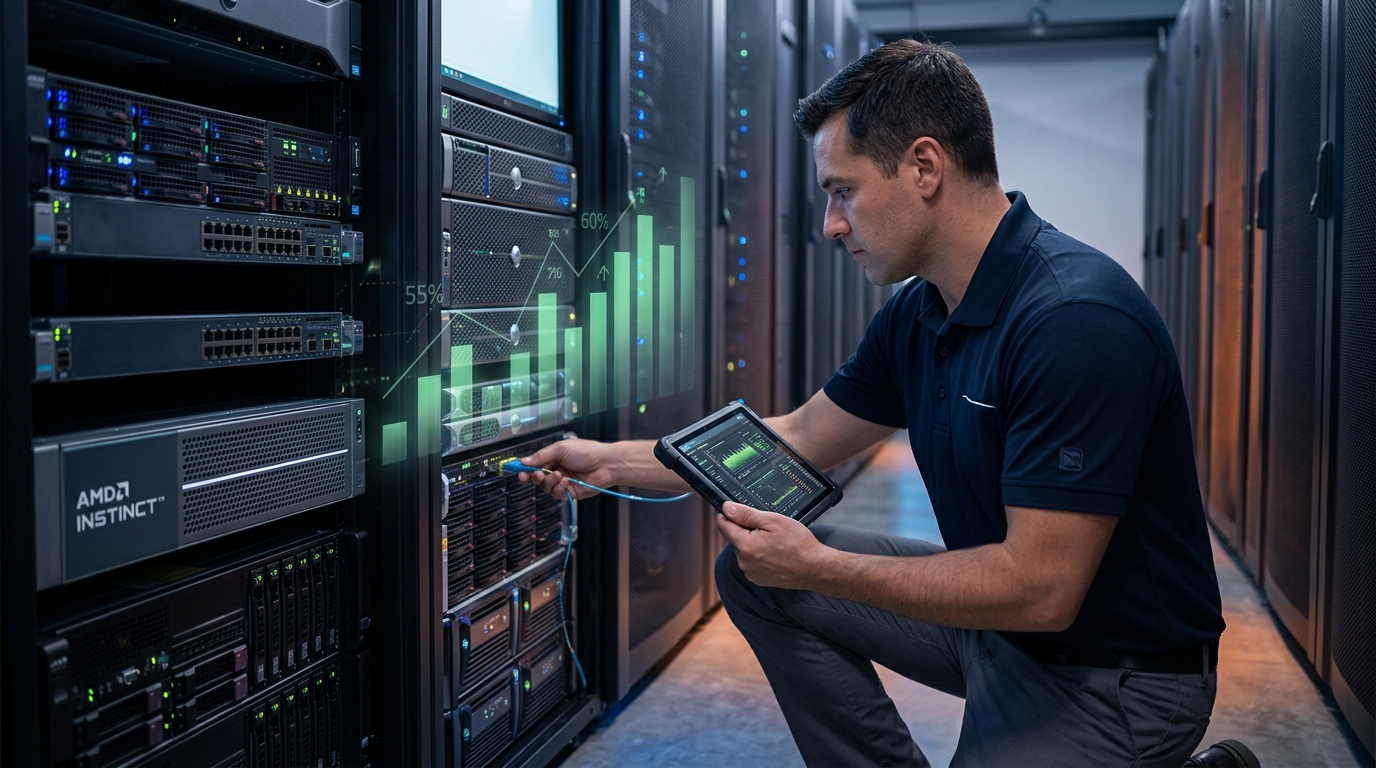
This is not about selling individual chips anymore. AMD’s Helios rack-scale platform combines EPYC “Venice” CPUs, Instinct MI450-series GPUs, Pensando networking, and ROCm software, and AMD has tied Helios to major customer partnerships including Anthropic and Meta, with Microsoft also highlighted by AMD as a partner around Helios-related deployments. AMD has framed Helios as delivering roughly 10% to 15% more performance at fixed rack power and up to 30% more tokens per dollar versus competition in its own benchmarking, with initial deployments and shipments expected to begin in the second half of 2026 and a ramp into 2027.
Anthropic has committed to deploying up to 2 gigawatts of MI450-series GPUs in AMD Helios rack-scale solutions, with deployment of the first gigawatt beginning in the first half of 2027, alongside a multi-year engineering collaboration focused on optimizing workloads and improving ROCm. The software dimension matters.
Q3 Guidance and What It Implies
AMD guided Q3 revenue to approximately $13 billion, plus or minus $300 million, against Wall Street consensus around $12.51 billion. The midpoint implies approximately 41% year-over-year growth and about 13% sequential growth. That guidance beat matters because it was issued into a quarter when MI450 begins ramping. Management has been explicit that MI450 is expected to run at gross margins below the corporate average as it ramps. Gross margin was guided at approximately 56% on a non-GAAP basis for Q3.
Options Market Analysis
AMD’s implied move was approximately 6.5% around the August earnings event, with IV rank running near 85. That elevated reading has since compressed post-earnings, which is typical. The semiconductor IV cycle has remained durable through 2026, with AMD typically registering a 30-40% IV rank. Shares have moved an average of 6.62% in the week following earnings over the past year. With the next earnings event approximately six weeks out, premium is not yet pricing the MI450 ramp risk at full intensity.
Structured Trade Framework
Bull case: If you believe MI450 ramp volume clears Q3 guidance and Helios deployments with Anthropic begin contributing meaningfully to recognized revenue, a defined-risk call spread targeting a 10-12% move from current levels captures that acceleration without uncapped downside.
Bear case: For traders expecting margin compression to outpace the data center revenue ramp in Q3, a put spread positioned near the 56% gross margin floor offers defined-risk exposure to guidance revision risk without betting on a structural collapse.
Neutral case: The largest ongoing risk remains software: AMD’s out-of-box experience can still require meaningful optimization work relative to CUDA-centric deployments. An iron condor with wings at the 6-7% expected move range captures time decay while that software story develops over Q3.
Action Checklist
- Monitor Q3 data center revenue against the $7.5B+ threshold that would confirm Helios volume is translating to recognized revenue
- Track gross margin: any non-GAAP gross margin below 55% on MI450 ramp dilution would reset the 2027 earnings model
- Watch ROCm adoption metrics, specifically the out-of-box model count, as a software moat signal against CUDA
- Verify IV rank before sizing any position; current readings near 30-40% suggest options are not expensive, favoring long premium structures into Q3
- Check Helios customer deployment timing: Anthropic’s gigawatt-scale commitment converting from forecast to booked revenue is the quarter’s defining variable