
September 9, 2026
Bonus Content: Airbus Cuts China Jet Demand by 470 Planes. What That Means for BA and Options Traders
Copper is at record highs. Gold just blasted to $5K.
And while most juniors are forced to repeatedly raise money to keep the drills turning… this sub – $1 copper-gold explorer has one of the world’s largest gold producers funding the work.
That’s a huge advantage.
Meanwhile, shares still trade below $1.
And major-company-funded drilling is only the beginning.
Across two premier Australian mineral belts, drills are turning with plenty of firepower for what comes next:
✔ Major-company-funded exploration Down Under
✔ An aggressive new multi-project drill campaign
✔ Multiple paths to copper-gold discovery
✔ A strong treasury and tight share structure
✔ BONUS: Our exclusive interview with the CEO
That’s a lot of upside packed into a sub – $1 stock.
Click here to access our FREE online report… and discover why this under-the-radar copper-gold explorer has all the ingredients for a major breakout as the drills turn Down Under.
Airbus Cuts China Jet Demand by 470 Planes. What That Means for BA and Options Traders
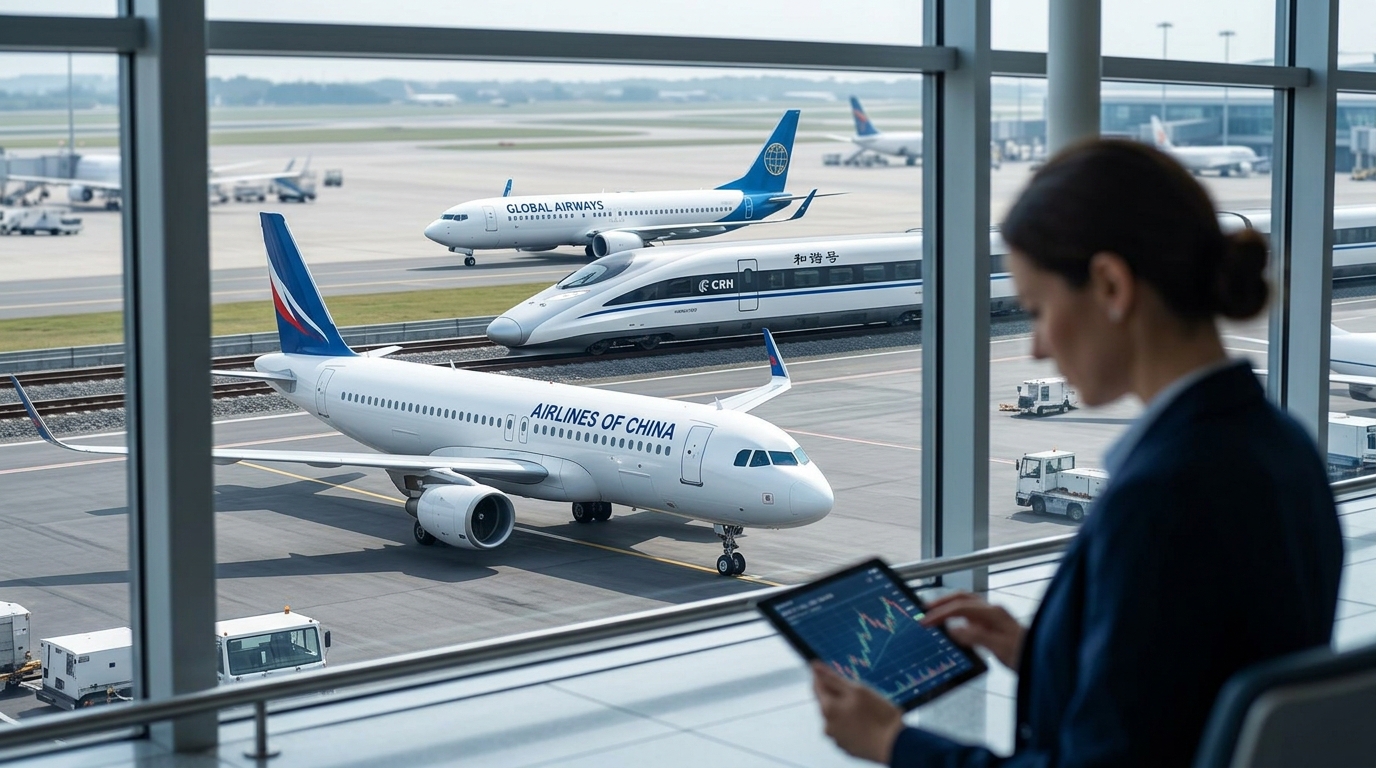
Markets don’t need a 20-year forecast to feel pressure. They need a structural shift that is already happening. Airbus supplied both on September 8, 2026 when it trimmed its two-decade single-aisle demand outlook for China to 7,480 aircraft from 7,950 last year, a reduction of 470 jets, and the first time the manufacturer explicitly quantified high-speed rail substitution inside its China figures.
The revision is significant for what it confirms, not for what it predicts. China’s high-speed rail network now exceeds 50,000 kilometers, accounting for more than two-thirds of global high-speed rail. Rail already dominates trips under 600 to 700 kilometers, and Beijing’s 2026-2030 five-year plan targets a network expansion to roughly 60,000 kilometers of high-speed routes by 2030. Airbus now expects approximately 10% of domestic air traffic to shift to rail over the long term. That is not a projection. It is an acknowledgment of what is already embedded in capacity data.
The Math Behind the Misery
The proof is in the carriers’ financials. Air China, China Eastern, and China Southern reported a combined first-half 2026 net loss of roughly 8.2 billion yuan (about $1.2 billion), marking the seventh consecutive year of first-half losses. Revenue at all three grew approximately 10% year over year. Losses still widened. Jet fuel expenses rose between 34.7% and 37.7% across the group after the Middle East conflict sent oil prices higher, and the carriers hedge little of their fuel exposure, amplifying every swing. HSBC analysts project a combined full-year 2026 loss near 16.8 billion yuan, against a prior market expectation for a 1.3 billion yuan profit.
The squeeze is structural, not cyclical. High-speed rail caps domestic fare power precisely when fuel costs demand higher yields. China Eastern noted that disrupted international routes and fuel prices had “severely undermined” profitability. The pincer does not relax simply because jet fuel retreats.
COMAC: The Third Variable
The Airbus revision also lands as COMAC accelerates C919 deliveries. The Big Three had expected 33 C919 narrowbodies in 2026, roughly double the 15 received in 2025. Actual pace has lagged; IBA forecasts approximately 25 deliveries for the full year, constrained by supply chain bottlenecks and dependence on Western LEAP-1C engines. Every C919 delivered displaces an order slot for a Boeing 737 MAX or an Airbus A320neo. The substitution is slow but directional, and the revised Airbus forecast implicitly absorbs it.
Options Market: What the Forecast Cannot Offer
This is where the editorial angle matters. A 20-year demand revision carries no dated catalyst for positioning in Airbus or Boeing options. There is no earnings beat or miss to trade around, no guidance cut with a quarterly timestamp. The event creates noise, not an edge.
For Boeing specifically, the China demand question has been structurally clouded for years by geopolitics, COMAC substitution, and now rail diversion. BA options traders need a near-term binary. This story provides none. Broad aerospace IV tends to move on deliveries data, labor disputes, and quarterly earnings, not on a manufacturer’s long-range market forecast.
For traders who do have a directional view on BA’s China exposure, the appropriate framework is defined risk over a multi-month horizon. A bull case rests on a U.S.-China trade thaw restoring delivery permissions and a global order backlog that still runs into the thousands. A bear case is built on continued COMAC substitution, sustained fuel dislocation keeping Chinese airlines from expanding fleet capacity, and any further regulatory restrictions on Boeing sales into the PRC.
Risk Checklist
- No dated catalyst: Avoid volatility-buying strategies tied to this specific forecast headline.
- Chinese airline stocks remain under structural fuel and pricing pressure through at least year-end 2026.
- COMAC C919 ramp is real but slower than official targets; it does not materially alter Airbus or Boeing near-term order books.
- Rail substitution in China is a 10-to-20-year margin compression story for narrowbody demand, not a quarterly event.
- If you believe Boeing’s China access improves diplomatically, a defined-risk long structure in BA beyond Q4 2026 expiry frames the upside without unlimited downside exposure.
- If you believe structural demand erosion compounds with fuel pressure, a debit put spread on Hong Kong-listed Chinese airline names captures a more direct expression of the thesis than BA options.