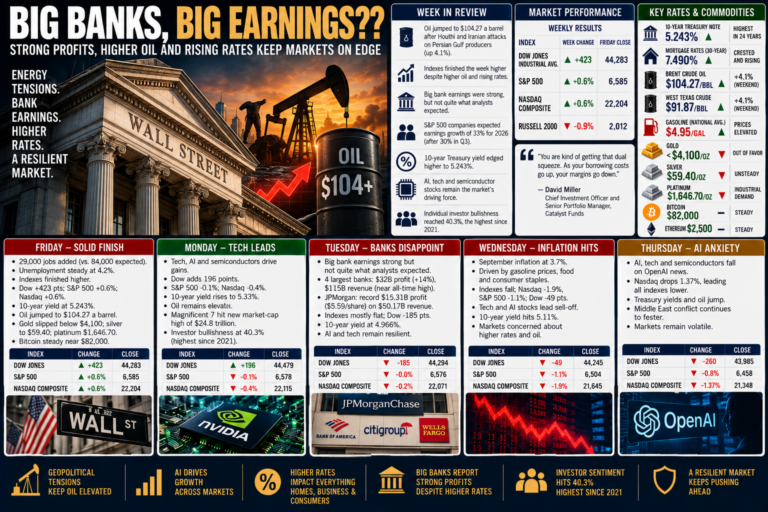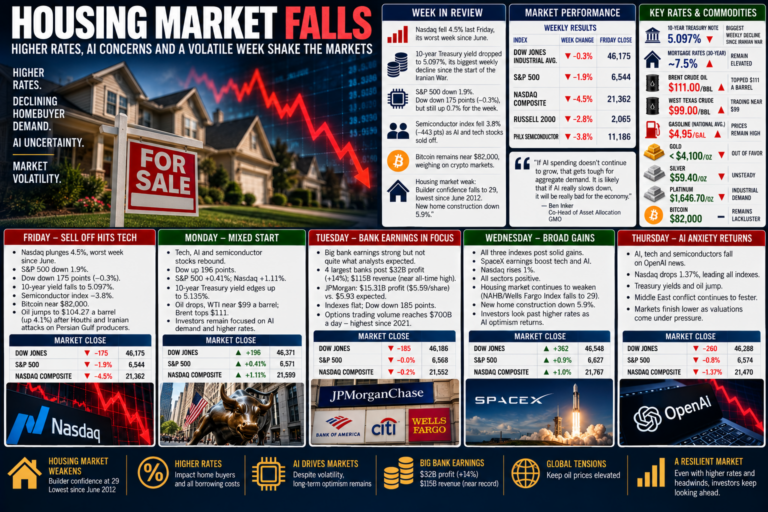
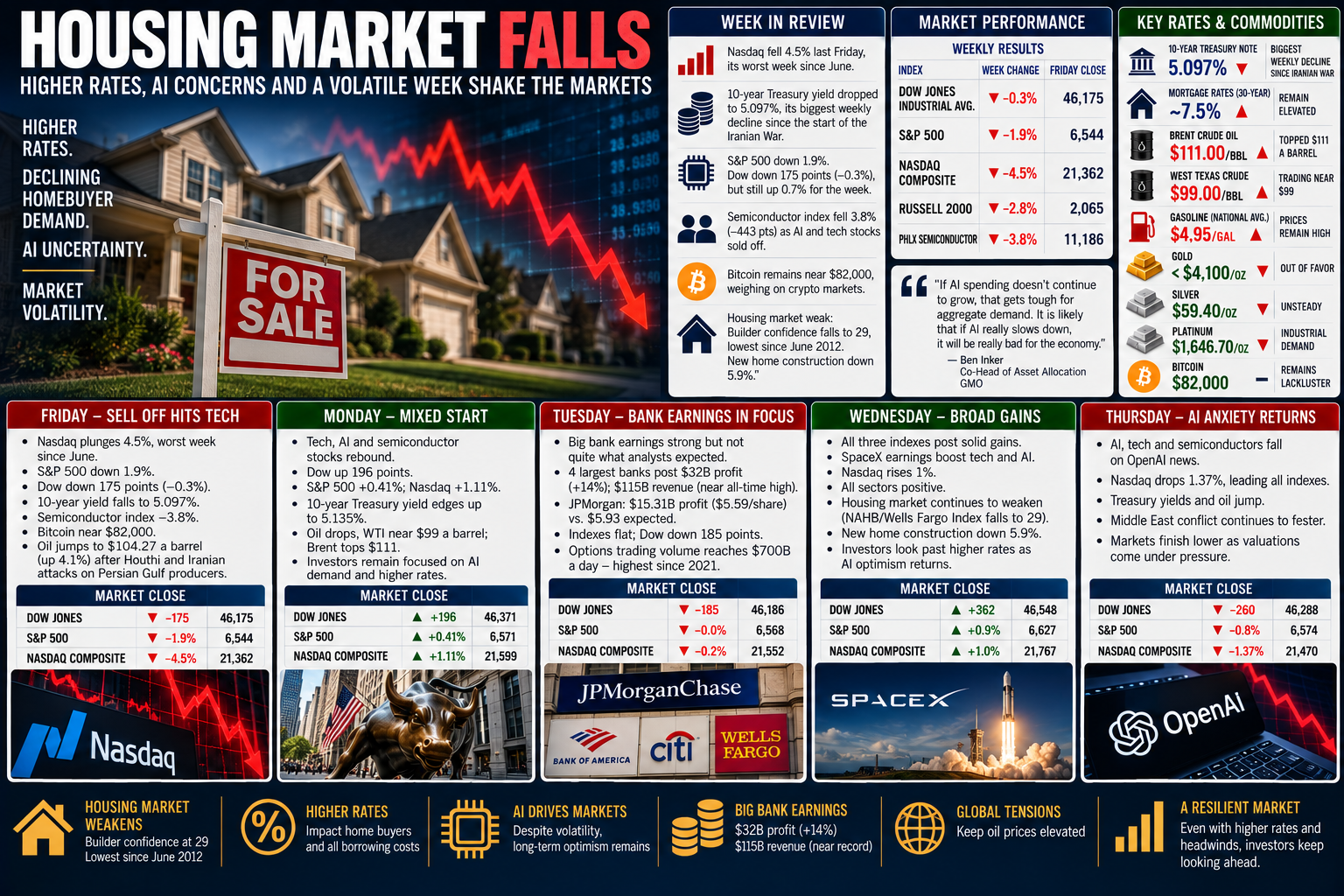
The high flying Nasdaq Composite Index suffered a disastrous week last Friday…falling 4.5%. A feared market adjustment by ‘leading gurus,’ analysts and seasoned market players ‘hit home’ on Friday. Creeping inflation, and mounting concern of the expected debt for the massive AI build-out, along with a confused bond market pushed technology stocks to the brink as a ‘quick–sell–off’ drove the heavy tech Nasdaq to its “worst week since June.” The 10–year Treasury note yield dropped to 5.097% as bonds edged upward according to TradeWeb, “its biggest weekly decline since the start of the Iranian War.” The S&P 500 lost 1.9%, while the blue chip Dow Jones Industrial Average held its loss to 175 points, off 0.3%, showing a slight gain of 0.7% for the week. Ben Inker, Co head of asset allocation at Boston based money manager GMO commented; “If AI spending doesn’t continue to grow, that gets tough for aggregate demand. It is likely that if AI really slows down, it will be really bad for the economy.” The PHLX semiconductor index, made up of AI, semiconductor, and technology stocks lost 3.8% Friday, or 443 points, streaking downward all week. Bitcoin continued to languish near $82,000 a coin unable to mount a rally, weighing negatively on all crypto currencies.
Investors and traders have been heavily ‘tuned in’ to concerns of the massive costs related to the build out of artificial intelligence companies, and their ability to sustain long term financial commitments. Cracks in the demand for AI stocks are beginning to surface with many issues retracking, slumping after a tremendous run–up. New inflation numbers have added to the financial puzzle. Tom Hainlin, national investment strategist at U.S. Bank, speaking of the financial obligations of AI companies; “We don’t think that’s a material concern right now. Do those companies still have strong demand or are we starting to get chinks in the armor?” Indexes were positive Monday with The Dow Jones Industrial Average closing just above flatline, while the S&P 500 finished up 0.41%. The heavy tech Nasdaq Composite topped all indexes, rising 1.11%. The 10–year Treasury note yield edged up to 5.135%. Oil dropped, with West Texas crude hovering in the $99.00 a barrel range while Brent crude oil topped $111.00 a barrel. “The NAHB/Wells Fargo Housing Market Index, a gauge of builder confidence in the market for newly built single family housing fell three points to 29 in October, the lowest reading since June 2012. Home building and buying declined in September, as construction of new homes fell 5.9% according to the Commerce Department. Homestarts, traditionally, are a good measure of upcoming economic trends along with mortgage rates. J.D. Joyce, president of Houston financial advisory Joyce Wealth Management said; “If interest rates go up x amount, what does that do to borrowing costs for all their debt laden companies that are doing this build-out and using financing to do it.?” He added; “It’s becoming more costly and that could hurt margins for some big players… but I don’t think it’s going to be the death knell for the AI rally.” All three indexes scored big gains Wednesday as all sectors were positive. Space-X led the techs higher as its quarterly report dazzled investors and spurred AI, technology and semiconductor (including the Mag–7 stocks) stocks higher as the Nasdaq Composite rose 1%.
RUMBLINGS ON THE STREET
Avi Salzman, Financial Writer for Barron’s, Barron’s – “The market environment has clearly changed. To adjust, investors may have to think less like employees…a little more like owners.”
Henry McVey, head of Global Macro and Asset Allocation, KKR, Barron’s – “It is borderline irresponsible to not understand China’s technology effort, even if you are going to buy the ‘Magnificent Seven stocks.”
Warren Pies, of Fourteen Research, Barron’s – “Fear is in the air. Whether or not it is prudent to reduce risk, this backdrop requires more tactical positioning and an extra dose of paranoia.”