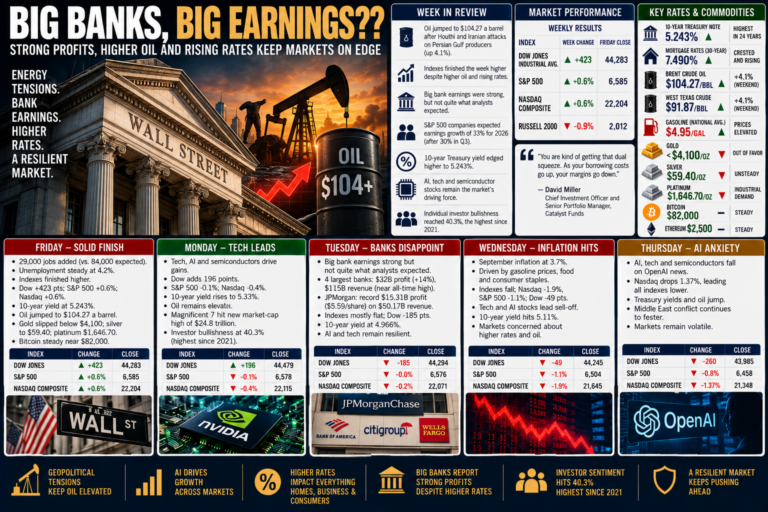
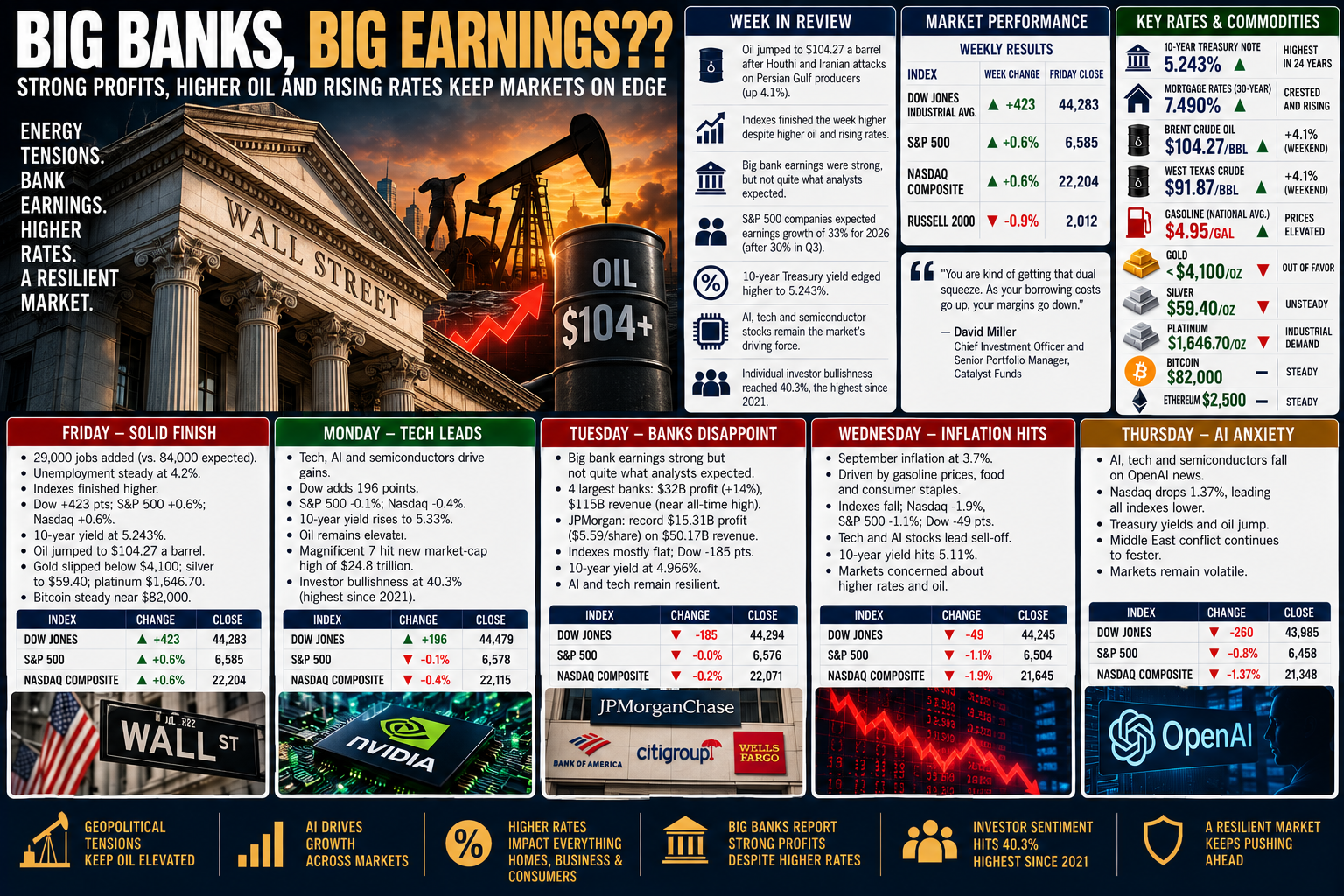
Oil soared Friday and Saturday after the Houthis and Iran released a blistering attack against “Persian Oil Producers in the Gulf.” Oil jumped to $104.27 a barrel, up 4.1%. West Texas crude followed, also up 4.1%, settling at $91.87 a barrel. Energy equities reacted…rising immediately in the U.S. across–the–board. Worldwide prices were higher.
The Russell 2000 index, consisting of smaller value–companies has fallen 0.9% the past 5 straight days. It is now down 5.7% the last 5 weeks, battered by the ‘on–slaught’ of heavy interest and buying of artificial intelligence, technology and semi–conductor stocks. Much rotation has and is occurring daily involving the index. The vulnerability of the smaller–value companies has taken a serious toll, as investors and traders look to massive growth potential in the fore–mentioned companies. Bond yields were more steady as the 10–year Treasury note yield (“the influencer of interest rates across the economy”) edged higher, finishing the week at 5.243%. Indexes also ended the week on an up–note, with the Dow Jones Industrial Average adding 423 points. Both the S&P 500 and Nasdaq Composite were each up 0.6%. “You are kind of getting that dual squeeze,” said David Miller, chief investment officer and senior portfolio manager at Catalyst Funds. “As your borrowing costs go up, your margins go down.”
Amazingly Resilient… consistently positive while brushing aside nearly all negative news, (including oil!) markets continue to ‘look ahead’ and fight any ‘take–downs.’ “Bullishness among individual investors, as measured by the percentage who expect stock prices to rise over the next six months, reached 40.3% for the week ended Oct. 7” (the largest level since 2021) according to The American Association of Individual Investors. Monday’s market was mixed, with The Dow Jones Industrial Average adding 196 points, while the S&P 500 and tech–heavy Nasdaq Composite indexes losing 0.1% and 0.4% respectively. Consistently higher corporate profits have driven stock prices higher nearly all of this year as noted above. According to FactSet, S&P 500 companies are expecting to report earnings for 2026 of 33%, as third quarter growth was 30%. AI is soaring and the ‘still hot’ tech sectors are continuing to ‘draw–away’ much of the attention from cryptocurrencies and the precious metals markets. Options tied to stocks trading have become intensive, reaching a volume of $700 billion a day, a number not seen “since the 2021 meme stock mania.”
Much consternation over bank earnings for the quarter disrupted the indexes on Tuesday. Big Banks earnings were very good, although not quite what analysts were looking for, a sad omen for the markets as nearly all of the released “Big–Bank’ earnings beat previous year–over–year numbers with significant gains. (as the writer interpreted) The combined profit of the 4 largest was $32billion, up an impressive 14% from a year earlier, with combined revenue at a near all time high of $115 billion. The benchmark of U.S. banks, JPMorgan Chase, had record profit of $15.31 billion or $5.59 a share on revenues of $50.17 billion. Analysts had “expected $5.93 a share on revenue of $51.23. Revenue for the 4 largest banks together showed an average rise of 39% in equities revenue…that says it all. Solid earnings were not enough to affect the market, in what should have been positive, as analysts were overly persuasive with questionable expectations. Indexes were flat with the Dow Jones dropping 185 points. The Nasdaq fell 0.2% and the S&P 500 finished flat. Wednesday’s September inflation report of 3.7%, was driven by gasoline prices, consumer staples, especially food. Tech and artificial intelligence stocks weakened as the day wore on, developing to a major sell–off. The technology heavy Nasdaq Composite dropped 1.9%, with AI stocks leading the downfall. The S&P 500 had a rough day also losing 1.1%. The Dow Jones slipped just 49 points, as its bread–and butter stocks bucked the trend.
RUMBLINGS ON THE STREET
John Auers, a refined–fuels analyst at NoviLabs, WSJ – Referring to large oil refineries “They make hay while the sun shines. When the sun isn’t shining, there’s not much hay to be made.”
Rageev Dhawan, an economist at Georgia State University, WSJ – “The labor market’s got a white-collar job malaise. Once the Fed realizes it isn’t as strong, they will pivot to rate cuts,”
Spencer Jakob, Financial writer for The Wall Street Journal, WSJ – “The more interesting point is when an equal–weight index wins. Like a rubber band stretched tight, it catches up a lot more quickly–and painfully–than it took to pull it into that shape.”