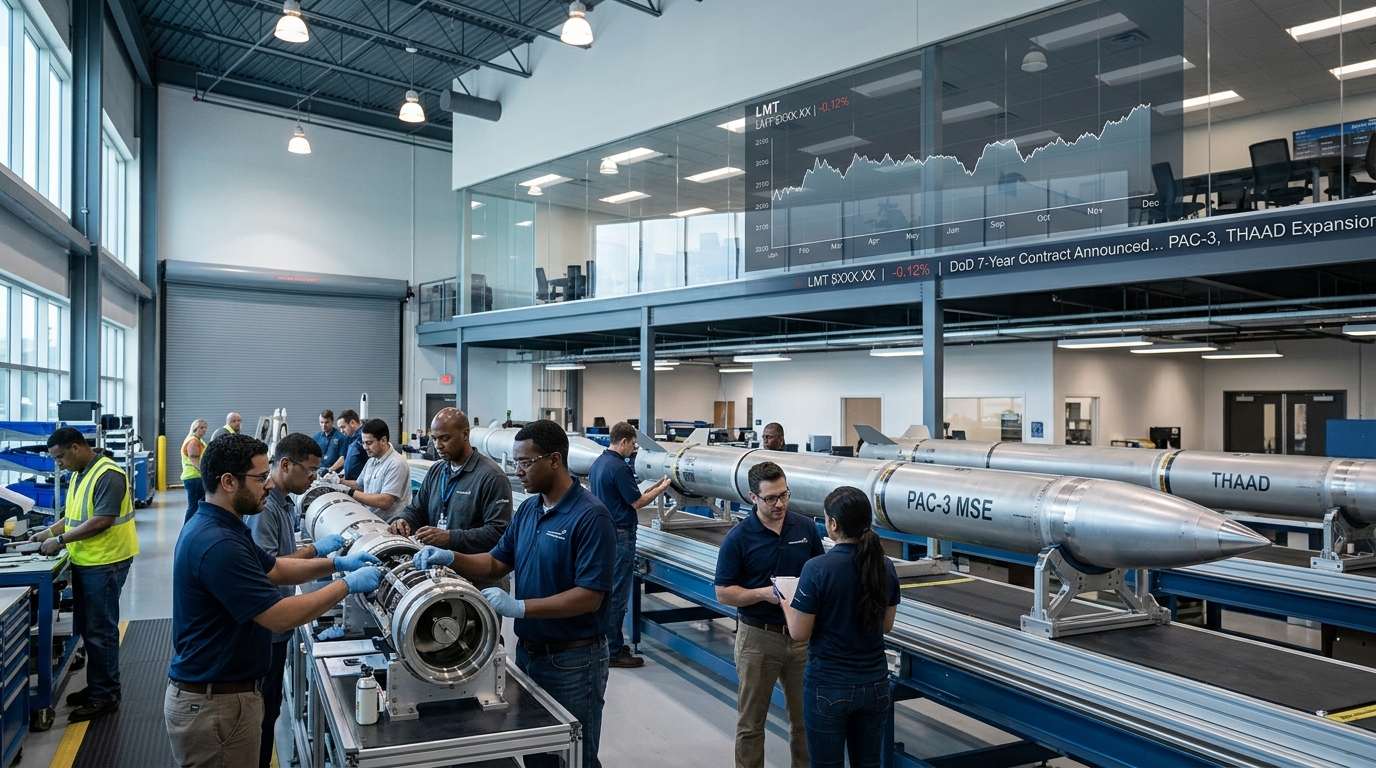
On Monday, August 31, the Department of Defense announced something genuinely significant: seven-year framework agreements with Lockheed Martin and General Dynamics Ordnance and Tactical Systems to triple PAC-3 MSE interceptor production capacity and quadruple THAAD output. The agreements cover motor cases, seeker housings, midsections, and shroud deployment systems, with guaranteed minimum annual quantities and accelerated delivery schedules.
Shares of both companies barely moved, slipping less than half a percent apiece. That is the story.
Why This Stock Now
The indifference is not irrational. Big capability multipliers without attached contract values tend to get filed as confirmation of an existing growth story rather than treated as a fresh catalyst. But the backdrop here is different from a peacetime procurement announcement, and the market may be underweighting it.
The United States reportedly began with approximately 2,330 Patriot interceptors before expending around 65 percent during the Iran conflict, leaving an estimated 759 to 827 missiles available by late July 2026. THAAD reserves also reportedly declined from approximately 452 interceptors before the war to between 234 and 278. These are not projections. They are the inventory reality the August 31 agreements are designed to address.
The Business
Lockheed Martin is the prime contractor for both the PAC-3 MSE interceptor and the THAAD system. That matters here because GD-OTS supplies critical subcomponents, but Lockheed captures the system-level economics. Every motor case General Dynamics produces feeds a missile Lockheed builds and books revenue on.
In late July 2026, the U.S. government awarded Lockheed Martin a seven-year undefinitized contract action modification worth up to $53.86 billion for PAC-3 Missile Segment Enhancement interceptors, expanding a multiyear procurement ceiling now totaling about $58.62 billion for fiscal years 2026 to 2032. The August 31 component-level agreements layer onto that structure, providing the subcontractor base with the same long-term demand signal Lockheed itself received weeks earlier.
Revenue topped $20.06 billion, up about 11% compared with the year-ago quarter, while the company raised its 2026 sales and EPS guidance to $79.75 to $81.75 billion and $29.95 to $30.65 per share.
Why Wall Street Is Paying Attention
The Army’s PAC-3 ceiling totals about $58.62 billion for fiscal years 2026 to 2032, which if divided evenly would amount to roughly $8.37 billion per year. Set against a recent share price near $545, that contract ceiling alone represents a large portion of Lockheed’s market value, spread across a program where the company has no credible competitor at scale.
According to 21 analysts polled by S&P Global, Lockheed Martin stock has a consensus rating of Hold and an average price target of $632.95. The all-time high closing price was $672.30 on March 2, 2026. The stock has fallen about 19% from that peak while the contract portfolio has grown, not shrunk.
What’s Driving the Opportunity
The production acceleration responds to a sharp depletion of U.S. air defense inventory driven by sustained demand from ongoing operations and active theaters in the Middle East alongside support for Ukraine. The current conflict is drawing heavily on Patriot stocks across multiple theaters simultaneously, including defending U.S. forces and partners and protecting regional civilian and energy infrastructure.
Even at 2,000 missiles annually, rebuilding inventories and meeting allied demand would absorb years of production, because new output must serve American forces, partners, European allies, Ukraine, and other Patriot operators, all competing for the same supply chain. Lockheed controls that supply chain’s exit point.
Lockheed projects 2026 free cash flow of $7.0 to $7.2 billion, supporting a business that is simultaneously ramping capacity and compounding backlog. Plans call for $8 to $9 billion in munitions investment by 2030.
What Could Go Wrong
The bear case deserves a clear hearing. Framework agreements are not booked revenue. The agreements are designed to support multiyear procurement contracts with guaranteed minimum annual procurement quantities, subject to annual appropriations. Congress controls the funding spigot, and a political shift could delay definitization.
Production ramps also take time. Lockheed delivered a record 620 PAC-3 MSE missiles in 2025. Getting to 2,000 annually requires years of facility investment, workforce growth, and supply chain deepening, and none of that is linear. Execution risk is real.
Valuation is not obviously stretched but it is not obviously cheap either. Lockheed trades at a discount to some faster-growing aerospace and defense peers, and a discount usually reflects something, here it reflects a slower near-term revenue growth rate than faster-moving peers.
The Bottom Line
Lockheed Martin is the only company that builds PAC-3 MSE interceptors and assembles the THAAD interceptor at scale, into a conflict environment that has burned through a large share of U.S. Patriot stocks in roughly five months. The Defense Department just committed to seven years of accelerated component procurement to refill that magazine. The stock sat still. That gap between strategic urgency and price inaction is the case for LMT today: a prime contractor with unmatched program position, a roughly $58.62 billion PAC-3 contract ceiling through 2032, and a share price that has yet to reflect what sustained multi-theater depletion actually means for the order book.