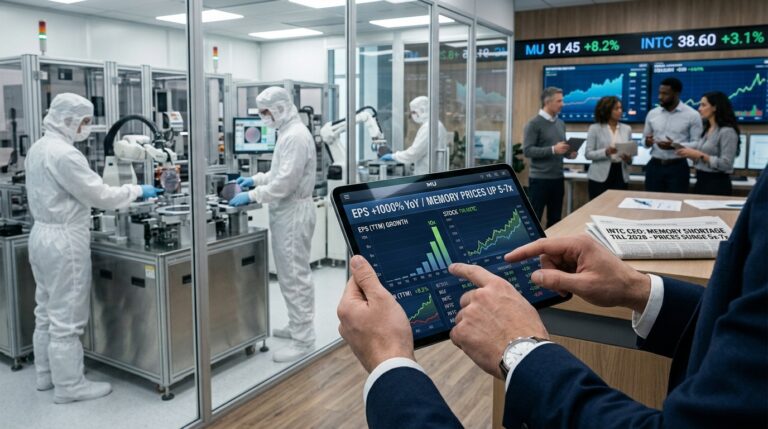
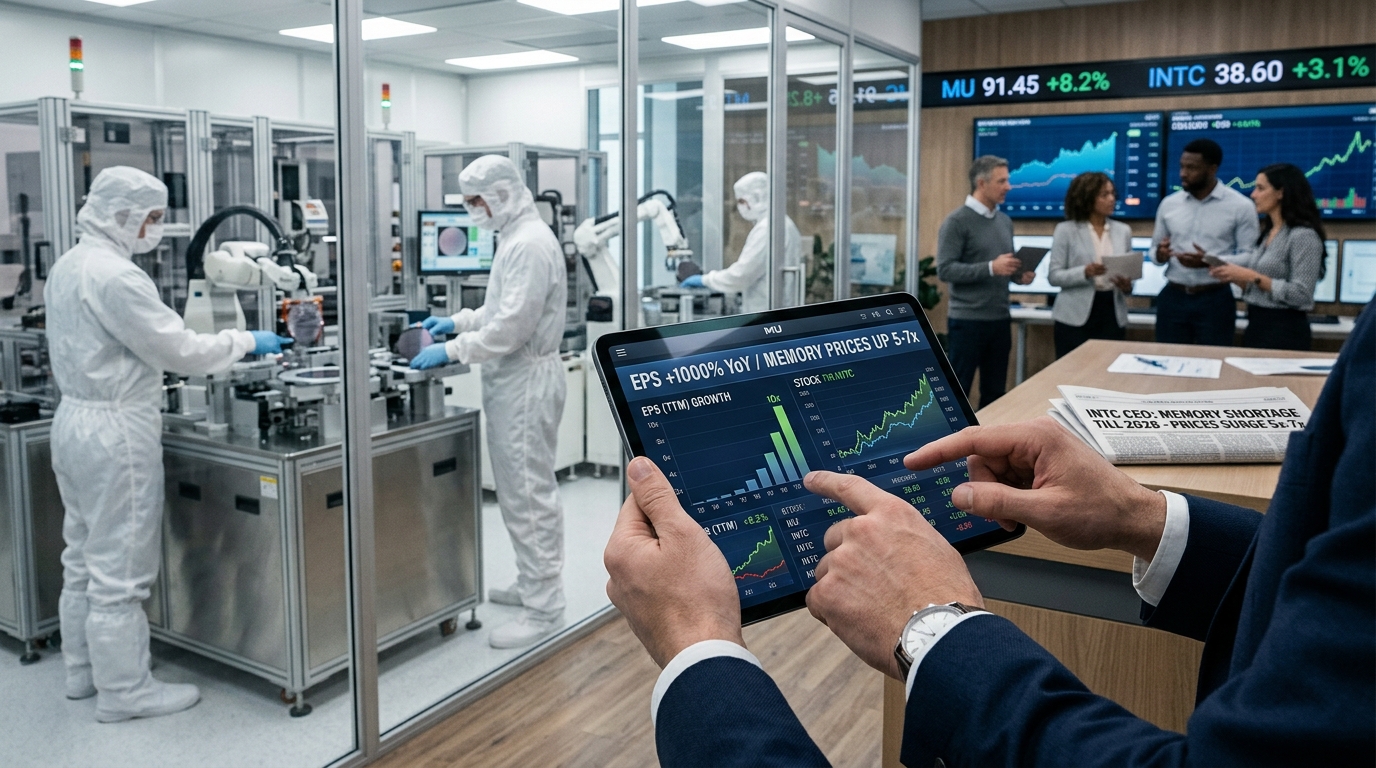
Markets don’t need a shortage story to move memory stocks. They only need one credible voice to put a number on it. On September 15, Intel CEO Lip-Bu Tan spoke at the AI Infra Summit in Santa Clara and supplied that number: memory prices have risen five to seven times, projects are being delayed because supply cannot be secured, and the situation will get worse. Micron closed the following session up 5.5%. SK Hynix gained about 5%. The memory ETF added more than 4%.
That reaction sets the table cleanly for the most data-dense earnings event of this month. Micron reports fiscal Q4 results on September 30, after the close, with analyst consensus sitting at $31.16 per share against $3.03 in the same quarter a year ago. That is a tenfold increase in EPS over twelve months. Revenue is expected near $50.4 billion, versus $11.32 billion a year earlier.
The Numbers Behind the Expected Move
Micron itself set this bar. In June, the company guided Q4 to $50.0 billion in revenue, plus or minus $1.0 billion, and non-GAAP EPS of $31.00, plus or minus $1.00. The guidance alone was a shock: analysts at the time had been modeling $43.58 billion, according to LSEG. The company blew past its prior quarter’s consensus by 17.6% on revenue and 23.8% on EPS, with non-GAAP gross margin hitting 84.9%.
The sequential deceleration is the real question in the room. Revenue is guided to grow 21% quarter over quarter, after growing 74% the prior quarter. EPS is guided to grow 23% sequentially, after growing 106%. TrendForce expects conventional DRAM contract price increases to moderate to 13-18% quarter over quarter in the third calendar quarter, compared to 90-95% in Q1 and 58-63% in Q2. The rate of change is slowing. The level is still extraordinary.
What Tan’s Comments Add to the Calculus
Tan’s remarks were not speculative. He described a structural constraint: AI data centers are absorbing memory capacity that previously served phones, laptops, and game consoles, and low-cost smartphones now face a reality where memory can account for 70 to 80 percent of the total device cost. He also said meaningful new supply will not arrive until at least 2028. Yorkville America CEO Steve Neamtz, whose firm runs the dedicated memory ETF, aligned with that timeline, saying new factories capable of materially easing the shortage may not reach full production until 2028 or 2029.
Micron’s own language from June matched: the company said it expects tight conditions to persist beyond calendar 2027 as a result of AI-driven demand across all segments. Fourteen of its first sixteen strategic customer agreements carried approximately $100 billion in minimum contracted revenue, with price bands designed to reduce cyclical exposure. The business model has structurally changed. Whether the stock price reflects that adequately at roughly $977 per share is a separate question.
Options Market Analysis
Options on MU are pricing an 11% move in either direction after the September 30 report, above the four-quarter average realized move of approximately 8.1%. Pre-earnings call volume has been running ahead of puts, with the put-to-call ratio on the broader options chain near 0.53, skewing decisively toward calls. That flow signals the market is leaning bullish into the report but paying up for the uncertainty premium.
At roughly $977, an 11% implied move places the upper bound near $1,085 and the lower bound near $870. The stock’s all-time closing high was $1,213.37 on June 25, 2026, set the session after the Q3 report, which itself beat consensus by 17.6% on revenue and triggered a 15.7% single-day gain.
Structured Trade Framework
Bull case: If you believe Micron delivers $50 billion or better in revenue and signals continued pricing power into fiscal 2027, a defined-risk long structure such as a call spread in the October expiry targeting the $1,050-$1,100 range captures the upside without full exposure to an earnings-night reversal. The long call partially offsets premium by selling the upper strike.
Bear case: For traders expecting guidance to disappoint on the deceleration question, a put spread anchored below $900 limits the premium outlay while expressing a view that the sequential slowdown is more pronounced than modeled. The key risk is the strong contracted revenue base softening the downside.
Neutral case: Given the elevated 11% implied move, a short strangle or iron condor structured outside the expected move captures premium if the stock settles near current levels. This is a volatility-selling posture. Defined-risk construction via an iron condor is the appropriate structure, given that MU can move 15% in a single session on surprise.
Risk Factors
The bear case does not require a disaster. Micron’s own guidance already signals deceleration. Consumer demand for PC and smartphone memory has reached price resistance. Any guidance below $52 billion for fiscal Q1 2027, or any sign that gross margins are compressing faster than the 86% floor implied by the Q4 guide, could move the stock toward $850. Semiconductor tariff risk, flagged as excluded from current guidance, remains a live variable. A Taiwan union threatening strike action over profit-sharing adds a supply-side footnote that most models are ignoring.
Action Checklist
- Confirm the September 30 after-close timing before placing event-driven structures
- Map the 11% implied move: $1,085 upside, $870 downside from $977
- Monitor call-to-put flow into September 25 for any directional shift ahead of the report
- Watch fiscal Q1 2027 guidance as the primary post-earnings price catalyst, not Q4 actuals
- Size defined-risk structures to reflect that MU has historically exceeded both the implied move and analyst consensus in the same quarter