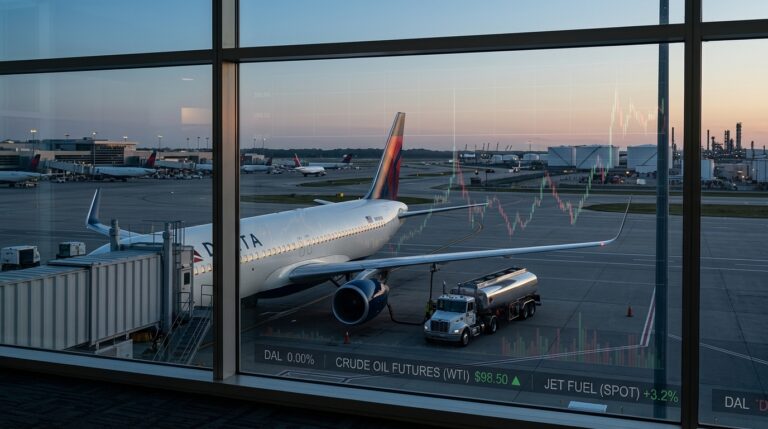
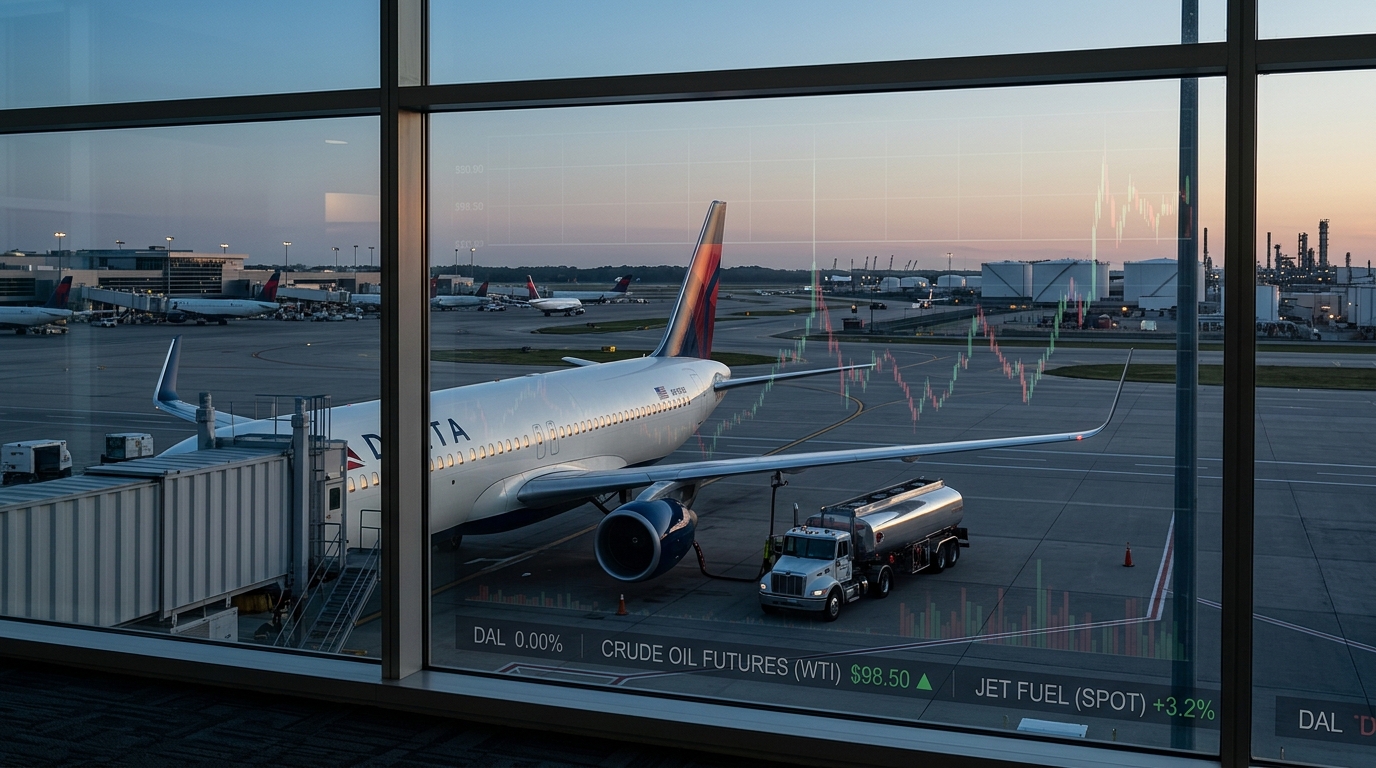
This is not about whether Delta beats $1.88. It is about whether guidance holds against $100-a-barrel oil.
Delta Air Lines is set to announce September-quarter 2026 results before the market opens on October 9, with revenue consensus at $17.62 billion and EPS anticipated at $1.88 per TradingView’s estimate. Yahoo Finance’s 20-analyst average sits higher, at $2.23, with a low of $1.78 and a high of $2.51, reflecting genuine disagreement about how much of the fuel shock Delta absorbed in the September quarter versus how much it passed through in fares. The quarter itself almost certainly beats. The guide is what traders are actually pricing.
Delta’s own management, at the June-quarter report, projected September-quarter revenue growing mid-teens year over year with an operating margin of 11 to 13 percent and EPS of $2.00 to $2.50. That guidance was set in July, based on the forward fuel curve as of July 2. Since then, Brent has traded above $100. In late September, renewed Middle East risk drove Brent to roughly $108 at one point. The question the market is asking Friday morning: did July’s guidance account for this, or does the Q3 call reset Q4?
The Numbers That Matter
The structural story entering this quarter is Delta’s premium milestone: premium cabin revenue overtook main cabin revenue for the first time in company history in the June quarter, with premium products generating $6.92 billion against $6.85 billion from main cabin. Premium and loyalty revenue were both up nearly 20 percent in the June quarter. Friday’s read will confirm whether that premium demand held through a period when oil spiked and ULCC capacity remained depressed.
Adjusted fuel expense in the June quarter came in at $4.4 billion, up 77 percent compared to a year ago. Delta has previously disclosed annual consumption of approximately four billion gallons of jet fuel; on that sensitivity, each $0.10 per gallon change in price is roughly a $400 million annualized cost swing. With Brent near triple digits at points in late September, the September quarter carried fuel risk above the June quarter’s $3.93-per-gallon adjusted average. How much refinery offset Delta captures, and what the forward fuel assumption is for Q4, will define the stock’s reaction far more than the EPS line.
Full-year earnings guidance stands at $6.50 to $7.50 per share, representing 20 percent year-over-year growth. Delta reaffirmed that guidance in July despite absorbing the highest quarterly fuel expense in its history, with CEO Ed Bastian saying the company expects to grow earnings by 20 percent while overcoming a multi-billion fuel headwind. Any narrowing or lowering of that range Friday would reset the entire sector.
Sector Divergence Is the Context
DAL opened 2026 near $69.42 and has since climbed about 21 percent to around $84. That stands in sharp contrast to American Airlines, which cut its 2026 earnings outlook in July, citing higher fuel costs, with record Q2 revenue almost entirely offset by an 83 percent jump in fuel costs. American carries no fuel hedges and has stated a policy against hedging. Delta’s refinery in Trainer, Pennsylvania, is the structural differentiator: third-party refinery sales were $2.09 billion in the June quarter, up 83 percent from the prior year.
Options Market Analysis
DAL implied volatility sits in the mid-40s, with premiums elevated versus much of the past year. Put-call positioning is mixed, with open interest skewing call-heavy even as recent volume looks more balanced. Earnings-implied move estimates for October 9 cluster around roughly 8% to 9%. On a stock around $84, that prices a one-standard-deviation range of roughly $77 to $91 for the post-earnings close. DAL’s four-quarter average earnings beat runs approximately 8 percent on EPS, so the implied move is not mispriced relative to history; it is fair.
Structured Trade Framework
Bull case: For traders expecting Delta to confirm guidance above $2.00 EPS and reiterate the full-year $6.50 to $7.50 range, a defined-risk structure would be a call spread buying the $85 strike and selling the $92 strike in the October 17 expiry. Maximum gain if DAL finishes above $92 post-earnings; maximum loss is the net debit. The consensus analyst price target sits around $103, which provides a longer-term anchor.
Bear case: If the Q4 fuel assumption surprises higher and the company narrows guidance toward the low end of $6.50, a put spread buying the $80 strike and selling the $74 strike captures the implied move lower without open-ended exposure. The $77 lower bound of the expected move is the natural target.
Neutral case: With premiums elevated, a defined-risk short strangle selling the $78 put and the $91 call, with long wings at $73 and $96, collects richer premium and profits if the stock stays inside the implied range. The structure breaks even outside approximately $75 to $94.
Risk and Forward Outlook
The primary risk is a guidance cut tied to Q4 fuel assumptions. Peer airlines have been explicit that elevated fuel prices are affecting capacity and cost expectations. Delta has not revised guidance since July. Friday is the first opportunity to do so publicly. A secondary risk: premium demand softness. If corporate bookings or transatlantic yields weakened materially in September, the premium-over-main-cabin structural story gets questioned.
Fuel remains the swing factor. The EIA projects Brent to average around $90 per barrel in the second half of 2026 on a baseline scenario, but late-September spot pricing ran above that forecast.
Action Checklist
- Anchor to the guidance range, not the EPS beat. Watch the Q4 EPS outlook and full-year range vs. $6.50 to $7.50.
- Monitor the per-gallon fuel assumption management provides for Q4 relative to the Q3 assumption of roughly $3.15 all-in.
- Track premium revenue vs. main cabin ratio for Q3. A reversal of the June-quarter crossover would reset the premium angle entirely.
- Size positions to the roughly 8% to 9% implied move. Structures outside $77 to $91 carry event risk beyond what the options market is currently paying for.
- Watch AAL and UAL for sector read-through: Delta moves first, and how competitors react to its guidance will signal whether this is a DAL story or an airline sector reset.