
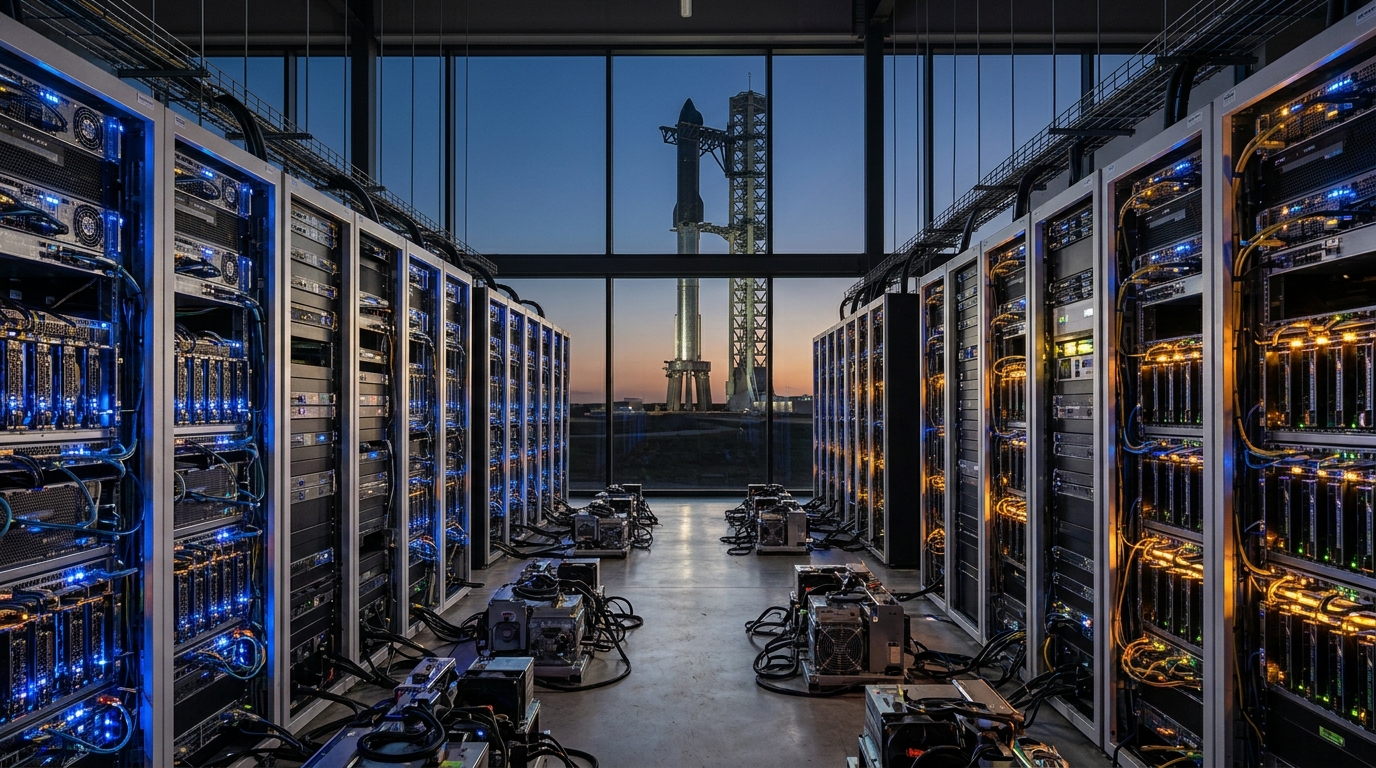
Markets spent the past two weeks dissecting AI order books. SpaceX just handed them an answer. Elon Musk said SpaceX had closed $40 billion in debt financing for GPUs expected to arrive in the first half of 2027. For Nvidia, that is not a headline. It is a delivery schedule embedded in a financing structure, spanning Q1 and Q2 2027, exactly the window where demand visibility had gone soft.
This is not about SpaceX’s ambitions. It is about what the deal says regarding Nvidia’s forward revenue. Two weeks of CoreWeave credit stress and wider risk premiums in AI-linked credit created a working assumption that AI hardware demand was more fragile than advertised. Musk added that the company is investment grade and generates revenue from its Starlink satellite internet and rocket launch businesses, which is precisely the profile that unlocked the financing. The demand for Nvidia chips did not weaken. The profile of who can fund that demand just got a hard filter applied to it.
The Credit Divide and What It Means for Nvidia
Musk said debt markets have largely closed to companies without substantial revenue beyond AI data centers, and he predicted that more than 200 neocloud providers will consolidate into a few survivors. Read that framing carefully. It is not a bearish call on GPU demand. It is a bearish call on leveraged GPU renters. Those are different trades.
Reuters reported this month that CoreWeave has about $50 billion in debt. Its 9.625% bond due in 2032 has been trading at distressed yields, roughly in the mid-teens in recent sessions. Oracle’s situation is less acute but not clean. What matters for Nvidia is not whether the ecosystem feels stress. It is which buyers can still finance large orders on acceptable terms, and which ones cannot.
SpaceX is a buyer, not a renter. Musk said the reason SpaceX could borrow the money is because it has a strong credit profile and steady revenue from Starlink and rocket launches, businesses that do not depend on AI data centers, making it easier to secure chip financing than for companies that rely entirely on data centers. The $40 billion flows to Nvidia’s revenue line regardless of what happens to CoreWeave’s credit spreads.
Options Market: Cheap Volatility Against a Firming Catalyst
Nvidia options have been trading with 30-day at-the-money implied volatility closer to the low-40% range in recent sessions, depending on data source and timestamp. That still leaves implied volatility well off the highs seen during prior volatility spikes this year, which matters for anyone structuring defined-risk premium buys.
Nvidia options traded about 2.54 million contracts on October 22, with calls outpacing puts and a put/call ratio around 0.70. Call skew is constructive. The options market is not pricing a fear event. It is pricing quiet, which creates a specific structural opportunity for traders who believe the SpaceX deal and the Q1-Q2 2027 delivery timeline shift Nvidia’s earnings visibility materially upward.
Structured Trade Framework
Bull case: If you believe the SpaceX deal, combined with SpaceX’s stated Q4 capex guidance of $35 billion to $40 billion, confirms that large-scale GPU procurement is accelerating into H1 2027, a defined-risk debit call spread targeting Nvidia’s next earnings window captures that view at relatively compressed implied volatility versus prior peaks. A January or February expiry gives time for the delivery confirmation cycle to develop.
Bear case: For traders who read the neocloud credit freeze as a demand-mix problem, not just a credit-quality problem, a defined-risk put spread on CoreWeave reflects that view without taking on directional exposure to Nvidia itself. CoreWeave bond yields in the mid-teens have been consistent with a distressed-credit read.
Neutral/defined-risk: A calendar spread on Nvidia, selling near-dated premium against a further-dated long, monetizes a lower-volatility regime while maintaining positive exposure to any volatility expansion driven by earnings guidance or delivery confirmations.
Risk Analysis
Musk said SpaceX has closed the debt deal, but Bloomberg reported that pricing talks were still ongoing and that the structure under discussion has been designed to keep the financing off SpaceX’s balance sheet via a special purpose vehicle. That ambiguity is the primary near-term risk. If the deal is re-characterized as still in negotiation, the demand signal weakens. Watch for formal lender confirmation and final pricing disclosure.
Forward Outlook
The credit bifurcation Musk described is the dominant theme in AI infrastructure for the next two quarters. Companies with investment-grade profiles and diversified cash flows will absorb GPU supply. Companies without those characteristics are being crowded out. Nvidia sells chips to both groups, but the former are better credits and larger buyers. That mix shift, if it continues, is constructive for Nvidia’s average selling price and revenue quality, even if unit volume from the neocloud segment softens.
Action Checklist
- Confirm pricing disclosure and lender validation that supports Musk’s “closed” characterization before adding size to any NVDA directional structure.
- Monitor CoreWeave bond yields and credit spreads as a real-time signal of conditions in AI infrastructure lending.
- For NVDA debit structures: implied volatility has been well below prior spike levels, which can make defined-risk long-call or call-spread structures more cost-effective than during peak-volatility windows.
- Track Oracle’s investor communications for guidance on how investment-grade AI borrowers are framing their own capex cycles relative to the SpaceX model.
- Size defined-risk. The pricing ambiguity on the SpaceX deal is a live tail risk for any position built on this specific catalyst.