
The Shocking Truth about the AI Bubble
In just 48 hours, a tidal wave of bad news battered AI stocks:
- Chip giant Intel dropped 29%…
- Google had its worst day ever, losing $500 billion in value…
- And tech stocks plummeted by more than $1 trillion in one trading day…
That’s more than $153 billion vaporized each hour!
Top internet news site Drudge Report had this headline screaming at the top of the page…
“$10 trillion ‘AI Boom” starting to crack…”

So is the AI bubble finally bursting?
It sure as heck looks like it…
But here’s the shocking truth: it isn’t bursting for every stock.
On the same day Intel plunged 29%, the S&P 500 fell just 1.8%.
In other words, the stock market is splitting in two.
And the independent millionaire who recommended NVDA at $6 saw this coming.
He calls this stock market split the Great AI Shock.
On one side, the most hyped AI stocks could see a 77% meltdown…
On the other side, a little-known corner of AI that NVDA’s CEO calls a “once-in-a-generation opportunity” could produce triple digit gains over the coming months…
And the recent carnage is only the beginning – because the stock market split is just getting started…
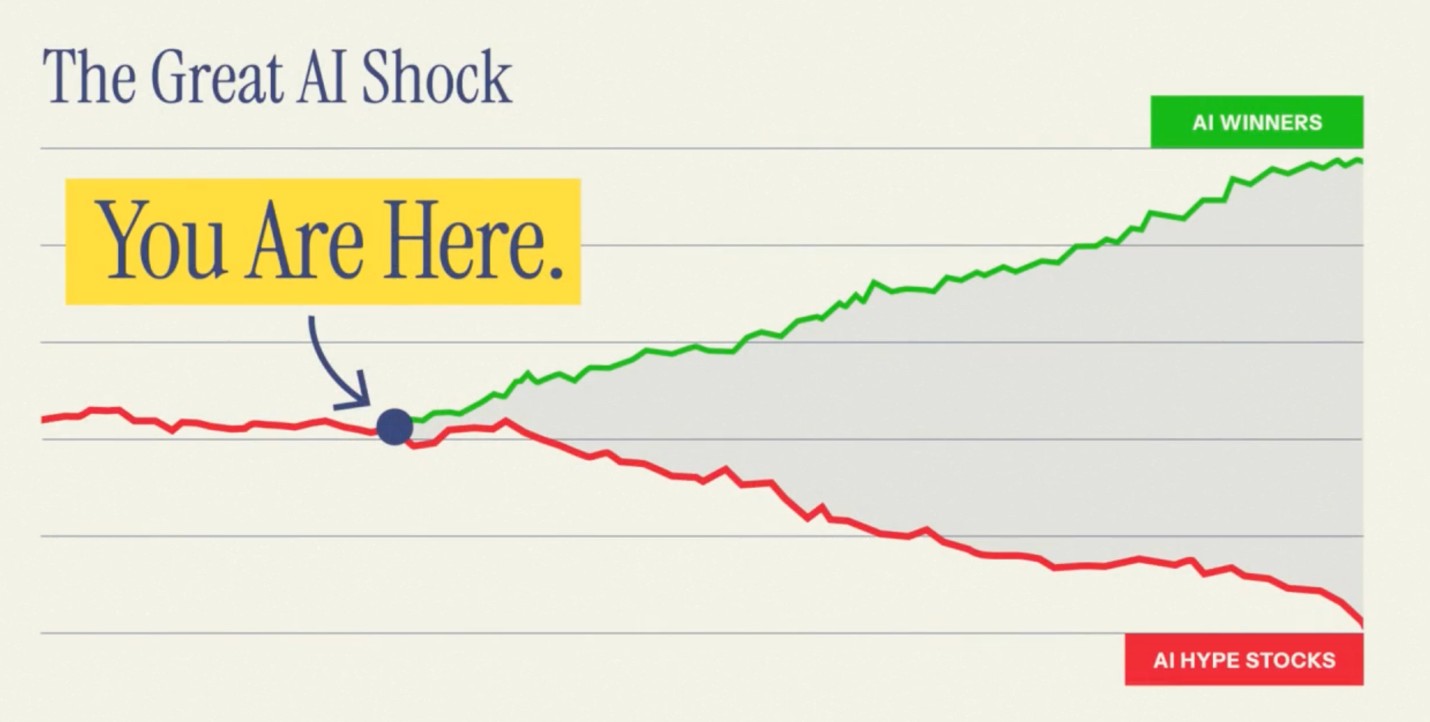
If you own any AI stocks, you need to decide which side of the split you’re on…
And you need to decide soon.
See the full story here, including details on the #1 stock on the right side of the split.
Lucid Reports Tonight. After a 70% Drop, the Only Number That Matters Is Cash.

Markets don’t need Lucid to be profitable tonight. They only need Lucid to still be in business next year. That is the blunt arithmetic ahead of this evening’s Q3 2026 earnings call, scheduled for 5:30pm ET, and it reframes every figure management puts on the table.
LCID closed at $3.29 on Friday, up about 10%, but remains down roughly 70% year to date. In the last year, shares hit a 52-week high of $18.00 and a 52-week low of $2.37. The loss question is secondary to a harder one: at what rate is the cash leaving, and when does the next sovereign check arrive?
What the Numbers Say
Wall Street expects a loss of $2.27 per share, compared with a $2.65 loss a year earlier. Revenue is expected to reach about $395.67 million, up from $336.58 million last year. That is roughly 18% year-over-year growth, a sharp deceleration from the 56% jump Lucid posted in Q2.
Lucid delivered 3,806 vehicles in Q3, down slightly from 3,953 in Q2, while production fell to 2,954 vehicles from 4,774. The production slowdown was deliberate, aimed at reducing excess inventory and bringing manufacturing closer to actual demand. That inventory discipline is the right call operationally. Whether it shows up in the cash flow statement is tonight’s test.
In Q2, Lucid reported revenue of about $405 million, up 56% year-over-year, and adjusted EBITDA losses of $901 million. The company also reported negative free cash flow of $1.48 billion and a gross margin of negative 105%, partly due to a $300 million inventory impairment. Cantor forecasts $346.7 million in revenue, an $886.3 million net loss, and $981 million in cash burn for Q3. If those figures land close to reality, the runway question sharpens fast.
The Sector Context No One Can Ignore
This is the first full quarter where a tougher federal EV incentive landscape hits demand signals across the category. For Lucid, whose vehicles start well above the EV credit’s income and price caps, the demand pressure is structural, not cyclical.
The sector backdrop hardened further last week. The Associated Press reported Friday that Tesla confirmed Cybertruck production will be winding down around the middle of 2027 at its Texas plant to free up capacity for its Cybercab robotaxi. Reports have also pointed to Cybertruck sales running far below the line’s stated capacity. When the category leader cannot sustain a halo product, it signals something real about EV appetite at premium price points.
The Balance Sheet Is the Story
Lucid’s survival mechanism is Saudi Arabia’s Public Investment Fund. Holding a majority stake in the company, the PIF has repeatedly acted as a financial lifeline, injecting billions of dollars of sovereign capital into the business to ensure Lucid has the runway to keep operating. Lucid has pointed to approximately $4.7 billion in pro forma liquidity, and in prior company materials said recent financing and operating actions were expected to provide a liquidity runway well into 2027. Management promised an updated liquidity timeline with tonight’s results. That update is the actual event.
Options Market: What Is Priced
The biggest expected move among all this week’s reporters belongs to Lucid at ±21.5%. Implied volatility on LCID options stands at 108.88%, against a historic volatility of 148.22%. IV is elevated but sits below realized vol, which means the options market is not fully reflecting how the stock has actually moved. That relationship matters for premium sellers.
The average realized one-day post-earnings move over prior reports is 7.99%. The ±21.5% implied move is nearly three times that historical average, suggesting the options market is treating this as a binary event on cash guidance rather than a routine quarterly report.
Structured Trade Framework
Bull case: If you believe Lucid’s management delivers a credible cash runway extension well past 2027 and Q3 free cash flow shows measurable sequential improvement, a defined-risk long structure targeting the $4.00 to $4.50 range captures upside without full binary exposure. A call spread expiring November 20 keeps premium cost bounded.
Bear case: For traders expecting cash burn to accelerate relative to Cantor’s $981 million estimate, or guidance that stops short of a 2028 runway, a long put or put spread on the November 20 expiry reflects a move toward $2.50 or below. Morgan Stanley carries a $3 target and an Underweight rating.
Neutral case: With IV at 108.88% and the implied move pricing a swing neither direction has consistently delivered, a short strangle or iron condor centered around the $3.00 to $3.50 range collects premium from an elevated vol environment. Define risk with wing strikes. This is not a structure for unattended overnight exposure.
Risk Analysis and Forward Outlook
Lucid has been battling tepid sales and missed Q2 2026 delivery estimates. While the company has the backing of Saudi Arabia’s PIF, it cannot solve its sales woes through financing alone. The question entering 2027 is whether Lucid can close the gap between sovereign backstop and commercial viability before the market stops giving it credit for one and starts pricing the absence of the other.
Action Checklist
- Watch Q3 free cash flow vs. the $981 million Cantor estimate, that delta sets the near-term direction
- Listen for management’s exact language on the liquidity runway, “well into 2027” is table stakes; anything less is a warning
- Note gross margin direction; negative 105% in Q2 leaves little room for further impairments
- IV at 108.88% makes long premium expensive; defined-risk spreads are more capital-efficient than outright single-leg positions
- Post-call, reassess the ±21.5% implied move against actual move before adjusting any open structure