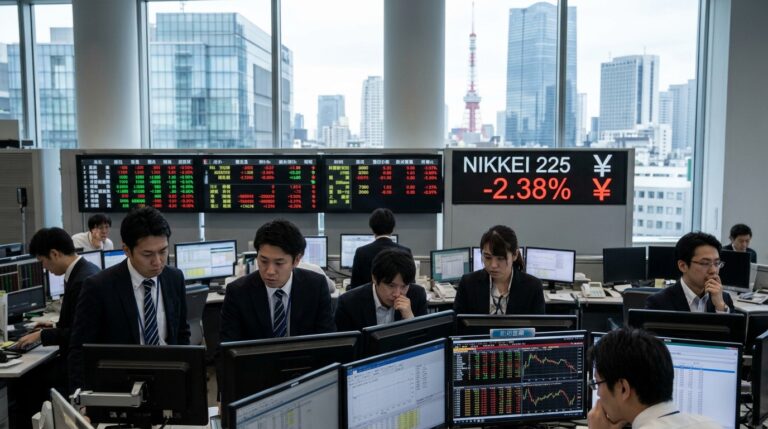
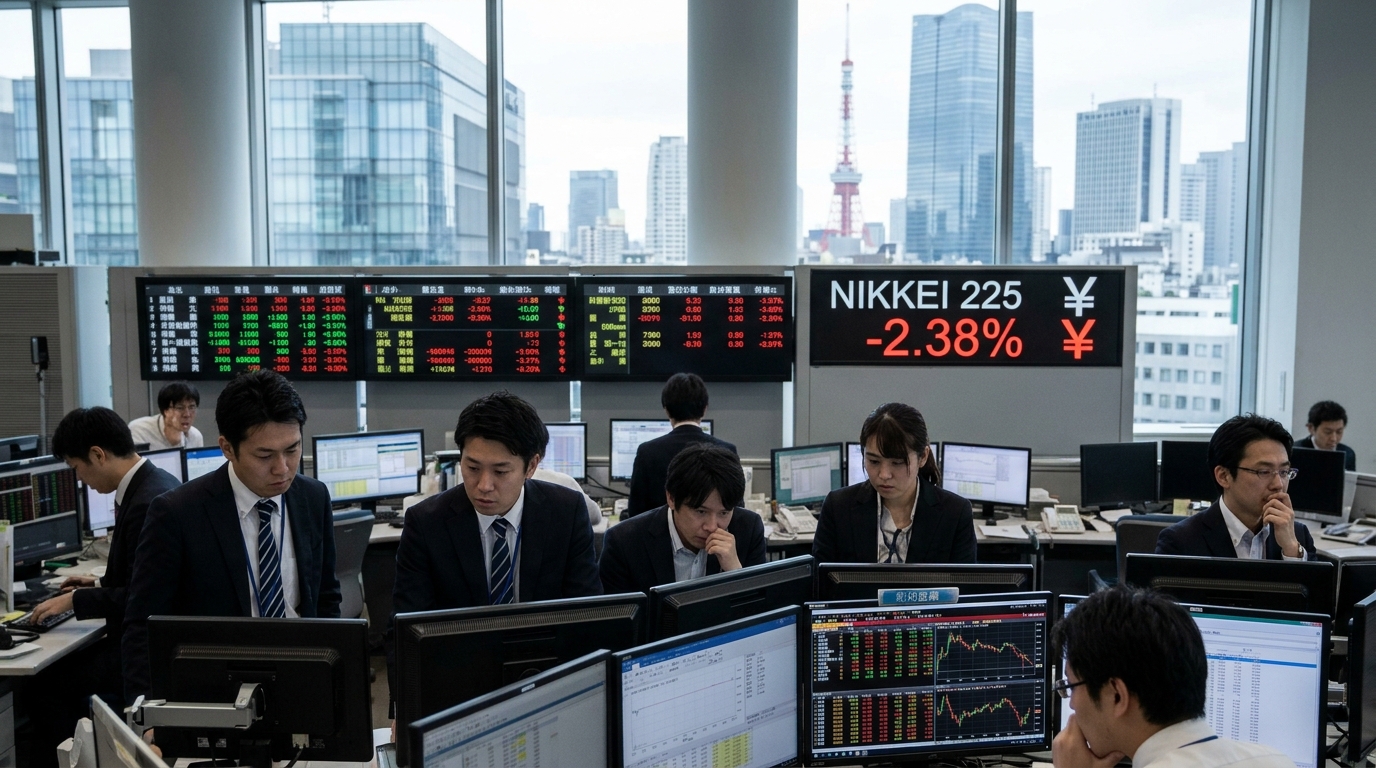
Japan’s Cabinet Office released Q3 GDP figures this morning, and the number arrived with the wrong sign. Japan’s economy shrank an annualized 0.1% in Q3 against a forecast of +0.3%, its first fall in four quarters, as consumption dropped 0.3% under high prices. That is a 40-basis-point swing from expectation to reality. The Nikkei 225 fell about 2.4% in Monday trading. The yen traded around 160 per dollar, and the benchmark 10-year JGB yield rose 3 basis points to 2.885%, its highest since October 22.
This is not a growth problem. It is a household problem wearing a growth number as a disguise.
The Data
Private consumption, which makes up more than half of Japan’s economic output, fell 0.3% during July-September, more than the economists’ forecast contraction of 0.2%. Private consumption fell 0.3% after a 0.3% decline in April-June. That is two consecutive quarters of household retrenchment. Household spending faced additional strain after energy subsidies expired in September, exposing consumers to higher energy prices.
Imports rose 2.5% from the previous quarter while exports of goods and services fell 0.2%, leaving net exports with a negative contribution of 0.6 percentage points. On the other side of the ledger, capital spending increased 1.6%, exceeding the market forecast of 1.5%, as companies invested in labor-saving technologies and AI-related projects. Capex cannot carry an economy where the consumer accounts for the majority of output.
Strategic Interpretation
Markets came into this morning expecting barely positive growth. The print landed negative. That gap matters less for its size than for what it confirms: high energy prices and sticky inflation are weighing on private spending, the key driver of growth. The GDP deflator, a broad measure of prices across the economy, rose 2.4% year-on-year, below forecasts but still above the Bank of Japan’s 2% target.
The political dimension sharpens the analysis. The long-term stability of Prime Minister Sanae Takaichi’s administration will depend heavily on whether voters feel that their household finances have improved as a result of the fiscal 2026 budget. A second consecutive quarter of consumer decline is precisely the kind of data that generates fiscal pressure, supplementary budgets, and energy subsidy extensions. Those tools add to sovereign borrowing exactly when the BOJ is trying to exit it.
Sector Implications
MUFG (NYSE: MUFG) closed on November 13 at $21.83. The group posted record first-half net profit of ¥1.6308 trillion, up 26%, raised its full-year target to ¥2.8 trillion, and approved an additional share buyback of up to ¥200 billion. A December BOJ hike widens net interest margin. Weak consumption, however, raises credit quality questions on the retail book. Toyota (TSE: 7203) last traded at ¥3,418, sitting roughly 15% below its 52-week high of ¥4,000. Export revenues translate back at around 160 per dollar; every 1-yen weakening in JPY adds incrementally to overseas earnings but signals the domestic demand backdrop is deteriorating.
Options Market Analysis
MUFG’s options open interest was about 14.2K contracts as of November 13, with roughly 10.7K calls and 3.5K puts, putting the put/call open interest ratio near 0.32. For the Nikkei 225, volatility was not signaling a fear regime heading into the GDP release.
Structured Trade Framework
Bull case (MUFG). If you believe the BOJ hikes 25 basis points on December 17 and rising NIMs outweigh modest credit deterioration, a defined-risk long structure makes sense. Buying a January $22/$24 call spread caps the maximum loss at the debit paid. The reward-to-risk improves if post-hike NIM expansion pulls analyst estimates higher through Q4.
Bear case (Nikkei/Toyota). For traders expecting consumption to deteriorate further into year-end, compressing the fiscal 2027 growth outlook, a put spread on Nikkei 225 futures captures the index-level move with defined risk. A protective put on TM above recent lows can limit downside exposure on a long position.
Neutral case. With Middle East uncertainty keeping energy-driven inflation elevated, Mizuho Securities market analyst Yuki Matsuda said it is difficult to envision a significant retreat in expectations for additional BOJ rate hikes, suggesting the JGB market is likely to remain heavy. A short-dated iron condor on MUFG centered near $21.50 collects premium while expressing no directional view. Keep position size small given the December 17 binary event.
The NIM expansion story is not unique to Japan. ANZ’s fiscal 2026 results show how rate-cycle timing and margin compression can quickly reverse a bank’s earnings trajectory.
Risk Analysis
Interest-rate swap markets are pricing a high probability of a 25-basis-point BOJ hike at the December 17 meeting. The remainder matters. The softer consumption reading will give more cautious BOJ board members something to point to. If the December meeting produces a hold rather than a hike, the yen weakens, Nikkei rallies, and the entire bear structure on domestic demand loses its catalyst. The JPY near 160 is itself a fiscal headache: a weaker currency raises the cost of energy imports, prolonging the household squeeze that generated this morning’s number in the first place.
Forward Outlook and Action Checklist
A monthly survey by the Japan Center for Economic Research projects the economy to grow 0.89% in fiscal 2026 and 1.02% in fiscal 2027. Those numbers assume the consumption drag is temporary. Two consecutive quarters of consumer decline suggest it may not be.
- Monitor the December 17 BOJ decision for a potential 25-basis-point hike, and track how OIS probabilities shift into the meeting.
- Track MUFG options positioning and implied volatility as the December 17 event window approaches.
- Watch USD/JPY around 160. A break toward 162 would signal further import inflation pressure, amplifying the household squeeze and strengthening the fiscal stimulus argument.
- Follow the 10-year JGB at 2.885%. A move toward 3.00% would pressure domestic bond portfolios at Japanese banks, complicating the MUFG bull case.
- Confirm Toyota’s FY2026 net profit guidance revision; the company raised its full-year target recently and further export-driven beats could cushion Nikkei downside from the consumption drag.