Dear Reader,
Physical gold has NEVER paid a dividend…
…NEVER generated income…
Its price can rise. But it has never paid you just for holding it.
Tokenized gold can change that. It’s real, vaulted gold that you own as a digital token.
Think of it like real estate.
You already own the house. Instead of letting it sit empty, you rent it out… and collect rent while you still own it.
With tokenized gold, you can deposit your tokens into a shared pool that other investors use to swap between gold and dollars.
Every time someone swaps, they pay a small fee. And a share of every fee goes to you.
The more people trading… the more fees you can collect.
Now, I’ll be straight with you. Those fees rise and fall. And if gold’s price moves a lot, the pool rebalances… so you may end up with less gold and more dollars than you started with.
That’s the trade-off. But for 5,000 years, gold never even gave you the option.
In my free video, I walk you through a real, live pool.
To your wealth,
Alex Grandwileski
Decentralized Masters
P.S. Gold has never paid you to hold it. See how tokenized gold can earn while you hold it →
Nvidia Has No Successor. That Is Now a Price Problem.
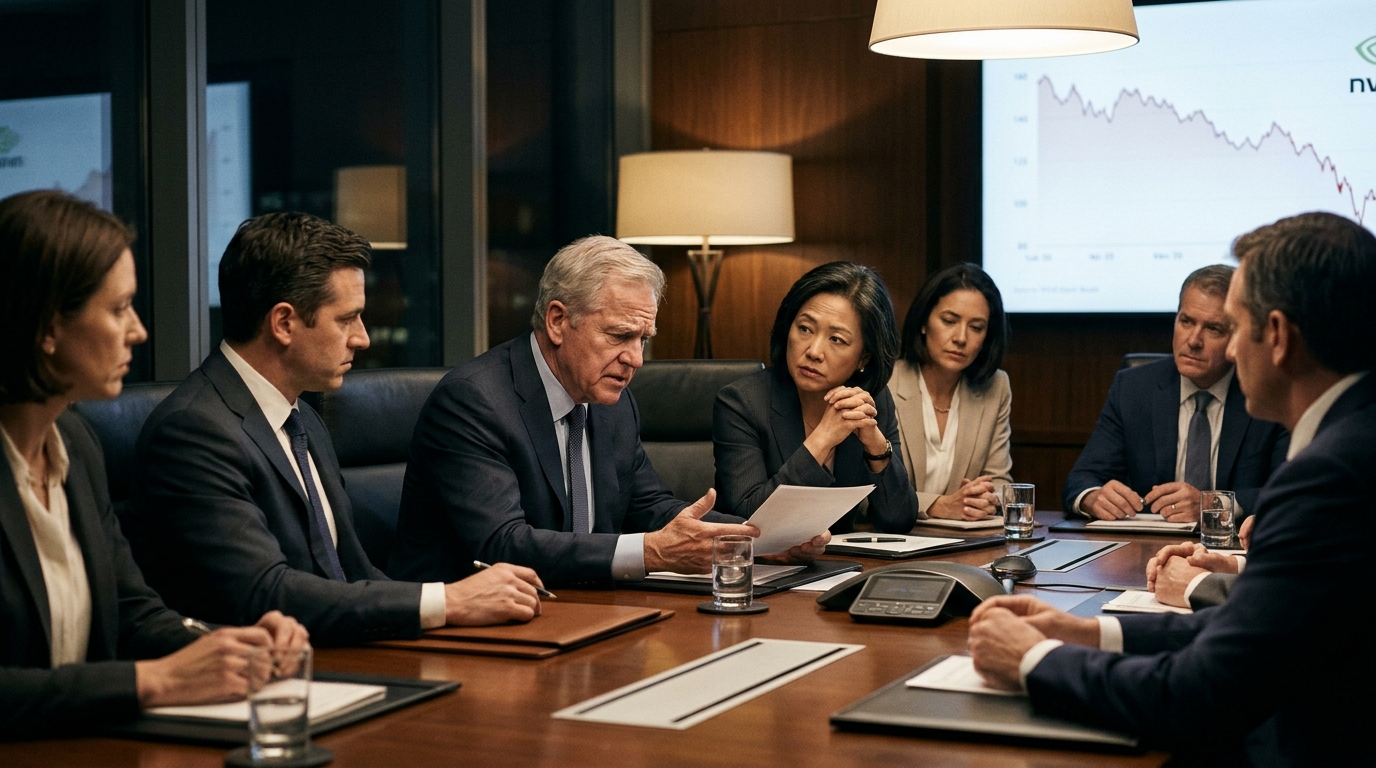
Markets don’t need a CEO to like a company. They only need to believe the next one exists. Nvidia’s stock dropped about 8% in after-hours trading as the board met Wednesday night to weigh the future of Jensen Huang, and prediction market traders placed high odds on his departure by December 1. That reaction is not about the scandal itself. It is about what the scandal exposed: a $4.5 trillion enterprise with no line of succession and a board that allowed it.
The word “succession” appears nowhere in Nvidia’s most recent annual report to shareholders, versus 25 times for Microsoft and 16 for Alphabet. That is not an oversight. According to The New York Times, citing former executives, discussions about establishing a succession plan took place within Nvidia for several years, but Huang consistently resisted the idea, believing a succession framework would only foster competition and division among executives. The result is a company where about 60 executives report directly to Huang, with no obvious deputy and no documented transition protocol.
The Numbers Behind the Governance Gap
Nvidia posted record quarterly revenue of $68.1 billion in its fiscal fourth quarter, up 73% year over year, and full-year revenue of $215.9 billion, up 65%. GAAP EPS for the quarter was $1.77, and for the full fiscal year $4.90. Those numbers define the problem. The harder they are to replicate under new leadership, the larger the discount the market demands to hold the stock through a transition.
Dan Ives believes that if Huang were removed as CEO, Nvidia would be “worth a lot less (25%-30%)” as a company and stock, and would change the future direction of the company and create a dramatically different competitive environment around AI GPUs globally, especially for China. Several Wall Street commentators on CNBC have said that if Huang is removed, the stock could fall an additional 20% from current levels.
What the Street Is Doing With It
The analyst community is not waiting for a verdict. Baird downgraded Nvidia and cut its price target sharply on Wednesday, citing both China-related demand risk and rising odds of a CEO transition into 2027. Other reported downgrades tied specifically to “increasing likelihood” of Huang’s removal were not confirmed in primary reporting as of November 12.
NVDA most recently closed at $173.73, hovering close to its 52-week low of $164.27, with shares down about 10% over the past year. The stock is also down more than 20% over roughly the past month. The valuation compression is real. The question is whether it has fully priced leadership risk or only begun to.
A leadership vacuum at Nvidia would ripple beyond the stock itself. Dell’s $95 billion AI server backlog depends on a stable Nvidia supply chain and pricing relationship.
Options Market Analysis
Options are pricing an implied move of roughly 9% by the November 18 expiration, with implied volatility elevated and IV rank in the 80s to low 90s depending on the data source. That is not just earnings premium. Nvidia’s next earnings report is scheduled for Tuesday, November 17, 2026, which means two binary events, the board decision and the Q3 report, are collapsing into the same weekly expiry. NVDA options traded 7.29 million contracts on November 10, well above the 20-day average of 3.18 million.
The put/call ratio stands at 0.85, still signaling net bullish positioning, which is notable given the drawdown. The flow is not capitulation. It reads more like hedged accumulation, buyers paying up for calls while keeping protective puts on the table.
Structured Trade Framework
Bull case: If you believe the board retains Huang or installs a credible interim leader with minimal disruption to data center relationships, the stock at roughly 10 times 2027 earnings is historically cheap. A defined-risk structure would be a December call spread, buying the $185 strike and selling the $210, risking only the net debit paid.
Bear case: For traders expecting a forced removal with no successor ready, a put debit spread targeting the $164 to $150 range captures the gap to the 52-week low with defined maximum loss. With IV rank elevated, buying naked puts is expensive. Spreads compress the cost.
Neutral case: With two catalysts colliding before November 18 expiry, an iron condor centered on the current price monetizes elevated premium if the stock stays rangebound through the board announcement and earnings. Implied volatility often falls after a binary event, making premium selling structures attractive for traders comfortable with directional uncertainty.
Two binary events colliding into one expiry is a structure options traders have navigated before. ARM’s options market showed how elevated implied volatility and defensive put positioning interact when an AI demand narrative is still unresolved.
Risk Analysis
Georgetown professor Jason Schloetzer, who co-authors an annual report on CEO succession planning, warned that if Huang is ultimately fired and replaced with an insider, “you’re going to have 59 people who will all think ‘it should have been me.'” That talent fragmentation risk is not priced into any model. It is the slow-motion version of the bear case, not a one-day drop but a multi-quarter erosion of the flat management structure that made Nvidia’s execution speed its competitive edge.
Forward Outlook
As of November 12, Huang remains Nvidia’s CEO, and no resignation has been confirmed. Prediction market odds on a December 1 exit have been elevated, but they remain probabilities, not facts. That gap between probability and fact is where this trade lives.
Action Checklist
- Monitor for any official board statement before November 17 earnings, which resets the entire volatility picture.
- Track the $164.27 52-week low as the key technical support level under a confirmed leadership change.
- For defined-risk bulls: December call spreads above $185 keep loss bounded if the board surprise is negative.
- For defined-risk bears: Put debit spreads, not naked puts, given elevated implied volatility.
- Watch the put/call ratio daily. A move above 1.2 would signal the hedged accumulation thesis is breaking down.