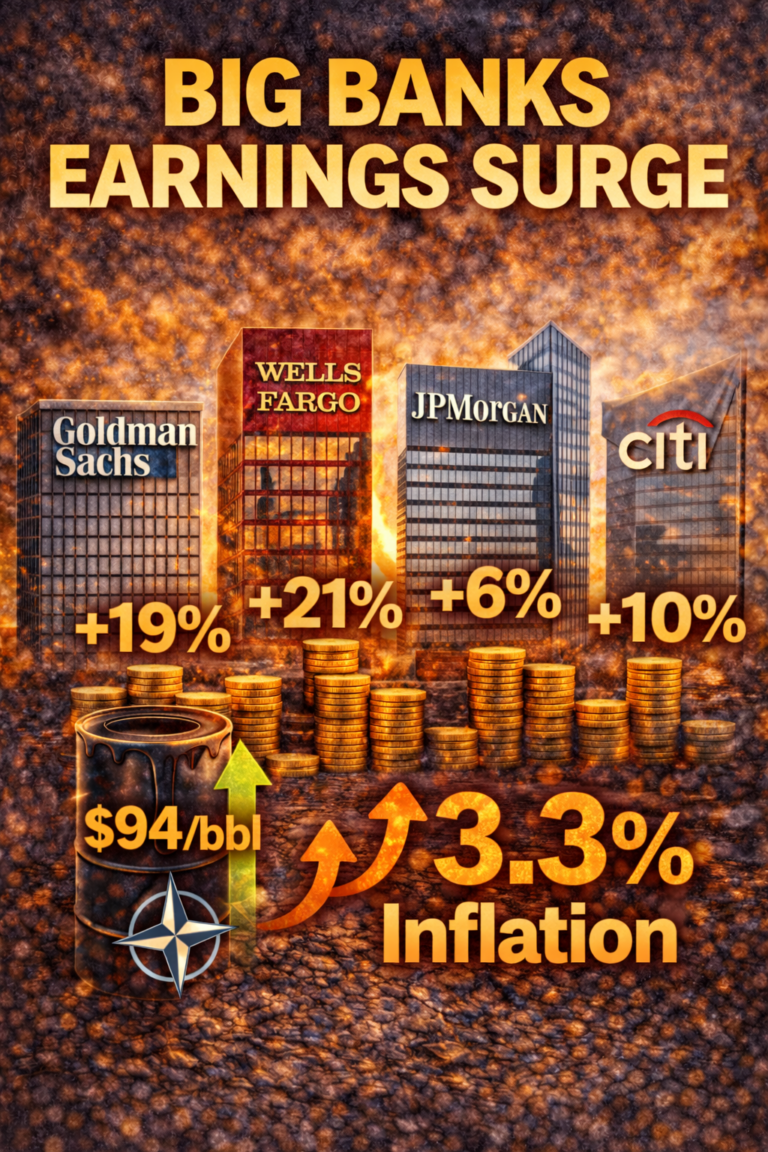
February was in fact a ‘tell-tale’ month of losses, influenced by the projected effect of Artificial Intelligence. Both the S&P 500 and Nasdaq Composite suffered as the exchanges lost serious ground in February as AI projections worsened. The S&P 500 finished the month down 0.9%, while the heavy-tech Nasdaq fell 3.4%. The blue-chip Dow Jones Industrial Average, to the contrary, edged up 0.2%, while “continuing its longest winning streak since 2018.” A scathing report on AI released last week by CITIRINI Research, laid out the detrimental aspects of how much impact AI potentially has on technology, software and supporting financial sectors. “Ross Mayfield, investment strategist at Baird commented: “The main story is still tech and AI uncertainty, and it is making investors question the fundamental underpinning of a lot of industries.” Bitcoin finished the week hovering near $67,400, Silver jumped 7% peaking at $93.25 while gold edged upward to $5,297.00 steadily gaining back to pre-selloff levels. Platinum surged $123.00 up 5.98% to a recent high of $2,373.00 at Friday’s close.
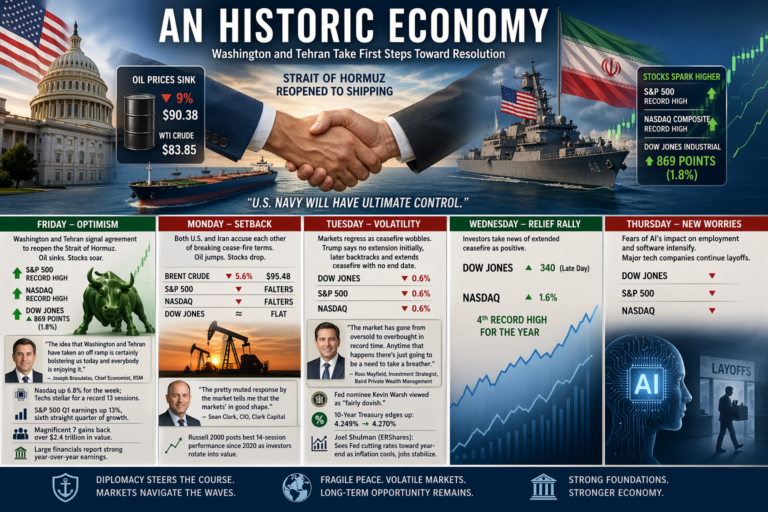
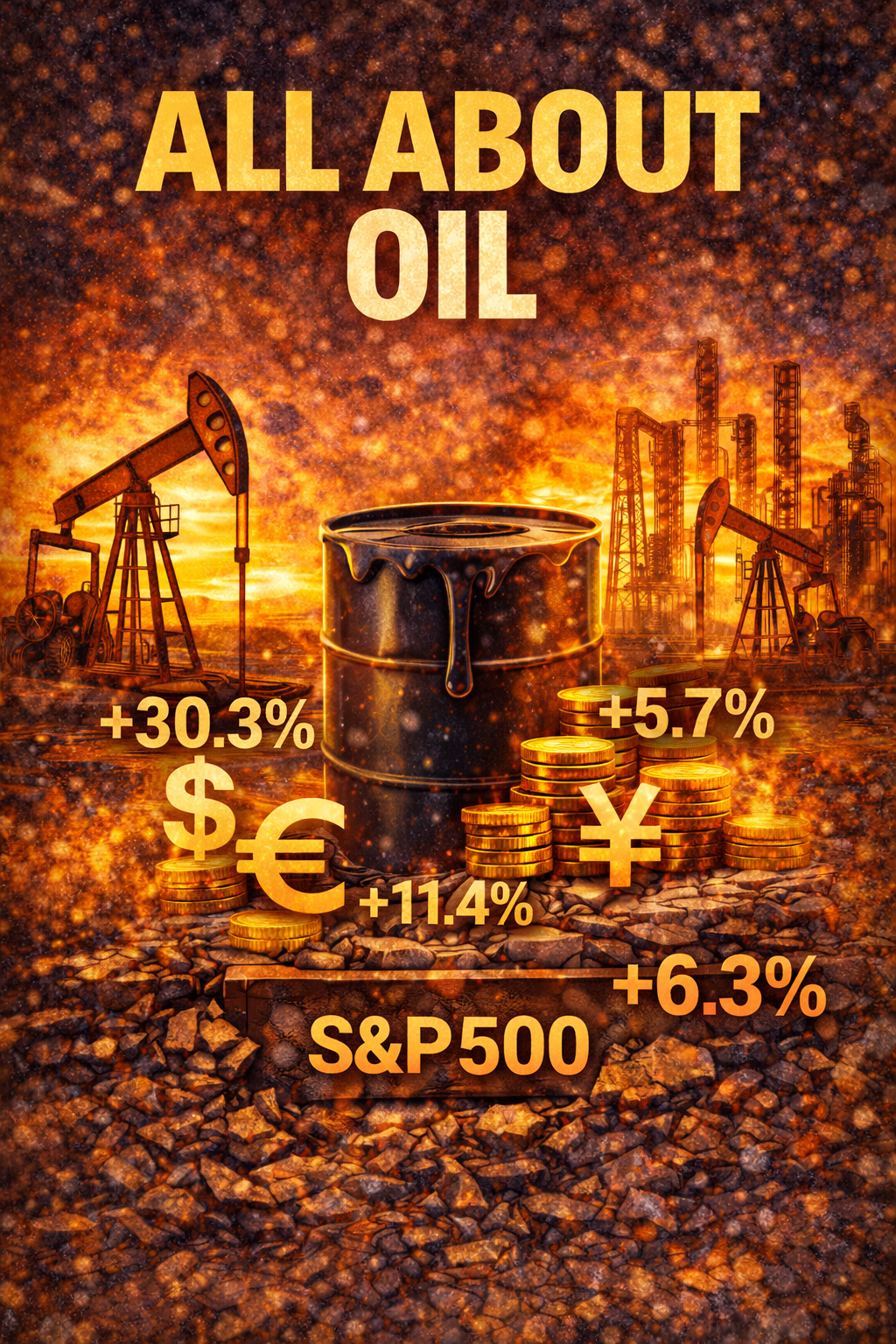
As the U.S. Israeli Iranian middle east conflict rages on, oil has soared to higher levels becoming a major influencer on economies around the world. West Texas Intermediate Crude jumped quickly up 8% Monday to $72.00 a barrel. The “international benchmark added 13% to $82.00 a barrel,” sliding back, settling at $79.00 a barrel. Markets opened Monday in a sell-off state, with investors and traders worried of the impact of the Middle East conflict and its duration. Both the S&P 500 and Nasdaq turned positive by day’s end, with the Dow Jones dropping 73 points. The Russell 2000 was up nearly 10% to 2655, as investors rotated from techs and AI stocks into trusted established issues. The ‘steady eddy forgotten index’ in recent months has become the ‘go-to- index’ with smaller value packed companies. World wide exchanges were jittery with the big question: “how long does it go on?” Oil inventories, according to analysts, “believe the global market is well stocked for several days.” Scott Shelton, an energy analyst for interdealer broker TP ICAP stated: “If the war goes beyond that [several days], I think [the market] gets a lot tighter a lot faster.” Oil Monday settled near $71.00 a barrel, well below the past 2 year average. Again, the war’s duration will be a strong factor in future oil prices.
Markets were skittish on Tuesday’s open as the Dow Jones Industrial Average dived 1200 points in early morning trading. Oil continued to drag markets lower not only in the U.S., but around the world as the Iranian war got more intense and…complicated. Fighting in the region is expanding into nearly all adjacent countries who stand with the U.S. Major indexes around the world suffered losses, Japan’s Nikkei 225 exchange fell 3.1%, while South Korea’s Kospi backed off 7.2%. The U.S. Dollar however remained stalwart, according to the WSJ Dollar Index, edging higher amid weaker foreign currencies. Stocks across the board were uneasy as market volume was weak, with some rotation noted. Precious metals were weaker as investors again took profits and pivoted positions. Markets livened up Wednesday as investors reaffirmed confidence in the market amidst the turmoil in the middle east. Crude is $81.05 a barrel, up $6.39. “It’s a huge testament to the psychology of American investors–they’re showing a huge ability to basically see the glass half full in any set of circumstances,” said Steve Sosnik, chief. strategist at Interactive Brokers. Oil soared, stocks dived on Thursday. The closing of the Strait of Hormuz clouded early prospects of a ‘short’ war. American crude shot up 8.5% to $81.01 a barrel. And…the Dow Jones Industrial Average gave up 785 points, while both the S&P 500 and Nasdaq both fell.
RUMBLINGS ON THE STREET
Adrian Helfert, chief investment officer at Dallas-based Westwood Holding Group, WSJ – “AI was considered this very large potential source, now it is considered to be a potential threat to corporate businesses.”
Daniel Hynes and Soni Kumari, Commodity Analysts at ANZ Research, WSJ – “Any escalation of conflict is likely to see OPEC step into calm the market. If disruptions occur OPEC+ is expected to tap spare capacity–with most of it sitting on Saudi Arabia and United Arab Emirates.
Greg Abel, CEO Berkshire Hathaway in a letter to shareholders, WSJ – “Berkshire’s culture and values form the basis of our operating framework, which shapes the strategy we pursue and the choices we make as we build Berkshire. As CEO, the framework governs how I lead every day.”
About the Author