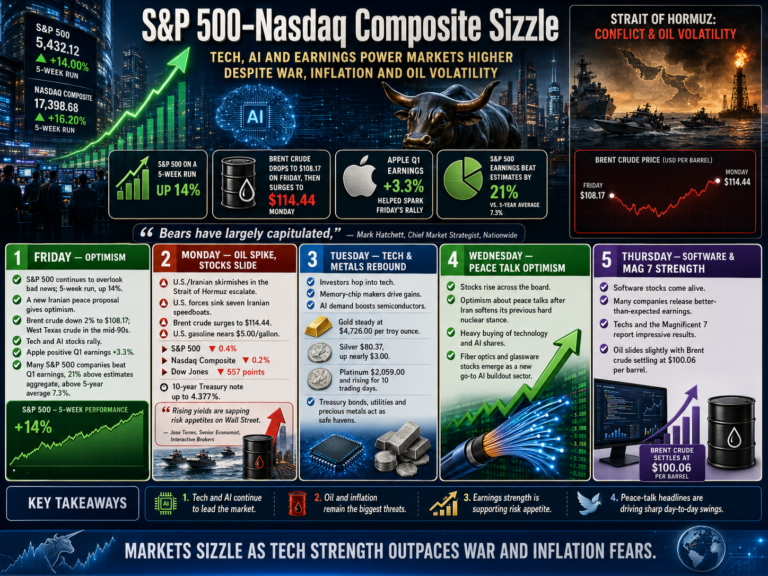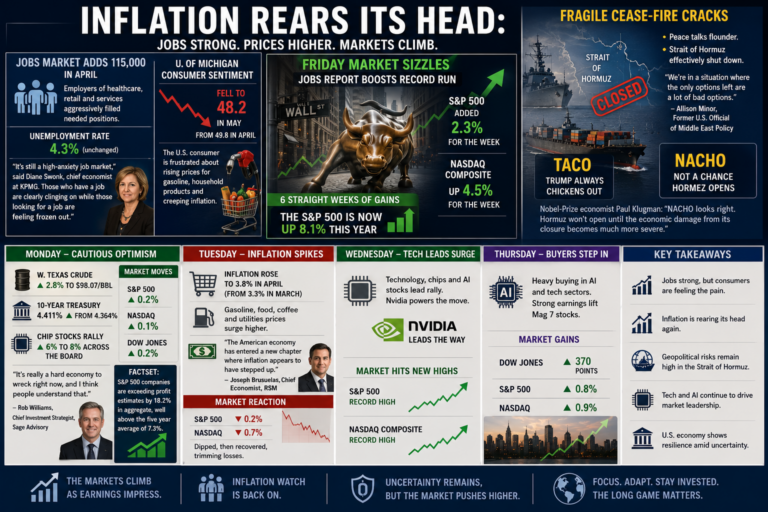
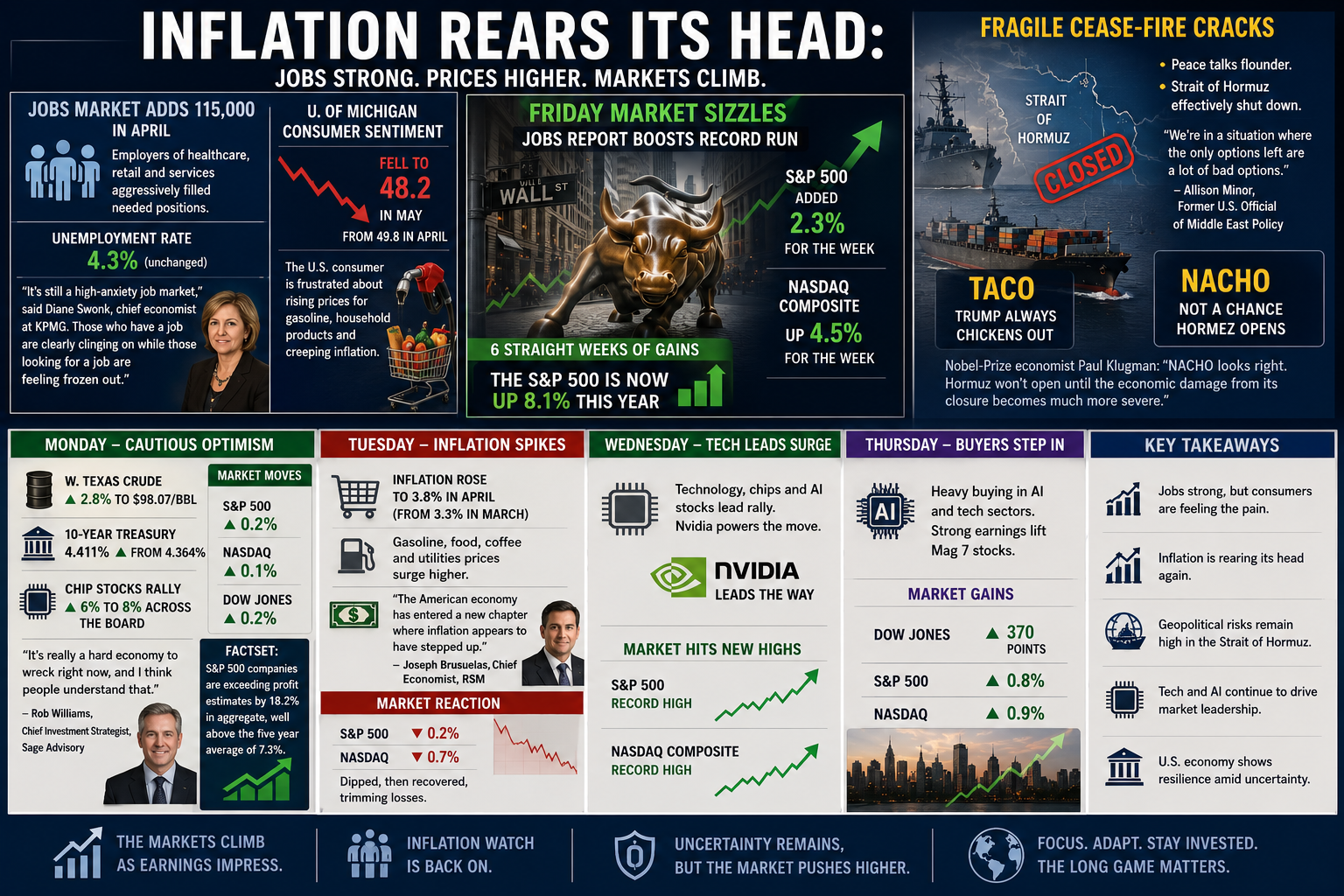
The U.S. Jobs Market added 115,000 jobs in April, as employers of healthcare retail and services aggressively filled needed positions. The Wall Street Journal had estimated that a hiring of 55,000 was expected. With the vigorous hiring the unemployment number stayed steady, the same as last month’s level of 4.3%. “It’s still a high-anxiety job market,” said Diane Swonk, chief economist at KPMG. Those who have a job are clearly clinging on while those looking for a job are feeling frozen out.” The University of Michigan’s Consumer-Sentiment Survey “fell to 48.2 in May from 49.8 in April.” Analysts had estimated a 49.7 reading. The U.S. consumer, as the survey points out, is frustrated about the severe rise in retail prices, namely gasoline, household products and creeping inflation. As the week closed Friday, both the S&P 500 and Nasdaq Composite, with 6 straight weeks of gaining, were boosted by the impressive Jobs Report, with both indexes establishing new record highs. The S&P 500 added 2.3% for the week, while the Nasdaq was up 4.5%. The S&P 500 is now up 8.1% this year.
The fragile cease-fire, now entering the 2nd month of the U.S./Iranian war is ‘cracking.’ Peace talks are floundering as each side confronts its new proposals with rejection. The Strait of Hormuz is clogged with many ships unable to pass through, as the U.S. Navy and Iran have effectively shut the Strait down. “We’re in a situation where the only options left are a lot of bad options,” said AllisonMinor, a former U.S. official of Middle East Policy. A ‘new term,’ coined by Wall Street, the acronym, TACO, meaning ‘Trump Always Chickens Out’ is now joined by yet another acronym, “NACHO, or NOT A CHANCE HORMEZ OPENS, is also borrowed from the pages of a Tex-Mex menu.” Nobel-Prize winning economist Paul Klugman wrote in a recent post that “helped to popularize the term, but ‘NACHO’ looks right. Hormuz won’t open until the economic damage from its closure becomes much more severe.”
Monday’s market opened positive as the indexes were not deterred by war pessimism. West Texas Crude was up 2.8% to $98.07 a barrel. Stocks slowly creep up with the S&P 500 and Nasdaq just above flatline, up 0.2% and 0.1% respectively. The blue chip Dow Jones Industrial Average added 0.2%. Treasuries were stronger, with the 10-year note at 4.411%, up from 4.364% at Friday’s close… Chip stocks continued their fierce rally with major gains up 6% to 8% across-the-board. “It’s really a hard economy to wreck right now, and I think people understand that,” said Rob Williams, Chief investment strategist at Sage Advisory. According to FactSet “S&P 500 companies are exceeding profit estimates by 18.2% in aggregate, well above the five year average of 7.3%.”
Inflation spurted up to 3.8% in April, with steep price increases in gasoline, food, coffee, and utilities, hitting the consumer in the pocketbook. According to Joseph Brusuelas, chief economist at RSM; “The American economy has entered a new chapter where inflation appears to have stepped up. Median American families are going to find it very challenging to adjust going into the second half of the year.” The Labor Department’s Inflation report for April was 3.8% surpassing March’s number of 3.3%. Reaction to stocks was quick, as the Nasdaq lost 0.7% and the S&P 500 was off 0.2%, as both indexes dipped , then recovered, trimming losses.
Wednesday’s market was all about Technology and chips and artificial Intelligence stocks, which led both the S&P 500 and Nasdaq higher, with both setting new all-time highs. After a dismal Tuesday, the turnaround was epic on Wednesday. Market leader Nvidia led the rally as investors reinforced their holdings to technology issues. Stocks were higher Thursday led by heavy buying in artificial intelligence and technology and AI sectors. The Dow Jones Industrial Average rose 370 points while the S&P 500 and Nasdaq added 0.8% and 0.9% respectively.
RUMBLINGS ON THE STREET
Michael Arone, chief investment strategist at State Street Investment Management “Artificial Intelligence, WSJ – “Artificial Intelligence fears are fading fast, and the fundamentals are back in focus.”
Jay Hatfield, CEO of Infrastructure Capital Advisors, WSJ – ”There’s a flat-out shortage in chips and a flat-out boom in chip stocks. And no amount of war headlines or even the lack of earnings is going to slow it down.”
Gus Faucher, chief economist at PNC, WSJ – “Businesses are seeing conditions stabilizing, and they have weathered the tariffs, so many are hiring. It’s looking somewhat better than it did last year.”
About the Author