June 18, 2026
The Dividend Fortress
Kroger leads the defensive shift as institutional capital moves away from high-beta tech.
When the Market Gets Nervous, Groceries Get Interesting
This morning, Kroger (NYSE: KR) dropped its first-quarter fiscal 2026 results. And while the stock moved lower in premarket trading on margin concerns, the actual numbers tell a more nuanced story than the initial reaction suggests. Revenue beat. eCommerce hit profitability for the first time ever. Full-year guidance held firm. For anyone watching the defensive rotation that has been building since early 2026, today’s report adds another data point to an already compelling case.
Let’s start with the headline figures, because they matter more than the knee-jerk selloff implies.
Your Complimentary Dividend Package
Today, you can claim the Ultimate Dividend Package… For FREE. (No credit card required!)
Inside, Marc Lichtenfeld – bestselling author of Get Rich with Dividends and world-renowned income expert – is giving away his top dividend picks.
You’ll get details on…
• Marc’s No. 1 dividend stock for 2026
• The safest 9% dividend in the world
• The top three “Extreme Dividend” stocks
• And much, much more!
What the Quarter Actually Showed
Kroger posted total sales of $46.12 billion for the quarter ended May 23, 2026 — up 2.2% year-over-year and ahead of analyst estimates that clustered around $45.35 to $45.47 billion. That’s a clean revenue beat of roughly $650 to $770 million depending on the consensus used. Net earnings attributable to Kroger climbed to $903 million, with GAAP EPS rising to $1.46 from $1.29 in the prior-year period. Adjusted EPS came in at $1.58, in line with the $1.58 consensus estimate.
The part people are skipping over: adjusted eCommerce sales grew 19%, and Kroger Precision Marketing profit grew more than 20%. That second number is important. Kroger’s retail media business — which leverages first-party purchase data from tens of millions of loyalty card holders — is becoming a high-margin profit engine inside what most investors still think of as a low-margin grocery chain. The eCommerce segment also reached profitability for the first time, ahead of management’s original timeline. These are not small developments.
Identical sales excluding fuel rose 1.0%, a deceleration from the 3.2% posted in the same quarter a year ago. Gross margin narrowed slightly to 22.7% from 23.0%, pressured by a heavier fuel revenue mix, rising transportation costs, and egg deflation. CEO Greg Foran acknowledged the cost discipline challenge directly on the earnings call. None of that is hidden. But the full-year guidance — adjusted EPS of $5.10 to $5.30, free cash flow of $2.7 to $2.9 billion — was reaffirmed without change. That is the part institutions care about.
The Bigger Picture: Why Defensive Capital Is Moving Here
Kroger doesn’t exist in a vacuum. It’s anchoring a much larger capital shift that has been underway since early 2026. Consumer staples spent most of 2025 in the shadow of AI-driven growth stocks, widely underperforming the S&P 500 as investors chased tech momentum. That changed fast. As tech valuations came under pressure and tariff uncertainty rattled markets, investors rotated hard into defensives — sending the Consumer Staples Select Sector SPDR Fund (XLP) up roughly 13% year-to-date through early February, one of its strongest starts in over a decade, while the technology sector declined around 3% over the same stretch.
The logic isn’t complicated. When growth decelerates and rates stay elevated, institutional desks trim higher-beta exposure and shift capital toward sectors with steadier demand, stronger balance sheets, and more predictable earnings streams. Consumer staples fits that description precisely. Groceries, household essentials, pharmacy — these are not discretionary purchases. Kroger serves more than 11 million customers daily across roughly 2,700 stores in 35 states. Demand doesn’t disappear because sentiment softens.
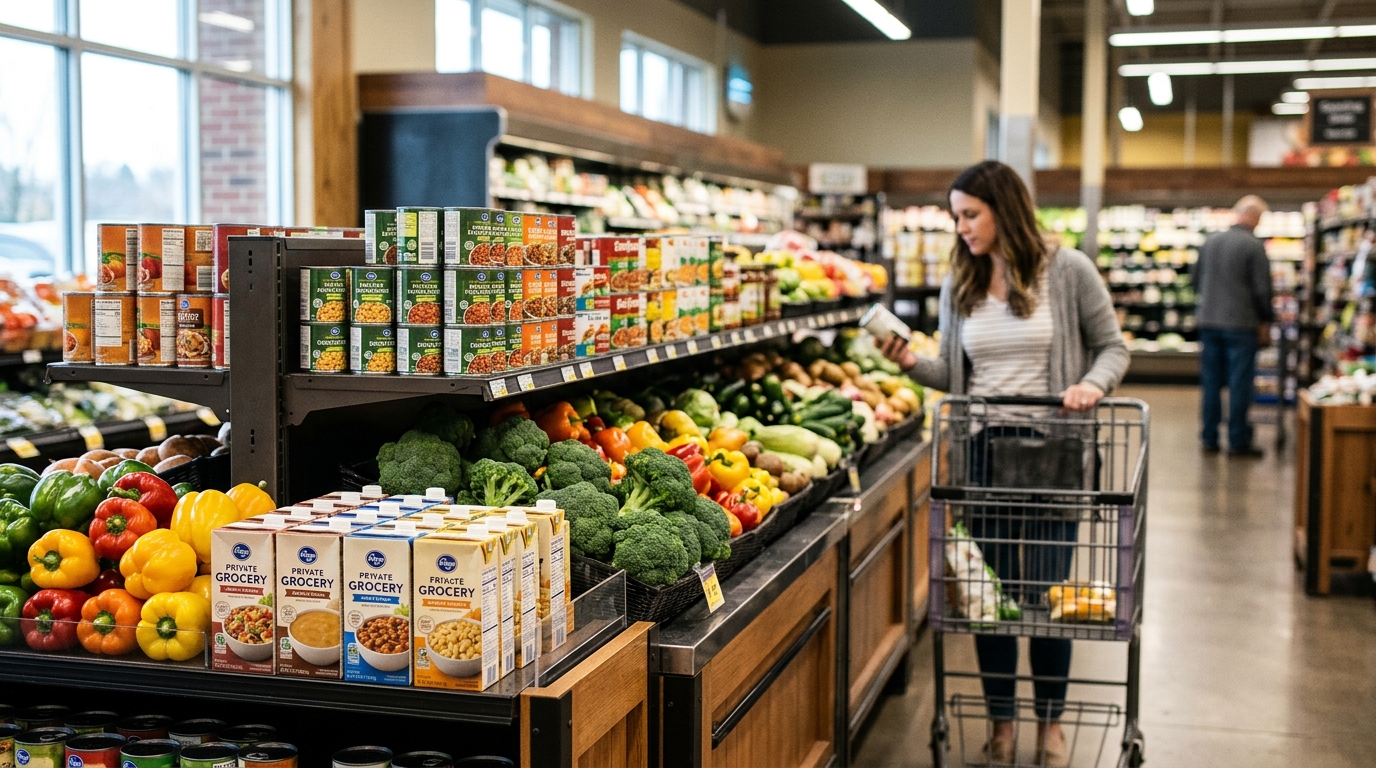
Kroger’s private-label portfolio, branded as “Our Brands,” outpaced national brands by 175 basis points last quarter. In a price-conscious consumer environment — where Walmart and Costco are also pushing value aggressively — that kind of private-label momentum matters. It’s structural pricing power dressed up in grocery store packaging.
2026: The Year of the Robot
A revolutionary new robot is beginning to emerge.
Elon Musk says it will “change civilization as we know it.”
Microsoft’s Bill Gates said, “it will be as revolutionary as the PC.”
Nvidia’s Jensen Huang says it could be “the largest technology industry the world has ever seen.”
Creating a $24 trillion opportunity for investors.
And one $7 stock could be the biggest winner of all.
The Dividend Case
Kroger pays an annual dividend of $1.40 per share, with a current yield of approximately 2.2%. The company has now grown its dividend for 18 consecutive years — a track record that reflects the kind of free cash flow consistency that income-oriented institutional allocators actively seek. The board approved an additional $2 billion share repurchase authorization in December 2025, expected to be completed by year-end. Net total debt to adjusted EBITDA sits at 1.75 — well below the company’s own target range of 2.30 to 2.50 — leaving ample financial flexibility.
What’s interesting is that the dividend yield, the buyback program, and the reaffirmed EPS guidance all point in the same direction: management believes the business is generating enough cash to reward shareholders while continuing to invest in digital infrastructure. That combination is rare in an environment where most companies are being forced to choose one or the other.
What to Watch From Here
The margin story is the one hanging question. Gross margin at 22.7% is thin, and operating costs are growing faster than sales — something Foran called out directly. Management expects cost savings to accelerate through the back half of fiscal 2026, and an investor update is scheduled for October 20, 2026, where the company will provide additional detail on pricing strategy and longer-term financial targets. That date is worth putting in the calendar.
The broader consumer staples rotation may not be permanent — it rarely is. If risk appetite returns sharply, the premium being paid for defensives could compress. But for portfolios seeking lower volatility, reliable dividend income, and exposure to a business where demand doesn’t require a healthy economy to function, Kroger’s Q1 results — read carefully, not just at the headline — present a case worth examining.
- Q1 FY2026 Revenue: $46.12B vs. ~$45.35-45.47B est. (+2.2% YoY)
- GAAP EPS: $1.46 vs. $1.29 prior year; Adjusted EPS $1.58 (in line)
- eCommerce Growth: +19% (adjusted); reached profitability ahead of schedule
- Kroger Precision Marketing: Profit +20%+
- Same-Store Sales (ex-fuel): +1.0%
- Full-Year Adj. EPS Guidance: $5.10-$5.30 (reaffirmed)
- Annual Dividend: $1.40/share, ~2.2% yield, 18 consecutive years of growth
- Key Risk: Gross margin at 22.7%, operating cost inflation; watch October 20 investor update
Why Musk May Need This Company Next
Musk has a pattern: when his empire needs something critical, he buys it. Batteries. Solar. Data. Now, his AI buildout may depend on one small power-system company moving faster than the giants.
The stock still trades like a forgotten industrial.
All figures sourced from Kroger’s Q1 FY2026 earnings release dated June 18, 2026. This is analysis, not investment advice. All data should be independently verified before making any financial decisions.