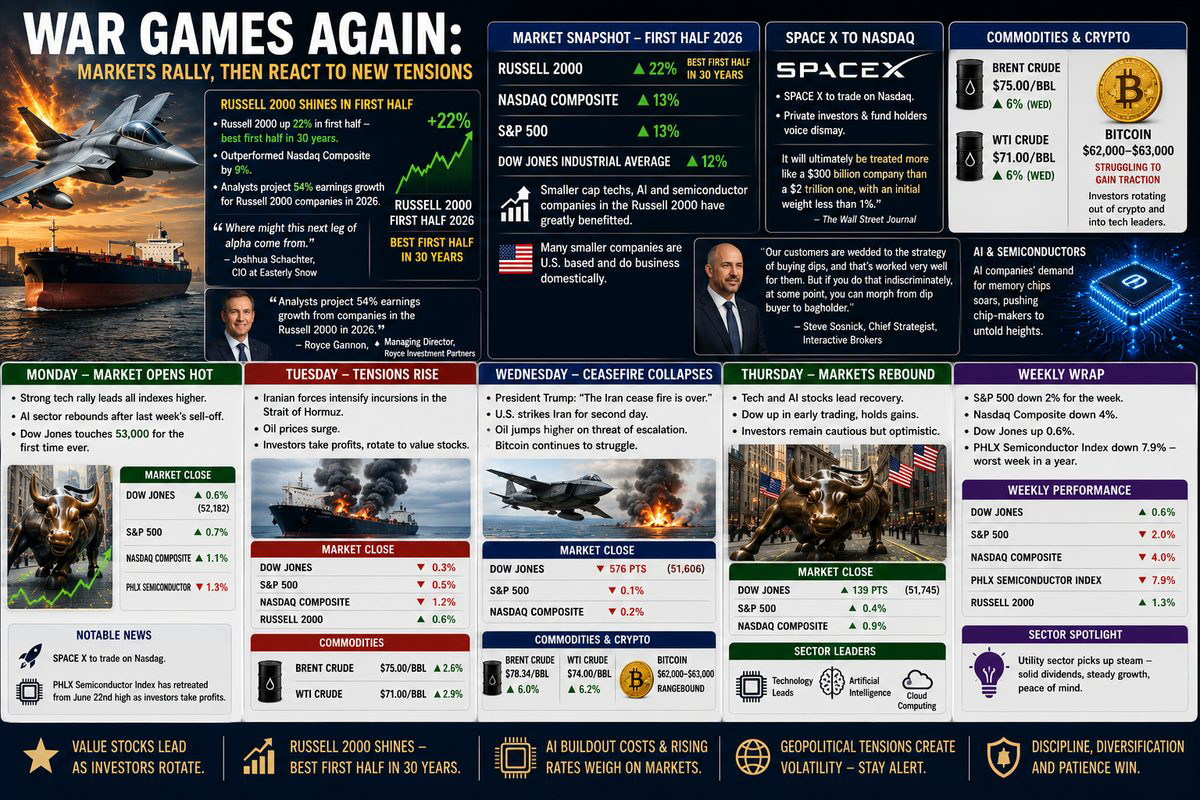
The small cap Russell 2000, made up of smaller value companies had an outstanding first half performance, up 22%. It was the best first half in thirty years. The often ‘forgotten index’ loaded with prime growth stocks outshined its ‘big brother’ indexes by a wide margin, surpassing the tech heavy Nasdaq Composite by 9%. Investors are stepping back and saying “where might this next leg of alpha come from,” said Joshhua Schachter, chief investment officer at Easterly Snow, (referring to the tremendous appreciation of stocks the past two years). Many smaller cap techs, AI and semiconductor companies in the Russell 2000 have greatly benefitted from the massive explosion of growth of the largest companies, coupled with a soaring in economy, the index has continued to thrive. Many of these ‘smaller companies, ‘home–grown in the U.S. are doing a large portion of business domestically. According to Royce Gannon, a managing director at Royce Investment Partners, “analysts project 54% earnings growth from companies in the Russell 2000 in 2026.”
Monday’s market opened ‘hot’….led by a strong technology rally, overflowing to all indexes. The artificial intelligence sector kicked in after last week’s sell–off, adding to the boost. SPACE X announced Monday it would trade on the Nasdaq Composite, much to the dismay of large private investors, and fund holders, “claiming exposure, whether they like it or not.” Per The Wall Street Journal; for Space X, that means “it will ultimately be treated more like a $300 billion company than a $2 trillion one, with an initial weight less than 1%.” Both the S&P 500 and the tech heavy Nasdaq closed Monday up 0.7% and 1.1% respectively. The PHLX Semiconductor index has regressed from its June 22nd high with the past several sessions dropping as investors take profits, waiting to repurchase on dips. Artificial Intelligence companies’ requirements for memory chips have soared, pushing chip–makers to untold heights. Steve Sosnick, chief strategist at Interactive Brokers said: “Our customers are wedded to the strategy of buying dips, and that’s worked very well for them. But if you do that indiscriminately, at some point, you can morph from dip buyer to bagholder.”
The Dow Jones Industrial Average touched 53000 the first time ever Monday, only to fall Tuesday. Oil surged higher Tuesday as Iranian forces intensified incursions in the Strait of Hormuz. Multiple attacks by Iran on awaiting tankers gave strong signals that the ceasefire was crumbling as Brent crude crept up to $75.00 a barrel, with West Texas crude at $71.00 a barrel… Indexes struggled Tuesday as the Dow Jones lost 0.3%, while the S&P 500 slipped 0.5%. The heavy tech Nasdaq was off 1.2% as tech, AI and semiconductors were weaker. Investors and traders again were taking profits pivoting into value stock on the DJIA and Russell 2000.
President Trump proclaimed: “The Iran cease fire is over,” as hostilities worsened. Threatened oil edged higher Wednesday, with Benchmark crude edged up 6% to $78.34 a barrel, with WTC settling at $74.00 a barrel. Bitcoin continued to struggle, languishing in the $62,000 to $63,000 range unable to gain a foothold in the growth ladder. Many crypto currency investors are rotating out and into market leaders of technology stocks. Stocks on Wednesday were mostly in a negative stance all day as the Dow Jones closed down 576 points. Both the S&P 500 and Nasdaq finished near flatline. The U.S. struck Iran for the second day as President Trump expressed frustration with the violation of the ceasefire agreement and unfruitful negotiations. Thursday’s market was positive as the Dow Jones in early trading was up over 200 points, finishing the day up 139 points, while the ‘hot’ tech–heavy Nasdaq up 336 points with technology and artificial intelligence stocks leading the market.
RUMBLINGS ON THE STREET
Julien Laforgue, chief market strategist at Barclays Private Bank, WSJ – “With the new Fed chair having placed the focus squarely on inflation, June payrolls are unlikely to shift interest–rate expectations on their own.”
Alan Eyers, a former senior State Department negotiator with Iran, who is now at the Middle East Institute, WSJ – “Iran is perfectly happy to substitute “process for ‘progress’ he said. “They realize that at least in the short term time is on their side.”
Nancy Tengler, chief executive of Laffer TEngler Investments, WSJ – “This is a productivity–driven environment, much like the 90s were, and productivity is spreading across sectors. It’s thanks to not just WI, but all the new technologies.”