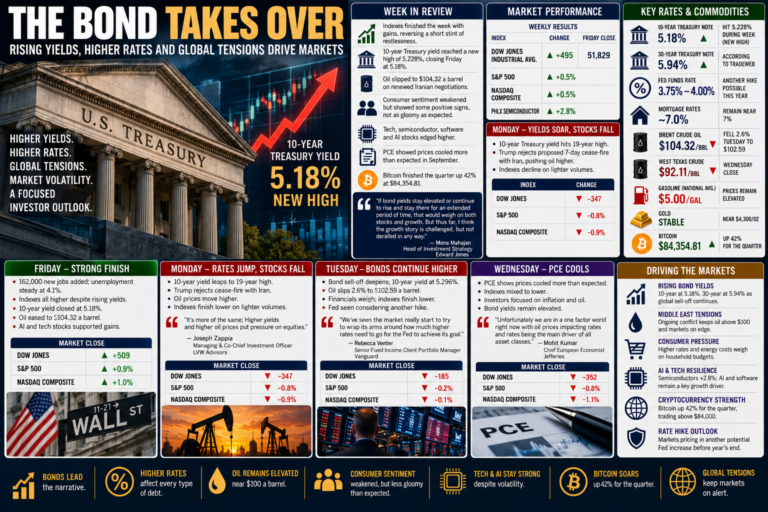
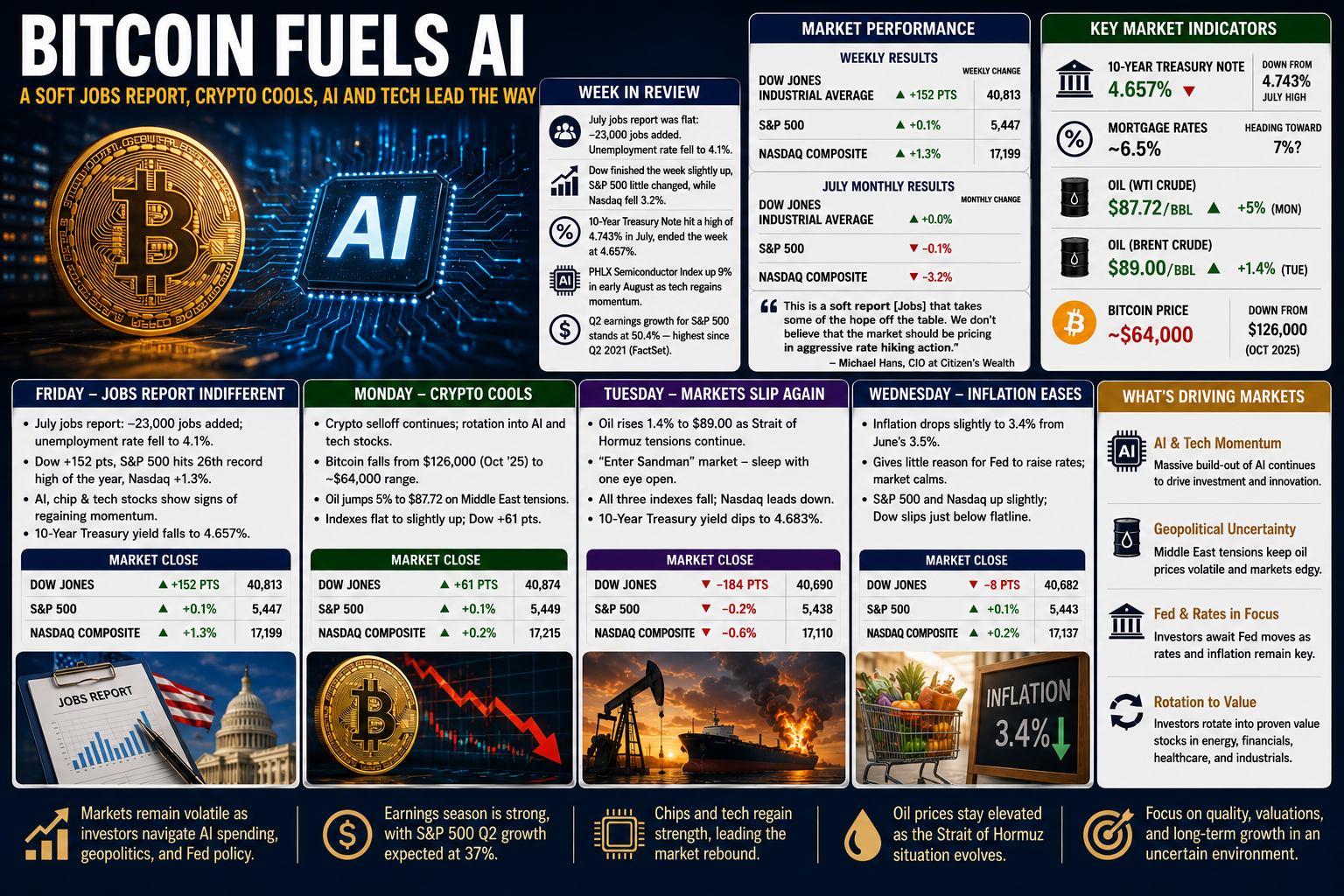
The Labor Department’s Job’s Report released Friday was indifferent. July’s numbers were flat, as the economy lost 23,00 jobs, a ‘far–cry’ from what economists had predicted. The unemployment rate fell from 4.4% to 4.1% for the year, strongly suggesting that “that the U.S. workforce might not need to generate that many jobs to keep up with the dwindling supply of new workers,” according to The Wall Street Journal. President Trump’s “immigration crackdown” and the loss of migrant workers has affected jobs numbers, especially in the summer months. Markets were slightly affected Friday as all three indexes were lethargic, unable to generate buying interest. Yet the Dow Jones Industrial Average gained 152 points while the S&P 500 hit its 26th new record high of the year. The heavy–tech Nasdaq Composite led again by AI buying was up 1.3%. According to Michael Hans, chief investment officer at Citizen’s Wealth said, “This is a soft report [Jobs] that takes some of the hope off the table. We don’t believe that the market should be pricing in aggressive rate hiking action.” The influential 10–year Treasury note, a good barometer to judge future borrowing costs, fell to 4.657%. Chips, AI and technology stocks have all shown recent signs of regaining momentum. The PHLX Semiconductor Index is up 9% in the first days of August, supporting recent tech moves. According to FactSet, “The earnings growth rate for companies in the S&P 500 stands at 50.4 for the second quarter which is the highest since the quarter of 2021.”
The rush to artificial intelligence stocks is continuing to drive prices ‘up–stream.’ Stocks across-the-board struggled Monday as investors and traders committed heavily to AI issues, rotating from Bitcoin and crypto currencies. What was once a go–to sector [Cryptocurrency] has faltered as evidenced by the massive fall in valuation from $126,000 a bitcoin in October of 2025 to recent trading price of the $64,000 range as of Thursday morning. “What’s happening in crypto to the purge is just getting started,” said Mike McGlone, a senior commodity strategist at Bloomberg Intelligence. Many crypto companies have and are selling bitcoin to lighten up a volatile weakening investment, and to pay dividends. As quoted in The Wall Street Journal; “Popular trading platforms for crypto traders such as Hyperliquid have embraced AI derivatives.” Stocks other than AI slipped lower as all three indexes floated just above flatline. The Dow Jones Industrial Average added 61 points. Oil edged higher as Middle East conditions remained stalemated, jumping 5% to $87.72 a barrel.
Stocks fell Tuesday, for the second day in a row. Oil rose higher as the Strait of Hormuz issue muddied with failed ‘deals’ coming and going. U.S. attacks resumed, then stopped as talks of de-escalation gave optimism–then faded. Oil added 1.4% to $89.00 a barrel as the ‘roller–coaster’ Middle East situation stews. Matt Stucky, chief portfolio manager of equities at NorthwesterMutual Wealth Management said; “It’s kind of like the ‘Enter Sandman’ market–sleep with one eye open, hold your pillow tight.” The indexes all fell with the Dow Jones dropping 184 points. The heavy–tech Nasdaq led all down falling 0.6%. Brent Crude settled near $89.00 a barrel, whip–sawing all day as words of positivity turned to desperation as skirmishes heated up in the Gulf. The 10–year Treasury yield dropped, falling to 4.683%.
Inflation backed off last month, dropping slightly to 3.4% from June’s reading of 3.5%. Falling pump prices, lower food–stuffs costs have given some respite to creeping inflation. Wednesday’s inflation report had little influence on the market as the S&P 500 and Nasdaq were up slightly while the blue–chip Dow Jones fell to just below flatline. The reading gave little cause for the Fed to raise interest rates, giving some ‘calm’ to the marketplace.
RUMBLINGS ON THE STREET
Mark Malek, chief investment officer at Siebert Financial, WSJ – “The pullback has made stocks look attractive again, and earnings season has exceeded expectations.”
Bradford Smith, portfolio manager at Janus Henderson, WSJ – “A hot inflation print would very much increase the probability of a hike in September, but just one print isn’t going to bake it in the cake.”
Stan Veuger, of THe American Enterprise Group, WSJ – “My guess would be that the rest of the year will, if anything, see slower jobs growth than what we’ve seen so far.”