August 14, 2026
The $100B Refund Most Investors Ignore
Washington is refunding more in tariffs than it collects. Gold is a quiet beneficiary.
Cheaper Phones Could Send EarnPhone Soaring
Apple’s push for lower-cost Chinese memory chips says it all: the smartphone race is shifting toward phones more people can afford.
Mode Mobile is built for this shift. Their EarnOS turns everyday smartphone activity into earnings. Like Uber turned cars into taxis, Mode is turning phones into EarnPhones, reaching 490M+ users and helping them earn and save $1B+.
As AI demand grows, Mode’s first-party data economy could become more valuable for model training while users share in the upside. With 32,481% revenue growth and Nasdaq ticker $MODE secured, investors can still invest at $0.52/share.
Click to explore Mode’s pre-IPO offering before the share price changes today.
Please read the offering circular at invest.modemobile.com. This is a paid advertisement for Mode Mobile’s Regulation A Offering.
The $100B Refund Most Investors Ignore
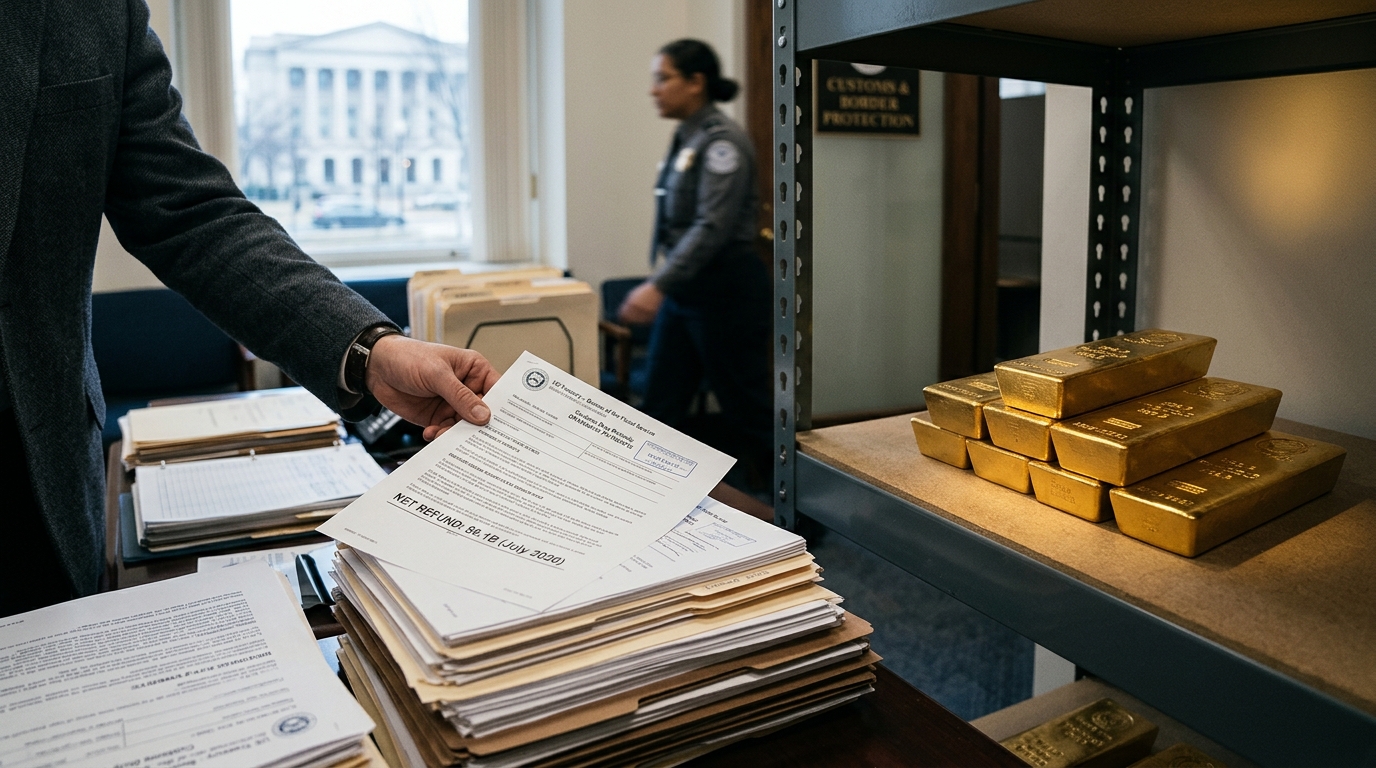
The Treasury Department released its monthly statement on Wednesday, and buried inside a table most investors will scroll past is a number that changes the fiscal math for the rest of 2026. In July, the U.S. paid $33.4 billion in “refunds and drawbacks” tied to customs duties while collecting about $24.3 billion in gross customs duties, making customs duties a net cash outflow for the third straight month. Total refunds have now surpassed $100 billion since the Supreme Court’s February ruling struck down the IEEPA tariff program.
That ruling, issued 6-3 on February 20, found that only Congress, not the executive branch, holds constitutional authority to impose tariffs at the scale the Trump administration deployed. The Supreme Court did not order refunds itself, but the Court of International Trade has since been overseeing litigation over how refunds should be handled, including whether payments must extend to importers beyond the plaintiffs. Court filings and reporting indicate roughly $166 billion is at issue, with slightly more than $100 billion already refunded and about $66 billion still outstanding.
What’s Driving the Market
The refund flow is doing something that rarely happens in fiscal policy: it is widening the deficit at the exact moment the government is also trying to rebuild tariff revenue through replacement authorities. The Congressional Budget Office now projects the fiscal 2026 deficit will reach $2.1 trillion, about $200 billion above the agency’s own February forecast, reflecting the ruling and weaker customs-duty receipts. Treasury Secretary Scott Bessent has endorsed a goal of moving the deficit toward 3% of GDP. At $2.1 trillion, it is tracking closer to about 6% of GDP instead.
That gap matters to precious metals investors for a reason that is easy to understate. A wider deficit means more Treasury issuance. More issuance puts upward pressure on yields unless the Fed actively accommodates it. And today’s July CPI reading confirmed that accommodation is not coming quietly: headline inflation held at 3.4% year-over-year, still 140 basis points above the Fed’s 2% target. Core inflation was 2.5% year-over-year. Energy prices fell in July, including a drop in gasoline prices, even as housing remains a major source of upward pressure on core inflation.
The tariff refunds are feeding into this dynamic in a way that is not yet fully priced. The Federal Reserve Bank of Atlanta estimated that financially constrained businesses will receive roughly 34% of all refunds, or about $56 billion. Those firms are most likely to use the cash to invest, hire, or cut prices. Better-capitalized companies will more likely hold the cash, repay debt, or return it to shareholders, which means the stimulus effect is real but uneven. PepsiCo told investors it plans to use its refund to help offset commodity inflation. The broader corporate posture suggests this windfall is extending spending capacity rather than creating deflation. None of that is structurally bearish for gold.
He went 11-for-11 during the last Fed shock. Another one is about to hit.
In 2022, when the Federal Reserve made its most dramatic pivot in history and the S&P lost nearly 20%, Larry Benedict didn’t lose a single trade.
He knew where the money was going and positioned his readers to profit.
Trump is now installing his own Fed Chair, something Wall Street is already calling a generational shift.
Larry says his readers will be ready for it.
Click here to find out the one ticker he’s positioning in, completely free.
The Investment Opportunity
Gold is trading near record territory, not because of a single catalyst but because three structural supports have converged simultaneously: a fiscal deficit tracking worse than earlier projections, a Fed that remains sensitive to inflation data, and central banks that are buying regardless of price. The World Gold Council estimates global central banks bought about 289 tonnes in the second quarter.
The angle most investors are missing is that the tariff refund cycle can be inflationary by construction. Prices rose when tariffs hit. Refunds went primarily to importers, not consumers. The firms that absorbed tariff costs and raised prices may keep the refunds rather than cut prices, because tracing exactly which tariff drove which price increase is practically difficult. Nintendo is already fighting a class-action lawsuit from customers who argue the company raised prices, sought refunds, and then kept the benefit.
For investors seeking direct exposure, the major royalty companies offer the cleanest leverage to sustained gold prices without the operational risk of owning a single mine. Streaming agreements lock in production at fixed costs, meaning margin expansion at high gold prices flows disproportionately to the bottom line. Wheaton Precious Metals has highlighted record results in 2026, and the royalty model can insulate investors from some cost inflation that hits traditional miners. On the producer side, Barrick has guided to about $0.75 to $0.85 billion of capital expenditures in 2026, with the Lumwana Super Pit Expansion a central growth project. Newmont has guided to about $1.40 billion in 2026 development capital, with a focus that includes mine life extensions at Lihir and Cerro Negro alongside other key projects.
Broader sector valuation remains anomalous relative to the gold price itself. Gold producers are often discussed as trading at single-digit EV/EBITDA multiples and at discounts to stated net asset value, but the exact ratios vary by index and date. The key point stands: equity valuations have not kept pace with the metal’s move, a condition that historically has tended to resolve through stronger equities when the gold price remains elevated.
Risks to Monitor
The case for gold is not without friction. Today’s in-line CPI reading, 3.4% annual headline and 2.5% core, is a dovish data point relative to what would force the Fed’s hand immediately. If September and October both produce CPI readings in this range, the rate hike that markets have been pricing as a coin flip could recede further. A sustained hold scenario, with no hike and no cut, would remove one of gold’s near-term tailwinds: the argument that the Fed is falling behind inflation.
Dollar strength is the other variable. The dollar’s traditional inverse relationship with gold has weakened substantially in 2026, but it has not disappeared. Any sharp reversal in risk sentiment that drove genuine safe-haven dollar flows could create short-term pressure on the metal even as the structural fiscal story remains intact. Meanwhile, the tariff refund pool is finite. Once the remaining roughly $66 billion is paid out, the deficit-widening mechanism from refunds ends, and replacement tariff revenues under Section 122, Section 301, and Section 232 may begin rebuilding the collection line. That transition could take 12 to 18 months to stabilize, but investors should not treat the current fiscal dynamic as permanent.
Bottom Line
The $33.4 billion in July refunds is not just a budget line. It is evidence that the biggest tariff revenue experiment in recent history is being unwound at meaningful fiscal cost, with the economic damage landing on consumers who faced higher prices and never received a check. That combination: consumer inflation still above target, a fiscal 2026 deficit now projected around $2.1 trillion, and central banks still buying gold in heavy volume, is the kind of environment where gold earns its place as something more than a trade. The July CPI reading gave the Fed room to hold in September. It gave gold investors one more month to accumulate in a market where the fiscal arithmetic is no longer theoretical.