

October 4, 2026
Bonus Content: Levi’s Shorts Are Betting Against Raised Guidance
For a while now, I’ve been showing regular traders like you how to take advantage of a specific 60-minute window…
One that lets us go after 50% returns every morning – whether the market opens higher… or lower.
Here’s what I mean…
If you had spotted this 60-minute opportunity yesterday morning… all you would’ve had to do was place a quick trade before 10 am…
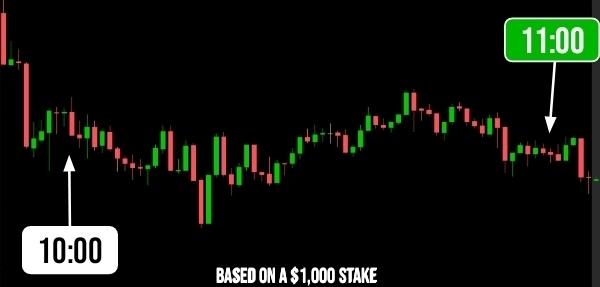
Went ahead with your morning plans and when you return a couple of minutes later, there’s a good chance you’d find $500 in extra income sitting in your account (on a 1k stake)
It wouldn’t have mattered what happened with the overall market… this 60-minute window would have been all you needed to target cash.
Today? Same story.
Place a quick trade, grab your coffee… and let the setup do the heavy lifting.
And just 60 minutes later… come back to what could be a nice $500 in extra income sitting in the brokerage account.
I designed the setup to be that straightforward.
Granted, there will be trades that won’t work out
But if you want in?
Levi’s Shorts Are Betting Against Raised Guidance

There is a specific tension heading into Levi Strauss’s Wednesday report that does not show up in the consensus estimate. Management already raised guidance in July. The Street already nudged its EPS estimate upward in the past 30 days. And yet the short base has spent September steadily rebuilding.
That is not noise. It is a direct disagreement between two groups of market participants who have read the same filings.
What the Numbers Say
Levi Strauss is expected to report fiscal Q3 2026 results after the market closes Wednesday, October 7, with analysts looking for about $0.36 per share in earnings and roughly $1.62 billion of revenue for the quarter. Company guidance issued in July called for adjusted EPS of $0.34 to $0.36 and revenue growth of 4% to 5%. The consensus essentially sits at the top of that range, meaning the bar management set is already priced in at its best case.
In Q2, LEVI reported $0.28 adjusted EPS, beating the $0.24 consensus by $0.04, while quarterly revenue rose 8.0% year-over-year to $1.56 billion, above the $1.52 billion estimate. The direct-to-consumer business, which accounts for 51% of revenue, rose 8% in the quarter, with DTC comparable sales up 6%, marking the 17th consecutive quarter of comp growth. That Q2 result was the catalyst for the guidance raise. The shorts are betting Q3 cannot repeat it.
After Q2, Levi raised expected reported revenue growth for fiscal 2026 to 7.0% to 7.5%, up from 5.5% to 6.5%, and lifted organic revenue growth expectations to 5.5% to 6.0%.
The Short Base Disagrees
Short sellers have continued adding positions at a deliberate pace, with short interest now representing about 8.65% of the free float, up 39% over the past month, as shares short climbed from roughly 6.4 million in early September to nearly 9 million. The build has been steady rather than driven by any single session.
Borrowing costs remain low, and availability remains ample. Shorts are not fighting a tight borrow market. The accumulation looks deliberate. That distinction matters. This is not a forced, opportunistic pile-in against a hard-to-borrow name. Someone is making a considered bet that the stock disappoints Wednesday.
What Options Are Paying For
The options market is pricing a high-single-digit to low-double-digit move around the results. Implied volatility is elevated versus recent realized volatility, even if the absolute IV rank is only moderate by longer lookback measures. Elevated IV percentile confirms this: options are pricing a wide outcome distribution relative to the past year, even as the absolute IV rank sits in the moderate range.
The math is straightforward. A roughly 9% options-implied move on a stock near $20 puts the upper bound around $21.80 and the lower bound near $18.20.
Structured Trade Framework
Bull case: Management guided $0.34 to $0.36 and has beaten the consensus in each of the last five quarters. For traders expecting an in-line or above-consensus result with raised full-year guidance, a defined-risk structure such as a bull put spread outside the lower implied-move bound keeps premium risk contained if the short base unwinds sharply.
Bear case: LEVI trades at about 12 times forward earnings. The short base has rebuilt with deliberate conviction, and management guided to 4% to 5% revenue growth for Q3. A bear call spread above the implied-move ceiling captures premium if the stock fades into the guide, as it did following Q2 despite that beat.
Neutral case: With implied volatility elevated, premium sellers have an edge if the realized move stays inside the options-implied range. An iron condor positioned just beyond the expected move on both sides benefits from volatility contracting post-result, regardless of direction.
Risk and Forward Outlook
Key risks include tariff pressures, currency volatility, and macroeconomic headwinds. That is the variable the market cannot model cleanly before the call.
Wednesday’s result is less about whether LEVI beats $0.36. The question is what management says about the path to $1.46 to $1.52 for the full year, and whether a rebuilt short base covering into an in-line print produces more price movement than the options market is currently charging for.
Action Checklist
- Consensus: about $0.36 EPS, about $1.62bn revenue. Company guided $0.34 to $0.36 with 4% to 5% revenue growth.
- Short interest around 8% to 9% of free float, up sharply month-over-month. Borrow costs remain low and supply appears ample.
- Options-implied move: roughly high-single-digits to low-double-digits into the print.
- Bull structure: defined-risk put spread below the lower implied-move bound, targeting short-covering or another guidance raise.
- Bear structure: bear call spread above the upper implied-move bound, targeting guide disappointment or macro caution.
- Neutral structure: iron condor outside the expected range, selling elevated volatility pre-result.
- Key catalyst: full-year 2026 guidance and management’s tariff assumptions on the 5:00 PM ET call.