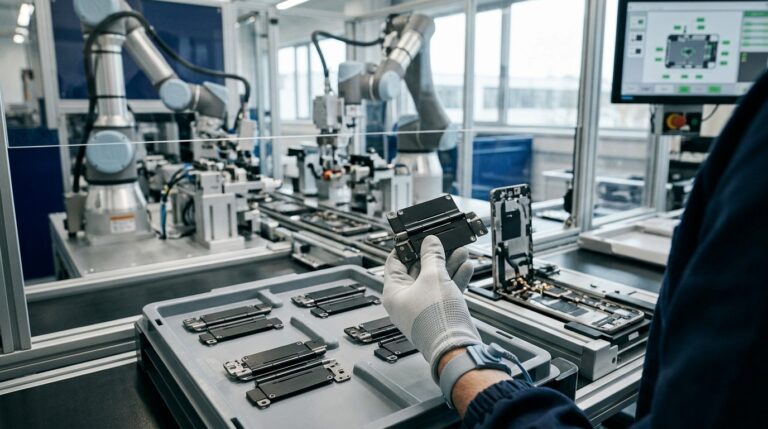
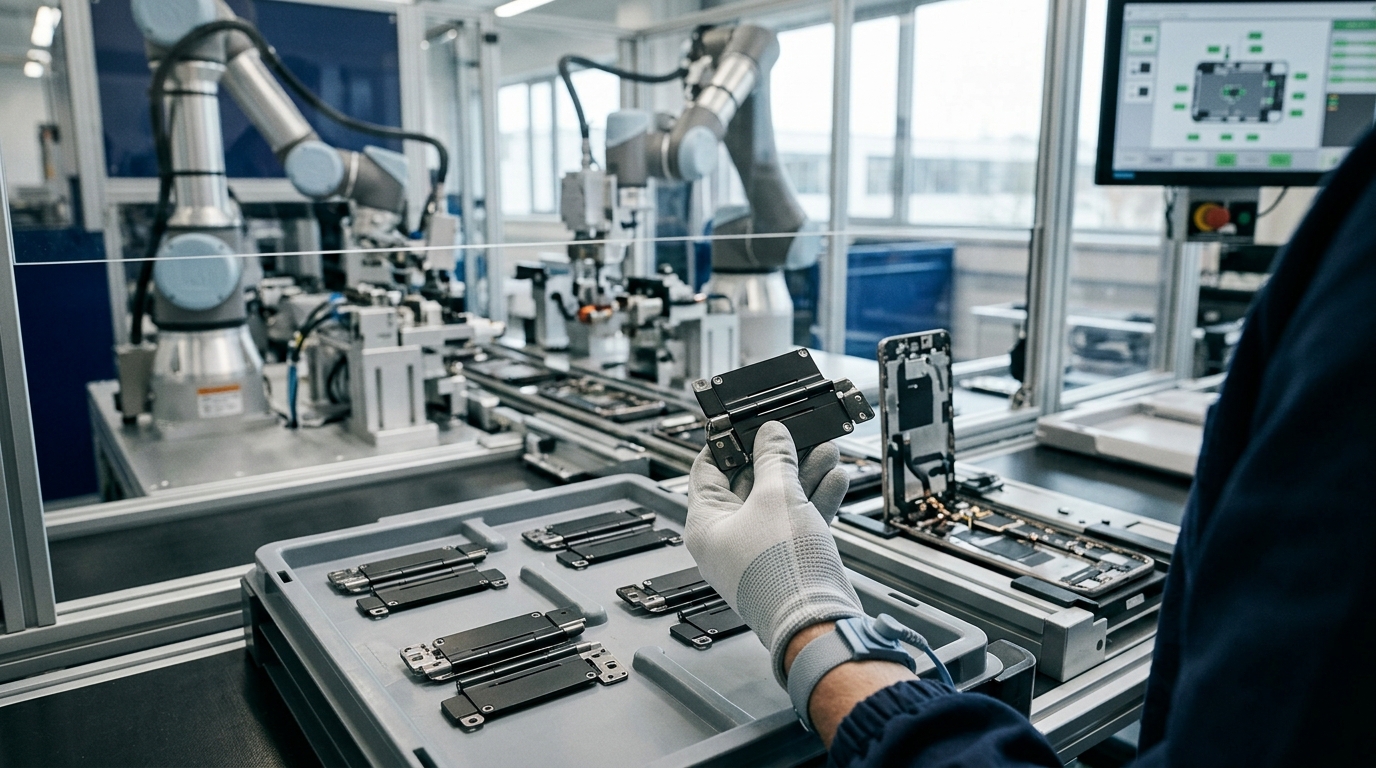
Apple’s first foldable iPhone is three weeks from going on sale, and it is already producing more scrap than usable phones. A person said to be close to Foxconn’s supply chain told China’s Jiemian News that final assembly yields for the iPhone Duo were only slightly above 60% as of September 17. One Foxconn supply-chain source reportedly said it could take another six months to a year for the line to reach a mature yield that meets Apple’s standards. The October 16 preorder date and October 23 launch have not moved.
Most coverage treats this as an Apple problem. It isn’t, at least not for investors. Apple at $3-plus trillion barely registers the math on a global stocking target of approximately six million to eight million iPhone Duo units during 2026. The better question is who gets paid more per phone specifically because the phone is hard to make. That answer points to Amphenol.
Why the Hinge Is the Bottleneck
The foldable OLED panel is supplied by Samsung Display and also suffered from low yield and arrived late. Korean outlet ZDNet reported that the hinge is the part holding up production most, and that its main supplier is the only one among the core component makers to have hit obstacles. Initially, Amphenol was supposed to be the main hinge supplier. Its production output reportedly fell short of Apple’s expectations, after which Apple increased the role of Taiwan’s Shin Zu Shing. Both remain in the supply chain, but the constraint itself reveals the value: the complex hinge incorporates more than 100 components beneath a 3D-printed hinge cover. There is no equivalent part in a conventional iPhone. At $1,999 per device, Apple cannot substitute it away.
On Apple’s side, final assembly goes to Foxconn, Samsung Display is the panel supplier, and hinge supply involves Amphenol and Shin Zu Shing. Every one of those suppliers collects a larger check per unit on the Duo than on a standard iPhone. Amphenol is the one you can trade.
The Business Behind the Ticker
Amphenol is not a foldable iPhone story. It is an AI infrastructure and defense interconnects story that the foldable iPhone joins as a catalyst. Revenue for the quarter ending June 30, 2026 was $8.76 billion, a 55% increase year-over-year. Revenue for the trailing twelve months ending June 30, 2026 was $29.0 billion, a 54% increase year-over-year. First quarter 2026 sales of $7.6 billion came in up 58% in U.S. dollars and 33% organically versus the prior year, with orders of $9.4 billion producing a book-to-bill of 1.24:1. That backlog number matters: demand is running well ahead of current output.
Amphenol reported Q2 adjusted EPS of $1.35, with revenue of about $8.8 billion on 55% year-over-year sales growth. The company has beaten consensus EPS estimates in each of its last four quarters. The board approved a two-for-one stock split in August 2026.
The Catalyst Stack
The timing is unusually clean. Preorders for the iPhone Duo open October 16. Amphenol’s next earnings date is expected to be October 28, 2026, before market open. That is five days after the foldable goes on sale. If launch demand is strong and management signals stronger hinge volumes in guidance, investors get a fundamental confirmation just as the consumer story is peaking in the press cycle.
What Could Go Wrong
Yield risk cuts both ways. If Apple relaxes quality thresholds to accelerate output, defect rates climb and Amphenol ships parts that come back as warranty claims rather than revenue. A separate report indicates that a primary contract manufacturer prompted Apple to choose between prioritizing production yield and expanding gross device output. Accelerating assembly lines could yield higher unit volume but risks accumulating defective hardware and inflating factory scrap expenses. There is also valuation. Amphenol’s growth is driven primarily by AI-driven datacom demand. The stock remains near highs after the company raised its outlook, while analysts debate whether the premium valuation is justified by the growth runway. A deceleration in AI hyperscaler spending would hit the core business harder than any foldable launch could offset.
The Bottom Line
The iPhone Duo’s 60% yield is a supply-chain problem today and a production-ramp opportunity over the next six to twelve months. The company at the center of the hardest-to-make component, with a book-to-bill above 1.2, a four-quarter streak of earnings beats, and a report expected five days after launch, is Amphenol. Apple gets the headlines. APH gets the margin per unit on a phone that costs twice as much to assemble as anything Apple has built before.