Editor’s Note: We’re delighted to bring you the latest stock pick from our colleague, Wall Street legend Marc Chaikin. You may recognize Chaikin’s name from frequent appearances on CNBC, Bloomberg or Fox Business. His client list has included billionaires such as Paul Tudor Jones, Steve Cohen, and George Soros. His Power Gauge system flashed bullish on Nvidia right before it rose 50,001%. And it just flashed bullish on another off-the-radar AI stock poised to trigger a $248 trillion “White Swan” event as soon as October 20. See below for Marc’s research and free recommendation.
Dear Reader,
I’ve uncovered the single best AI stock in the world.
And it could explode in value on or before October 20.
That’s the date I anticipate a major announcement.
It relates to a brand-new technology this company just launched.
A technology so powerful…
It could speed up AI breakthroughs 360 times over.
Breakthroughs in medicine, energy, quantum computing and AI itself…
Breakthroughs that were five years away…
Could come in just FIVE DAYS once this technology launches.
I’m talking about something I call AI “micro clusters.”
These are clusters of AI compute that will soon replace the massive data centers blotting the American landscape right now.
Micro cluster technology uses 99% less energy than data centers.
It takes up 99% less real estate.
Yet it’s more than 1 trillion times more powerful than today’s data centers.
Micro clusters are about to trigger this $248 trillion AI “White Swan” event.
Those who understand what’s coming could get very rich.
Those who ignore what’s coming could see their AI portfolios wiped out.
The good news?
One company has engineered the special chips that will power this breakthrough.
The U.S. government is pouring billions into this company’s account ahead of the launch.
And when this story breaks into the mainstream…
I believe billions, even trillions more dollars will flow into this stock.
→ It’s not Nvidia.
→ It’s not Apple.
→ It’s not SpaceX.
It’s an off-the-radar AI play that could explode on or before October 20.
The time to get in is right now.
So, I created this urgent presentation detailing the whole opportunity.
I explain the technology.
I take you “inside” the secretive lab where it’s being finalized.
And I even give you the name and ticker of the company behind the coming technology revolution.
Fair warning: This presentation contains time-sensitive information.
I may have to take it offline as soon as 12 midnight, tonight.
Good investing,
Marc Chaikin
Founder, Chaikin Analytics
P.S. The company I name in this presentation represents the future of AI. Its new technology is about to replace AI data centers when it comes to major AI breakthroughs. And it will, I predict, trigger a $248 TRILLION reboot of the AI markets… and one of the biggest moneymaking opportunities we’ll ever see… about 50 times bigger than the whole AI boom to date, in fact.
Go here for full details, including the company’s name and ticker. And if interested, I urge you to get in on or before October 20, when this company presents its latest findings at a major tech conference in Europe.
Heavy Industry Found a Better Grid Shock Absorber
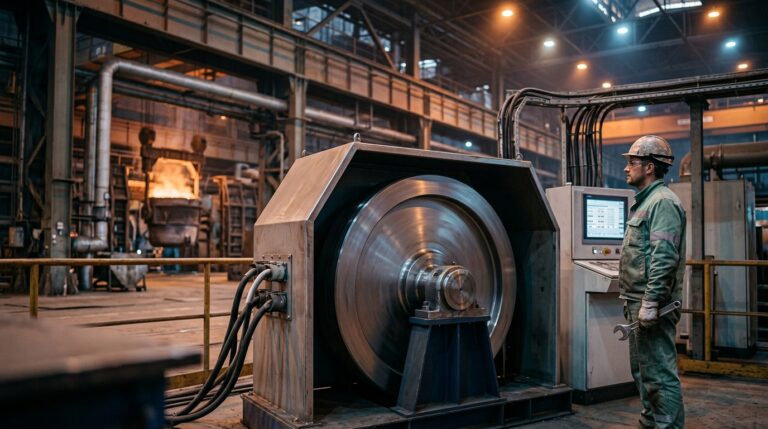
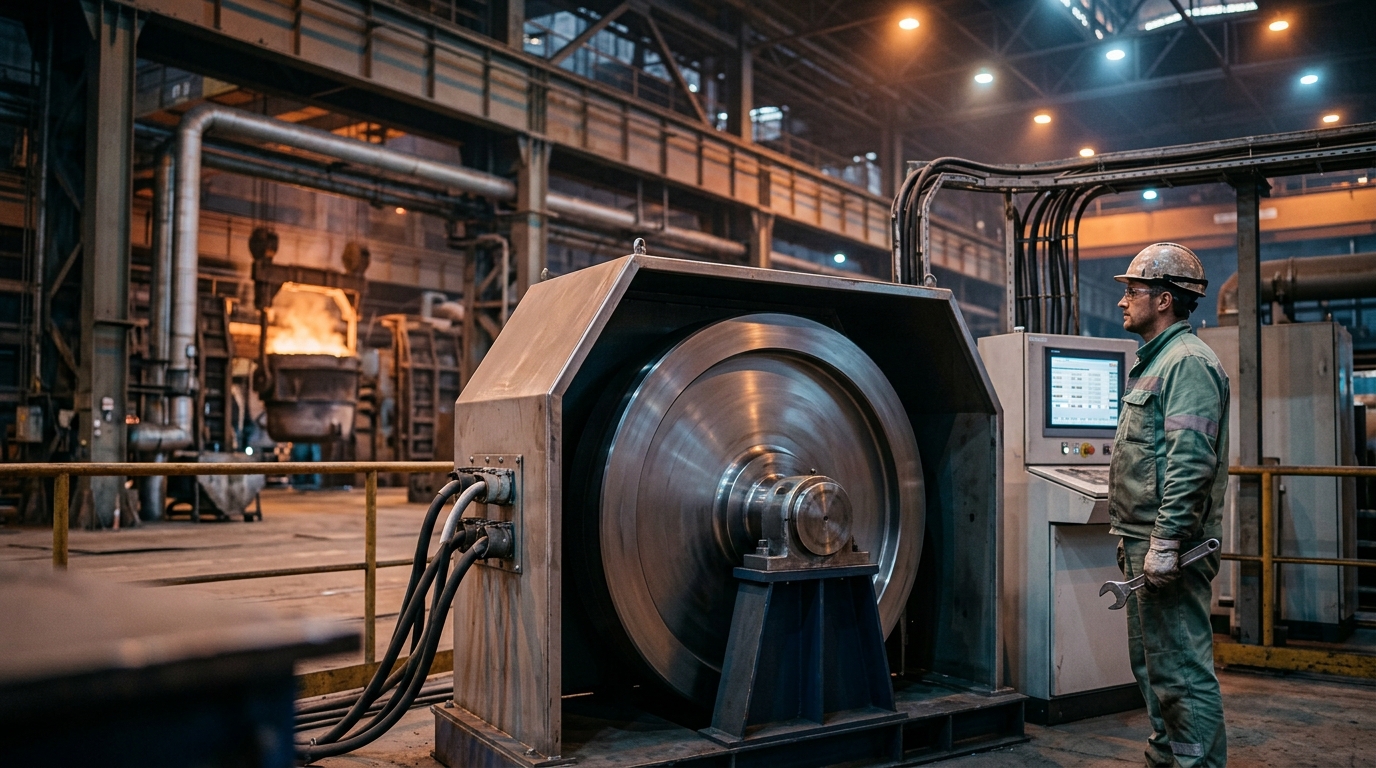
The question heavy industrial operators have been asking for three years is not whether to add storage. It is which storage actually survives the load environment on a steel mill floor, a port crane yard, or a cement works running kilns around the clock. The answer increasingly arriving on site is mechanical, not electrochemical.
The global flywheel energy storage systems market was valued at $527.8 million in 2025 and is projected to reach about $1.15 billion by 2033, driven by utilities, data centers, transportation networks, and industrial facilities seeking high-power, short-duration storage with rapid response and long operational life. That growth rate, 10.3% compounded annually, understates the urgency in the industrial segment, where the problem is not duration. It is spike amplitude and cycle count.
This is not about overnight load shifting. Flywheels release energy nearly instantaneously and are highly effective at supporting high-power, short-duration applications such as frequency regulation, voltage stabilization, and fast frequency response. For a port crane drawing 2 MW in under a second, or an arc furnace whose ramp demand can send a demand-charge meter into a higher tariff tier in a single event, that sub-second window is the only window that matters. Some flywheel systems can reach full power in under one second, and some designs advertise response in the millisecond range, while measured grid inertia over the past decade has declined by roughly 6% in the Eastern Interconnection and 15% in the Western Interconnection. Factories are now sitting on a grid with less buffer than it had five years ago.
The Underground Angle Changes the Economics
Electrifying a power-hungry industrial facility has collided with two realities: scarce yard space and demand charges that punish brief peaks. A familiar approach with flywheels is to site rotors in hardened enclosures, often below grade, partly for safety and siting flexibility. Below-grade installation can soften the footprint argument that blocks adoption at dense industrial sites, and it can reduce the thermal management burden that punishes surface-mounted battery enclosures in hot climates.
Gravity block systems are solving a different but adjacent problem. Gravity systems achieve bulk, multi-hour energy storage by using electric motors to raise and lower heavy weights: when the grid has surplus energy, the motor raises the weight; when energy is needed, the weight descends and drives a generator. Energy Vault has described EVx using large composite blocks, including blocks in the 25- to 30-ton range, made with waste-stream inputs in its materials concept. In May 2026, Energy Vault and Eskom announced a strategic development agreement tied to a gravity storage demonstration at Eskom’s Hendrina Power Station in South Africa, described as 25 MW of capacity and four hours of storage, equivalent to 100 MWh, with the platform positioned as scalable.
Where Batteries Still Win, and Where They Don’t
Flywheels handle short power spikes better than batteries alone; some developers are pitching hybrid architectures to cover both spikes and sustained loads. That hybrid architecture is the tell. No single technology covers the full load profile of a heavy industrial facility. Fast frequency response can require sub-second response, which is the domain of flywheels and other power-electronics-based resources, while peak shaving and renewable smoothing over two to four hours suits lithium-ion or flow battery systems.
The gravity battery market stood at $600 million in 2025, with demand expected to reach $800 million in 2026 and $6.5 billion by 2036, representing a projected CAGR of 23.1%. That trajectory reflects industrial buyers treating demand-charge exposure as a capital risk, not an operating annoyance. In many commercial and industrial tariffs, the highest 15-minute average demand interval can set the billing demand for the entire month, and some tariffs add demand ratchets that carry a prior peak forward. When one interval can reshape a month of charges, the return-on-investment calculation for a flywheel or gravity block system compresses from years to months.
The market is still early. Green Gravity has publicized work toward demonstrations of mine-shaft gravity storage systems, including projects tied to repurposing legacy shafts. But the direction is fixed. For heavy industry, the grid is no longer a reliable shock absorber. Operators are building their own.