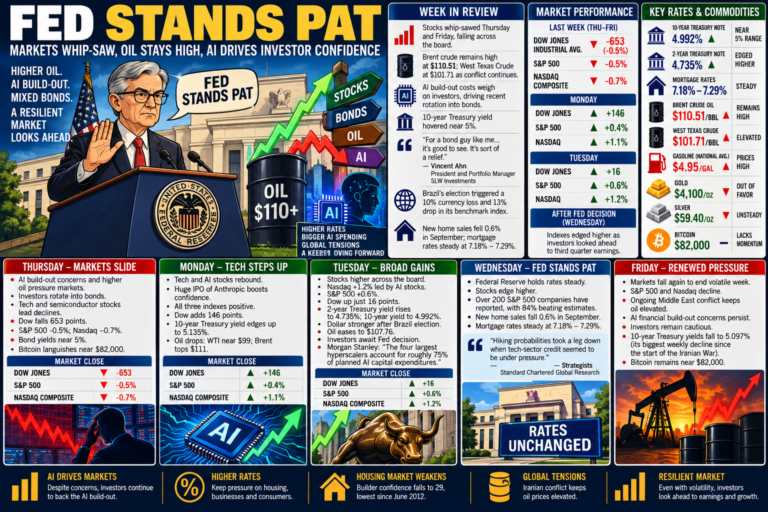
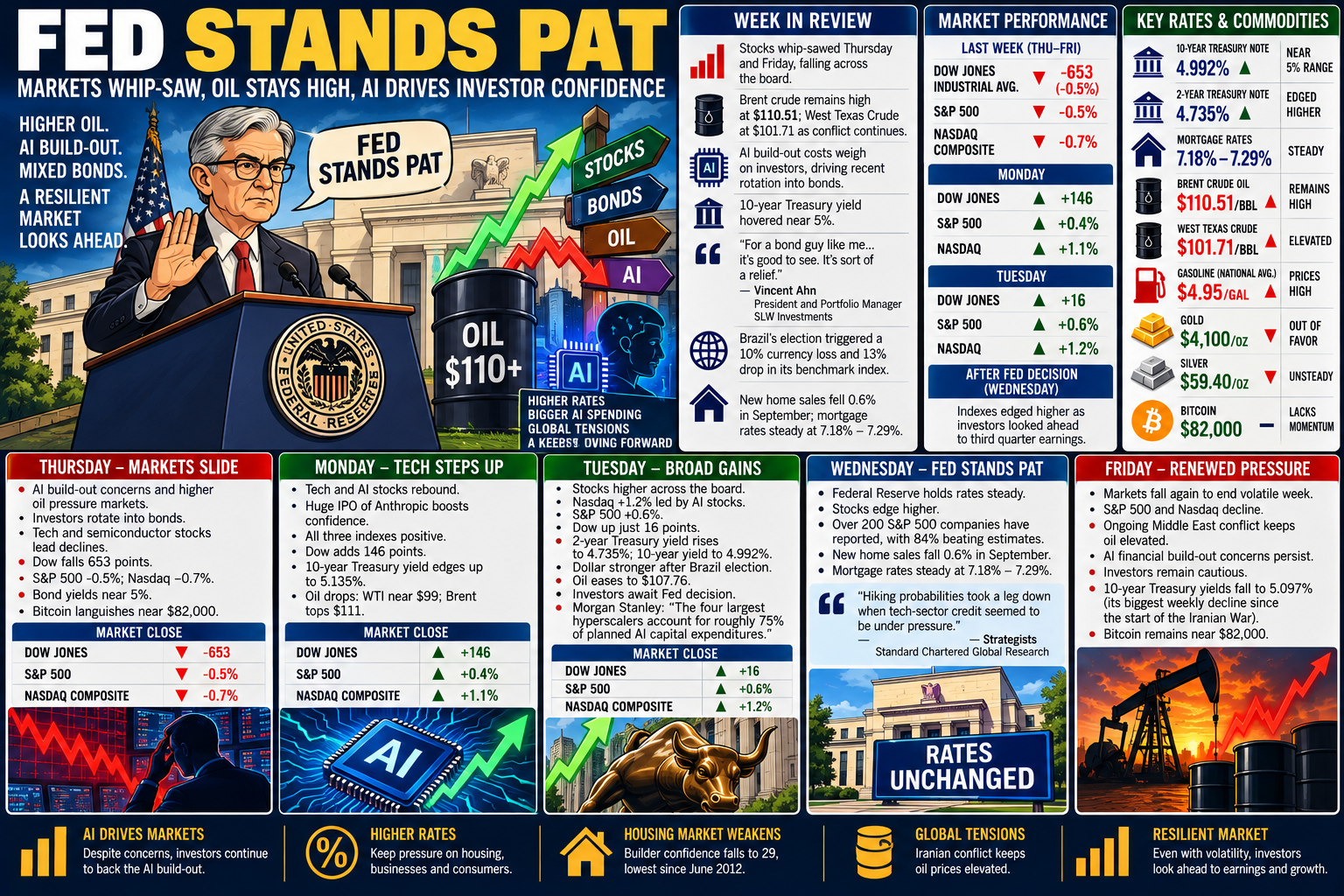
Last week was a barnburner, as stocks whip–sawed downward Thursday and Friday, pretty much across the board. The Dow Jones Industrial Average sank 653 points with both the S&P 500 and the heavy–tech Nasdaq Composite sliding 0.5% and 0.7% respectively. Accelerating oil and the artificial intelligence build–out, concerns mounted, driving the general market downward Thursday and heavier Friday. The artificial intelligence financial build–out outlays have deepened, weighing heavily on investors and traders as evidenced by recent rotation into bonds, namely the 10–year Treasury note, as yields recently have hovered in the 5% range. Said Vincent Ahn, president and portfolio manager at SLW investments; “For a bond guy like me….it’s good to see. It’s sort of a relief.” As the Iranian/U.S. conflict shows little signs of peace, and oil higher, inflation concerns are mounting. Brent crude remains high at $110.51 with West Texas Crude trading at $101.71 as fighting rages on in the war zone area.
Techs ‘stepped up to the plate’ Monday, with investors in a buying mood. The huge IPO of Anthropic did not dull any confidence as the AI sector buzzed with heavy buying. All three indexes were positive, with the Dow Jones Industrial Average up 146 points. The Bond market was mixed, with the short–term Treasury edging up a bit the day before the Federal Reserve’s policy meeting. Tuesday the steady–eddy S&P 500 was up 0.7% while the heavy–tech Nasdaq Composite gained 214 points. The benchmark 10–year Treasury note yield was cautiously up at 4.987%. The dollar was stronger against leading currencies, holding firm after the election of “left–wing incumbent Brazilian President Luiz Inacio Lula da Silva triggered a 10% currency loss.” The country’s “benchmark stock index dropped 13%, one of the biggest on record.” Benchmark crude dropped to $107.76 a barrel, reacting to “renewed U.S. diplomacy,” to bring about a peaceful solution in the Middle East conflict. West Texas Crude followed, easing back to $100 a barrel, as U.S. production levels were at near capacity. Even as the AI market expands with massive build–outs, requiring gigantic debt, and new huge IPOs on the horizon U.S. investors have ‘digested,’ and ‘taken in stride’ the implications, continuing to invest in the amazing sector. “Morgan Stanley strategists said in a note; “The four largest hyperscalers account for roughly 75% of planned AI capital expenditures. With average credit ratings of roughly AA, average market capitalization exceeding $3 trillion, diversified businesses, and long track records of profitability, they have ample capacity to issue more debt.”
Finally a two–day short streak for the embattled market as Tuesday was more of Monday as stocks across the board were higher with investors and traders putting aside market concerns, awaiting the Fed’s policy decision Wednesday. The Nasdaq led the market higher with a 1.2% gain, much of which can be attributed to the AI stocks it holds. The S&P 500 was up 0.6%, while the blue–chip Dow Jones closed near flatline, up just 16 points. Bonds were stronger with the 2–year Treasury yield rising to 4.735%, with the 10–year Treasury note yield edging up to 4.992%. “Hiking probabilities took a leg down when tech–sector credit seemed to be under pressure,” said strategists at Standard Chartered Global Research. The real estate market of “new home sales” fell 0.6% in September, with interest rates steady in the 7.18% to 7.29% area. As announced Wednesday, the Fed stood pat…..Stocks edged slightly higher as investors and traders were looking for 3rd quarter earnings. 3rd quarter earnings of over 200 companies in the S&P 500 index have so far posted results, with “84% bettering consensus estimates.”
RUMBLINGS ON THE STREET
Meryn King, Former governor of Bank of England, Barron’s – “The communications of a central bank need to focus on explaining its reaction function and developing a narrative about the state of the economy that changes over time meeting by meeting, report by report.”
Michael Feldman, Portfolio manager at Clearridge Investments, WSJ – “More and more these [AI] infrastructure related investments are driven by debt. At the same time you have rates rising. That’s posing some questions around “If rates keep going higher, how much more can these companies borrow?” “
Anders Persson, chief investment officer and head of global fixed income At Nuveen, WSJ – “All in all, I would say the market is taking this [The Fed’s stance of no rate hike] as less likelihood of aggressive hiking.”