For most of the last decade, owning the biggest technology stocks meant collecting an invisible dividend: relentless share buybacks funded by machines that generated cash faster than management could spend it. That model is ending. The numbers now say so explicitly.
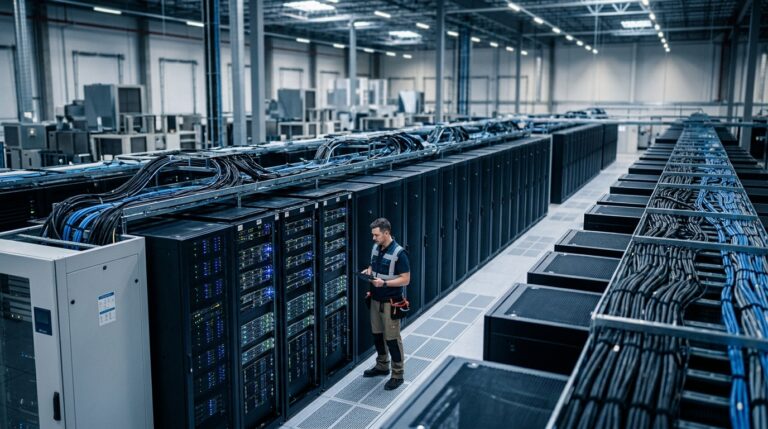
S&P Global Ratings projects that six major hyperscalers, collectively responsible for about $470 billion in capital expenditures in 2025, will reach about $870 billion in 2026 and $1.3 trillion in 2027. S&P Global Ratings expects all six to generate negative free operating cash flow in both 2026 and 2027, with recovery not projected until 2029. Five of the six are burning cash even as their spending climbs. Only Microsoft is projected to stay positive on free cash flow next year, and even that depends partly on how the company classifies its $329 billion in lease obligations.
What makes this week concrete is the pace of the commitments. On September 24, 2026, Akamai disclosed that total capital expenditures tied to its new $11.6 billion Anthropic agreement are estimated at approximately $5.5 billion, with roughly $1.7 billion added to 2026 capex immediately to pre-purchase critical supply chain components, including memory. That is a company buying hardware before it has revenue to show for it. The same logic is playing out at every level of the stack.
Epoch AI’s model, fitted on SEC filings from Q2 2023 through Q1 2026, finds operating cash flow across the major hyperscalers growing roughly 23 percent per year while cash capex grows roughly 70 percent per year. On current trends, Oracle has already crossed the point where capex exceeds operating cash flow, Amazon is crossing around now, Alphabet hits the line around Q1 2027, and Meta around Q3 2027.
The financing gap is being filled by borrowing and equity issuance at a scale tech companies have never attempted before. In the last 18 months, these companies have moved from almost fully self-funded capital spending to raising external capital at scale: incremental annual debt rose from 9 percent of capex in fiscal 2024 to 32 percent by mid-2026, and equity has returned to the funding mix, with Alphabet announcing an $84.75 billion equity raise in June 2026 and Oracle planning $40 billion of combined debt and equity for fiscal 2027. Alphabet’s most recent quarter was its first with negative free cash flow since the company went public as Google in 2004.
The shareholder consequence deserves more attention than it is getting. From 2010 to 2024, the hyperscaler group generated $2.7 trillion of operating cash flow and spent 39 percent of it on capex, leaving 61 percent available for buybacks and dividends. Capex is now projected to consume more than 90 percent of operating cash flow for the next several years, leaving almost nothing for capital returns. When a company issues equity to fund a data center, existing shareholders hold a smaller claim on future earnings. When it issues bonds, interest expense rises and the cushion under future buyback programs narrows.
This creates simultaneous equity dilution risk and investment-grade bond supply pressure, a double exposure most multi-asset portfolios are carrying without explicitly pricing it in. When hyperscalers issue new shares at scale, existing shareholders hold a smaller claim on future earnings, compounding the problem at valuations already above 32 times earnings.
The bull case is real: if Azure, AWS, and Google Cloud convert this infrastructure into durable AI revenue at the margins their CEOs keep describing, free cash flow recovers and the capex cycle looks prescient. The question is whether free cash flow recovers on the timeline implied by current valuations, and that is not settled. What is settled is the near-term arithmetic. The companies that quietly built wealth through buybacks are now writing checks their operations cannot cover, and the difference is coming from your index fund.
Wealth Takeaway: Before assuming the largest holdings in a broad index still function as cash-return compounders, check whether they are still generating the free cash flow that makes buybacks and dividends possible. The $1.3 trillion capex cycle has changed that calculation for most of them, and the recovery S&P Global Ratings models does not arrive until 2029 at the earliest.