The story on diesel right now is not just the price. It is who eats it.
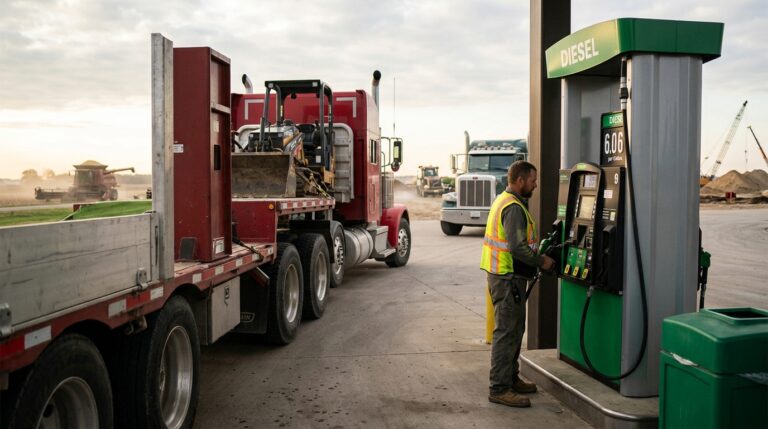
U.S. retail diesel crossed $6 a gallon last Friday for the first time on record, with AAA showing a national average of about $6.06, up from about $3.71 a year ago, a surge of a little over 60%. The spike has been tied to the Iran conflict and disruption risk around the Strait of Hormuz, plus tightening distillate supply as Ukrainian strikes have damaged Russian refining and Russia moved to restrict diesel exports this summer.
Then on Monday, President Trump posted that both Ukraine and Russia had agreed to stop hitting each other’s energy infrastructure. Kyiv immediately downgraded that to a proposal, not a deal, and the Kremlin has not publicly confirmed any reciprocal halt to strikes.
So the market is pricing a diplomatic headline that one of the two parties has not signed. That ambiguity matters enormously depending on which side of the diesel ledger you sit on.
Why This Stock Now
The downstream pass-through is the real investment story, and it cleaves the economy into two very different groups: those with contractual mechanisms to recapture $6 diesel, and those without any.
Trucking fleets with active fuel-surcharge agreements are the first category. DAT reported the average van fuel surcharge jumped from 41 cents to 61 cents per mile in March 2026 alone, the highest since late 2022. The formula is mechanical: the carrier’s contract indexes to the weekly EIA on-highway diesel number, the surcharge resets, and the cost lands on the shipper. Carriers in that position are not absorbing $6 diesel; they are billing it.
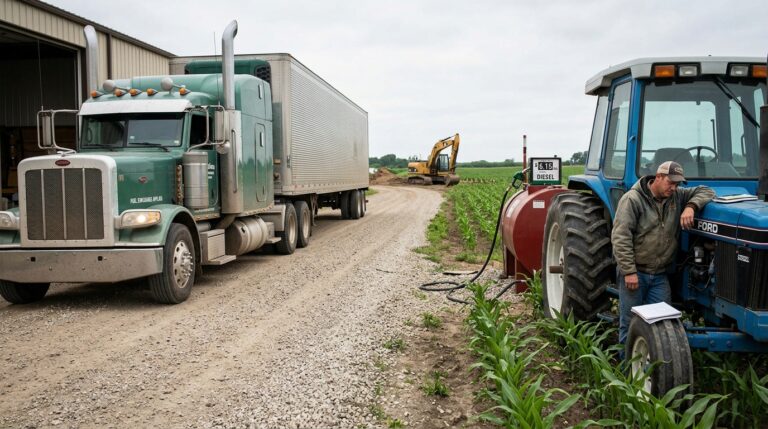
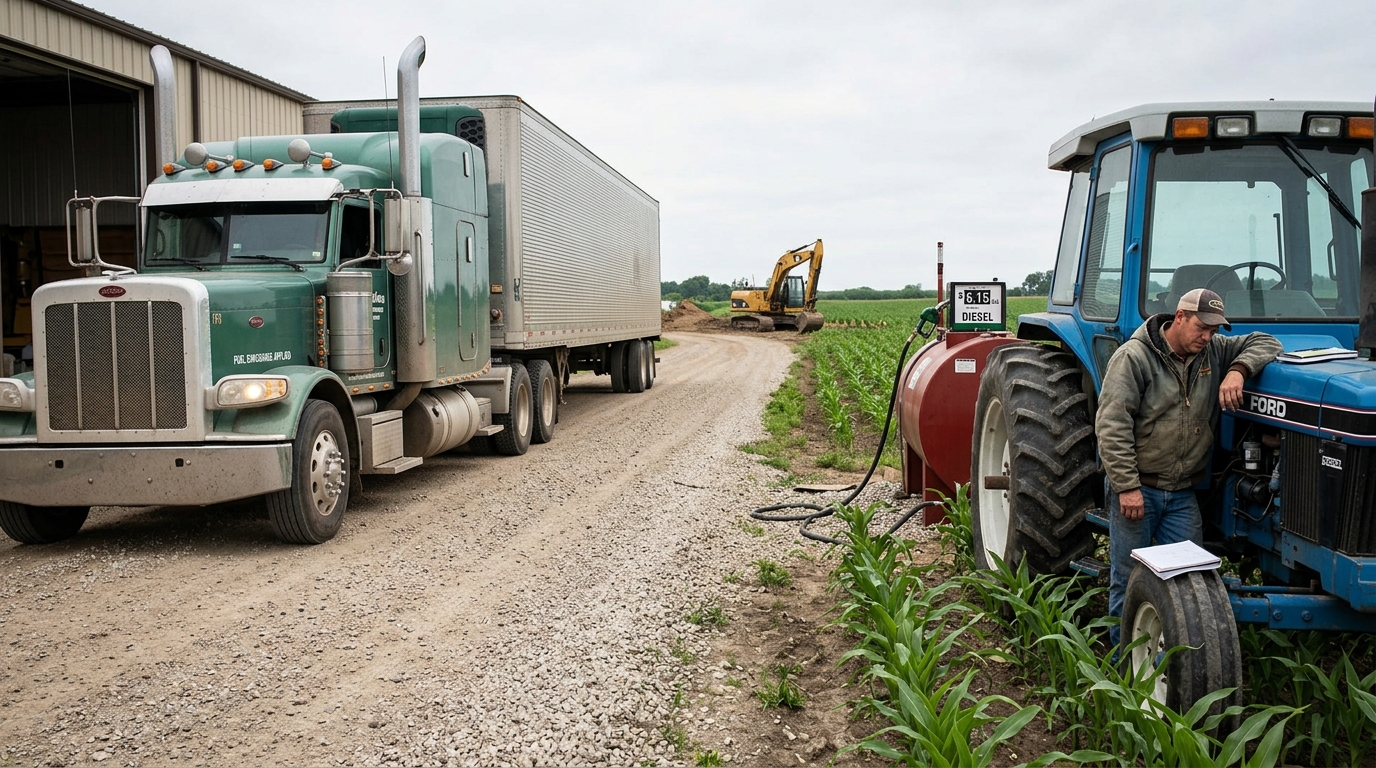
Farmers and construction operators are the second category, and they have no equivalent mechanism. One Missouri corn and soybean farmer said he was paying twice as much for diesel this year, with no commodity price offset to compensate. Diesel is not optional at harvest: it powers every tractor, combine, grain truck, and sprayer on the property. USDA data showed farm diesel at a record $5.41 per gallon in early May, already close to double year-ago levels, and pump prices have climbed further since then. Construction equipment operators are in an identical position: fixed-bid contracts, diesel-powered fleets, no surcharge language.
The Business
On the refiner side, this environment has been a windfall. The combined Q2 2026 profits of Marathon Petroleum (MPC), Phillips 66 (PSX), and Valero Energy (VLO) reached $12.6 billion, the highest since the post-invasion surge of 2022. Valero posted Q2 adjusted EPS of $12.54 against a $10.03 consensus. Marathon said it returned $2.8 billion to shareholders in the quarter.
The surcharge question cuts directly into the refiner thesis. A ceasefire in the Gulf that actually holds would push crack spreads sharply lower and take the refiners with it. The futures curve is also not treating today’s margins as permanent, with industry and government outlooks forecasting crack spreads to ease into 2027. Valero’s own sensitivity math makes this concrete: every $1 per barrel move in crack spreads corresponds to approximately $0.70 in per-share earnings impact, a figure that cuts both upside and downside.
What Could Go Wrong
Trump’s refinery truce claim is the clearest near-term risk to the refiner trade. Zelenskyy said Ukraine was willing to suspend strikes only if partners could ensure Russia genuinely refrains from hitting Ukrainian energy, infrastructure, and food routes, conditions the Kremlin has not accepted. Even a partial halt to Ukrainian drone campaigns would give Russian refineries time to repair, loosening the distillate market and compressing spreads. And the Hormuz disruption, the other leg of this supply crisis, is not addressed by a Russia-Ukraine truce at all.
For the sectors eating the cost without a surcharge pass-through, the risk runs the other direction: the longer $6 diesel persists through harvest season, the deeper the operating losses, with no diplomatic headline available to bail them out.
The Bottom Line
Valero is the most compelling single stock in this environment, specifically because of its scale, lowest-cost operator status among U.S. independents, and the mechanical sensitivity of its earnings to crack spreads that remain historically extreme. But the position demands honest sizing. The refinery truce, if it solidifies even partially, is a direct earnings headwind. Own it for the current tightness, watch the crack spread weekly, and treat any confirmed halt to Ukrainian refinery strikes as the signal to reduce exposure before the Q3 earnings release resets the stock.
The farms and construction sites absorbing this cost without a mechanism to pass it along are the economy’s warning signal. When their margin pain becomes broad enough, the demand destruction that finally breaks the diesel spike begins. We are likely not there yet. But that is the trade to watch on the other side.