
September 8, 2026
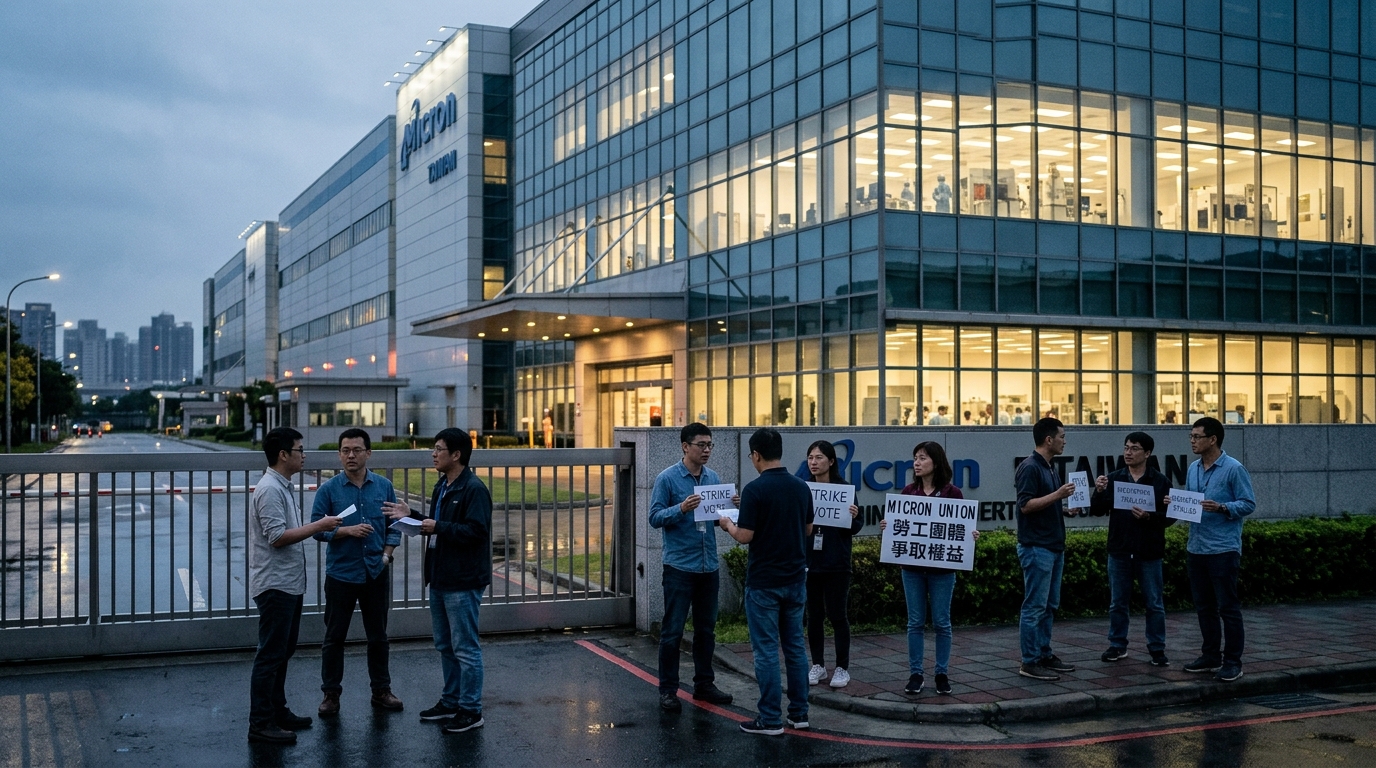
With 10,000 unionized workers demanding 15% of operating profit
Markets don’t need a strike to reprice Micron. They only need the credible threat of one, arriving three weeks before an earnings date that already asks the stock to justify a $50 billion quarter.
Jeff Bezos should be terrified.
He will be down on his knees, begging Elon for mercy.
Because Elon is set to:
Cut Amazon out of the AI race ENTIRELY… Completely DESTROY Blue Origin…And take control of the potential $25 TRILLION DOLLAR PER YEAR AI INDUSTRY.
And in his wake, potentially create 1,806,000 NEW millionaires over the coming years… Starting September 25.
And this is your chance to be one of them.
Micron faces a potential large-scale walkout at its Taiwan manufacturing base, with unions representing nearly 10,000 employees seeking changes to pay and profit-sharing terms following an AI-driven surge in profits. From fiscal 2027, the unions want Micron’s existing incentive plan replaced with a system that allocates 15% of operating profit to bonuses and distributes payments quarterly rather than annually. For fiscal 2026, the ask is more immediate: a one-off bonus the unions size at about 83 months of salary per Taiwan-based employee.
Micron held its first mediation meeting with the Taoyuan union on September 4, 2026. Although both parties have scheduled a second mediation session, the strike alert has not been fully lifted. If mediation ends without agreement, the unions can petition for a formal strike vote, but winning requires a majority of all union members in a secret ballot, not just a majority of those who show up.
What Is Actually at Stake in Taiwan
Micron has not disclosed a single percentage for how much of its global production sits in Taiwan, and it does not break out HBM output by geography. What is clear from the company’s filings is that Taiwan is Micron’s largest concentration of long-lived assets by country, at about $10.7 billion, reflecting the scale of its local manufacturing footprint.
The workers weighing a strike sit at the center of a business currently running operating margins around 80%. At margins like these, almost every dollar of lost revenue would come straight out of profit.
The unions’ framing is rooted in competitive arithmetic. Samsung’s semiconductor division and rival SK hynix reportedly pay bonuses worth 10.5% and 10% of operating profit, respectively. Micron’s Taiwan bonuses have reportedly run about 2.6 months of salary, under a plan capped near five months. That gap is the engine driving this dispute. Micron’s Taiwan office has said this year’s performance-bonus payout would be the highest in the company’s history, but the unions want a structural formula, not a discretionary record.
AI CEO Issues Code Red: Prepare for Meltdown
The CEO of this AI company (click here to get the name, 100% free) just issued a CODE RED in an internal memo…
Warning his employees that they’re dealing with a critical situation.
Another company executive even implied they might need a government bailout.
And now Jim Rickards is predicting this company is about to go bust, in a full-blown AI meltdown that could be 10 times bigger than Lehman Brothers.
The Earnings Equation on September 30
Micron guided fiscal Q4 to $50.0 billion of revenue, plus or minus $1.0 billion, with gross margin around 86%, and non-GAAP EPS of $31.00, plus or minus a dollar. In fiscal Q3, revenue grew about 346% year over year and beat consensus by $5.64 billion. The bar for September 30 is high by construction. Wall Street is looking for $50.8 billion, above even Micron’s own midpoint guide.
This is not about whether Micron will beat. It is about what the fiscal 2027 guide says, and whether a Taiwan production risk attaches to that guide before anyone models it. Micron has said it is in high-volume production of HBM4 designed for Nvidia’s Vera Rubin platform. Even a relatively short production disruption could have repercussions far beyond Micron. DRAM and NAND supplies are already tight as manufacturers prioritize AI-oriented products.
Options Market Analysis
As of September 7, 2026, MU closed at about $1,016. Recent options flow shows put volume around 201,000 contracts against call volume near 377,000, producing a Put/Call ratio of 0.53. Call volume is running more than 1.8x puts, a skew that reflects optimism around the earnings beat rather than hedging against labour disruption. The options market is priced for a clean report, not a contested factory floor.
Historically, implied volatility around Micron earnings has suggested a move near 8.8% in either direction, with the median move over the prior eight quarters running 8.3%. At $1,016, an 8.8% expected move places the one-standard-deviation range roughly between $924 and $1,106. A Taiwan walkout that halted even two weeks of production from facilities generating the bulk of Micron’s HBM output would not be contained inside that band.
Structured Trade Framework
Bull case: Mediation reaches a settlement before mid-September, Micron delivers Q4 revenue at or above $50.8 billion, and the fiscal 2027 guide surprises to the upside. For traders expecting resolution and beat, a defined-risk call spread expiring in October captures upside without full exposure to a gap event. A $1,050/$1,150 call spread would be one structured expression.
Inside the Nuclear Revival Reshaping Energy Markets
Governments worldwide are investing billions to revive a proven energy source. Supply chains are tightening, demand is rising, and select companies stand to benefit. The Nuclear’s Second Act report explains what’s happening next.
Bear case: Second mediation fails this month, a strike vote is authorized before September 30, and the Q4 guide carries a supply-disruption qualifier. A put spread in the $950/$880 range, expiring after the earnings date, would define the downside without requiring precise timing on the labour outcome.
Neutral case: The dispute stays in mediation through the earnings date, IV compresses post-report, and the stock moves inside the expected range. A defined-risk iron condor centered on the current price, with wings beyond the 8.8% expected move, monetizes elevated pre-earnings IV without taking a directional view on the labour outcome.
Risk Analysis
The asymmetry here favors hedges. Resolution is more likely than a full walkout: the dispute echoes a showdown at Samsung in South Korea, where a planned 18-day strike involving as many as 48,000 union members was called off in May 2026 after last-minute negotiations. But a Samsung-style settlement also carries a cost. If Micron agrees to a richer profit-sharing formula for its Taiwan workforce, employees at the company’s facilities in other countries may push for similar treatment. Either outcome adds to the operating cost structure heading into fiscal 2027.
MU shares slid from a post-Q3 peak above $1,200 to around $933 in late August before recovering above $1,000. The recovery is real, but the labour variable is not yet priced into the IV surface entering the most consequential report of Micron’s fiscal year.
Action Checklist
- Monitor mid-September mediation outcome: a second failed session increases walkout probability before September 30.
- Track put/call ratio weekly into earnings. Any shift above 0.75 signals institutional hedging of the labour risk, not just earnings uncertainty.
- Size any directional position around the 8.8% historical expected move. The labour overlay widens the realistic tail.
- Watch SanDisk (SNDK) and SK hynix as supply proxies: tightening spreads in HBM pricing post any Taiwan disruption would confirm contagion into the broader memory complex.
- If IV rises sharply in the week before September 30, defined-risk spreads become more attractive than outright long options, since elevated premiums compress the probability-adjusted return.