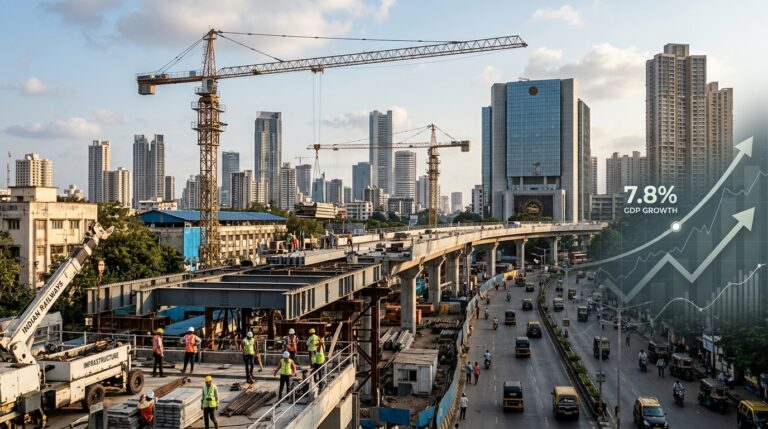
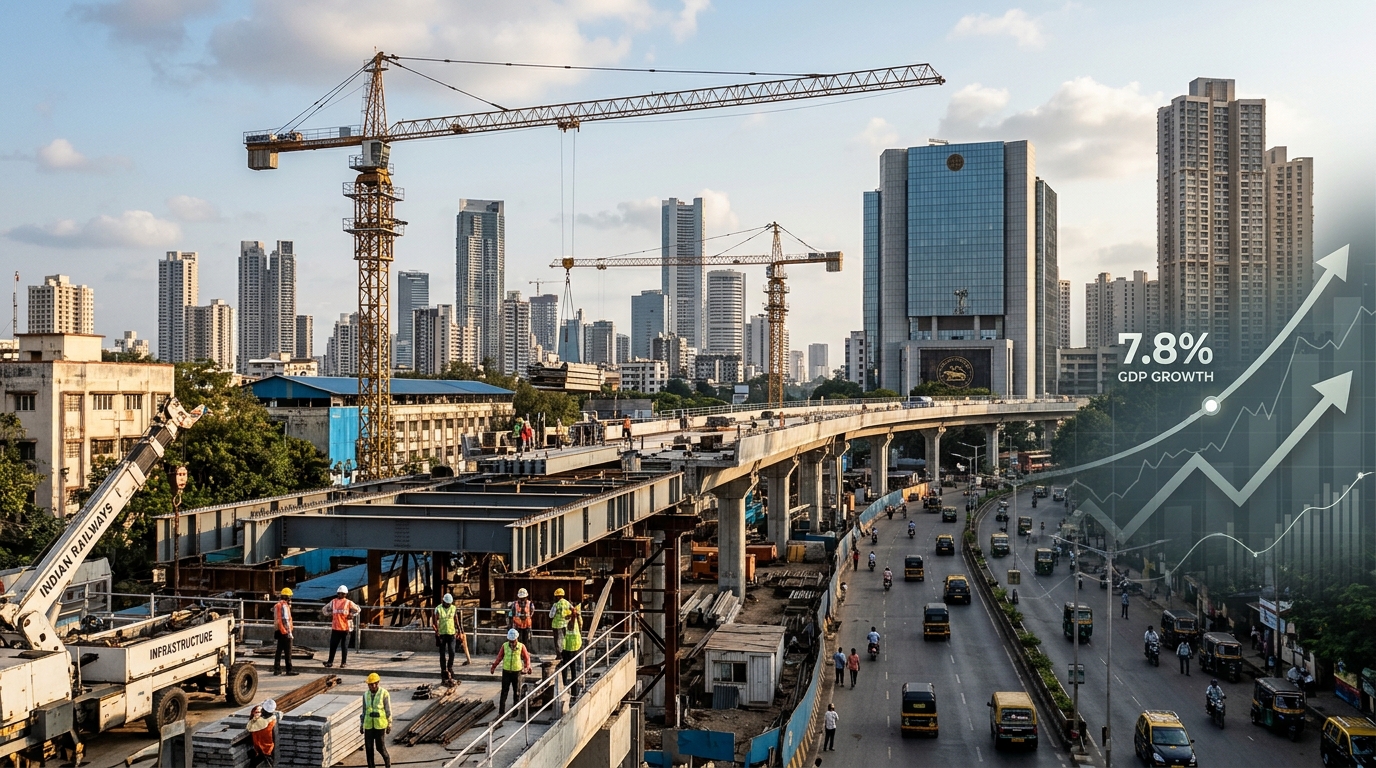
Monday brings the official verdict on India’s July-September GDP, and the numbers being floated by the country’s sharpest research desks are uncomfortably high for a central bank that is already tightening. India Ratings and Research puts Q2 FY27 GDP growth at 7.6%, driven primarily by investment. SBI Research is more aggressive: its dynamic factor model, drawing on 54 high-frequency indicators across agriculture, industry, and services, points to growth of about 7.8%. Both readings sit well above the Reserve Bank of India’s own projection of 7.2% for the quarter and 7.1% for the full financial year.
Ind-Ra’s chief economist noted that India is on course to record more than 7% growth for the sixth consecutive year, with average annual expansion of around 7.8% over the FY22-FY27 period. That is not a cyclical blip. It is a structural story, and the composition of this quarter’s growth makes it more durable than the headline figure alone suggests.
Investment Is Doing the Work
What distinguishes FY27 from earlier growth spurts is where the momentum is coming from. India’s real GDP grew 7.8% in Q1 FY27, with investment and exports emerging as the key drivers; real gross fixed capital formation grew 11.9% and exports grew 12.0%, compared with 7.1% growth in consumption. That matters enormously. Consumption-led growth is easier to replicate and quicker to fade. Investment-led growth builds productive capacity that compounds over years.
State governments are emerging as a new engine of this investment cycle, with their spending growth now outpacing that of the central government. On the corporate side, capital expenditure by BSE 500 companies is expected to increase 11% in FY27. The investment cycle is broadening, which is precisely what long-term investors should want to see.
Then Comes the RBI on Friday
The complication is monetary policy. The RBI raised the repo rate by 25 basis points to 5.50% at its October 2026 meeting, in a unanimous decision. The October resolution changed the stance to calibrated tightening and signaled that rate cuts are off the table in the near term, with policy action ahead limited to a hike or a pause.
Over 90% of economists in a Reuters poll expect the RBI to raise the repo rate to 5.75% in December, as policymakers weigh elevated inflation against risks to growth and financial stability. Nomura has gone further: the bank raised the possibility of a 50-basis-point increase to 6% at the December 4 meeting, citing the sharp rise in food prices in November as the primary reason for its revised assessment. October retail inflation came in at 6.09%, above the RBI’s 6% tolerance band.
For equity investors, this is where the opportunity sharpens. A rate hike is largely expected. What is not fully priced is what strong investment-driven growth means for Indian corporate earnings over a multi-year horizon.
Building the Case for Indian Equities
India’s 7.8% Q1 FY27 GDP growth and recent upgrades by multilateral agencies reinforce a constructive macro outlook, and fund managers expect Nifty 50 earnings to grow by roughly 10-12% year-over-year in FY27. Valuations of large-cap Indian equities remain mixed, with the Nifty 50 trading below long-term averages. That is a rare combination: above-trend growth, broadening investment, and an index that is not expensive by its own history.
HDFC Bank is worth watching here specifically. India’s largest private sector lender has returned nearly 24% to investors so far in November 2026, outperforming the Nifty 50. Anup Bagchi took over as CEO and managing director from Sashidhar Jagdishan on October 27, and JPMorgan rated the stock Overweight following its underperformance against peers earlier in the year, citing an attractive risk-reward. A new management team at a discounted valuation, inside a banking sector that benefits directly from infrastructure-driven credit demand, is precisely the kind of contrarian long-term position India’s macro story supports.
The Wealth Takeaway
Near-term rate volatility around Friday’s RBI decision is real. But the more important signal is structural: India’s growth is being built on capital formation rather than consumer borrowing, state spending is accelerating alongside the Centre’s, and corporate investment is broadening sector by sector. Economies that grow at 7-plus percent on the back of productive investment, rather than stimulus, tend to reward patient equity investors over five-year periods far more than any single policy meeting. Monday’s GDP number and Friday’s rate decision are data points. The investment cycle underneath them is the thesis.