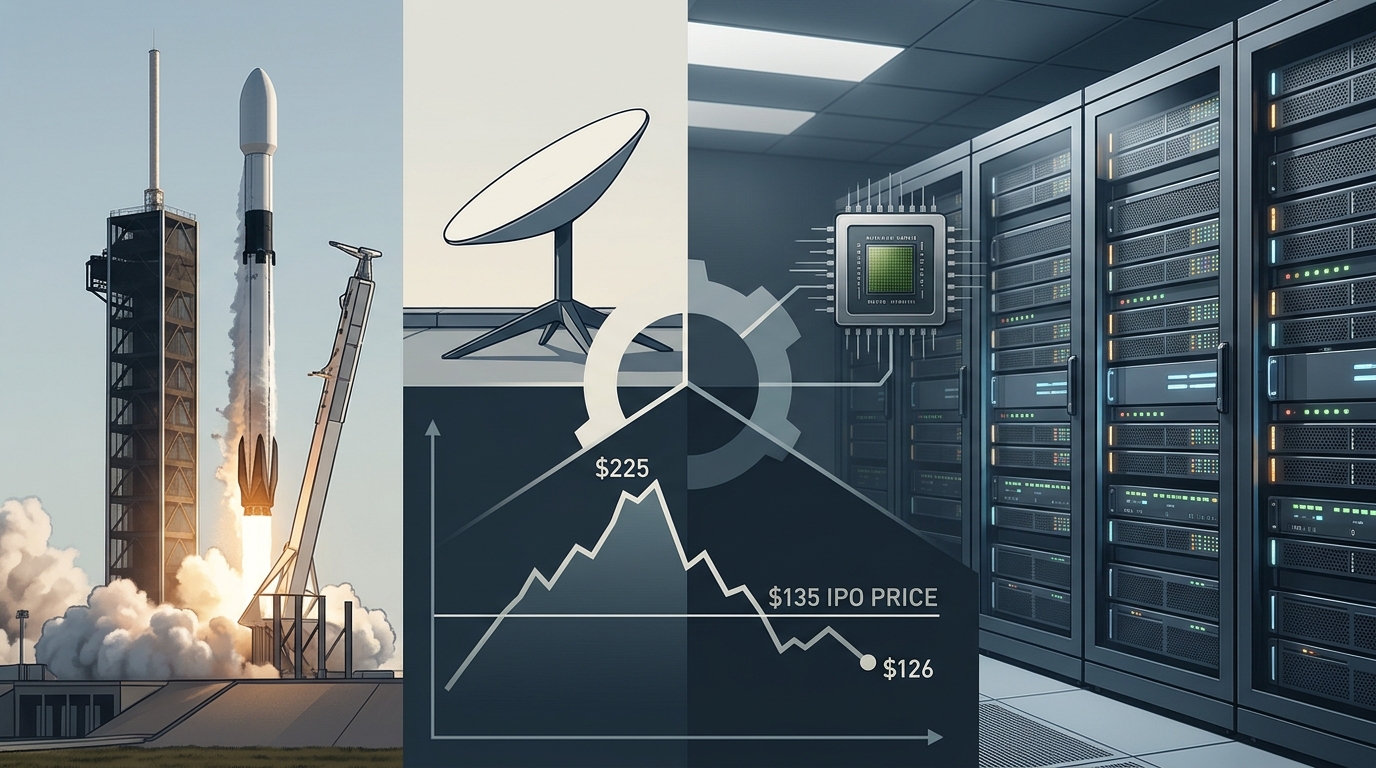
SpaceX went public at $135 in June, hit $225.64 within days, and is now trading around $126. That round trip is not simply a story about hype cooling. It is a story about which of three distinct businesses investors are willing to pay for, and which one they are quietly walking back from.
Three Businesses, One Stock Price
To analyze SPCX properly, you have to separate the businesses inside it. The first is launch: Falcon 9, Falcon Heavy, and an increasingly operational Starship. Starlink made up about 61% of 2025 revenue, with the Space segment around 22%. These are real, proven cash-generating operations.
The second business is Starlink. Starlink had 13.6 million consumer subscribers as of September 30, 2026, and SpaceX reported $11.387 billion of Connectivity segment revenue and $4.423 billion of Connectivity segment income from operations in 2025. This business has the financial quality a disciplined long-term investor can underwrite: recurring subscribers, expanding margins, genuine barriers to replication.
The third business is computing in orbit. SpaceX reported third-quarter 2026 revenue of about $14.6 billion, with its Super Intelligence (SI) segment generating $7.56 billion, up from $813 million a year earlier. Those numbers are real, but the capital being committed to get there is extraordinary. Of $19.593 billion in total capital spending in Q3, $16.444 billion went to the SI segment as the COLOSSUS II buildout continued. Growth that burns capital at that rate requires the debt markets to cooperate.
What the Bond Market Said
Last week, they cooperated, but at a price that tells you everything about the third business.
Project Saturn is SpaceX’s GPU-backed financing tied to acquiring Nvidia’s next-generation Vera Rubin systems. A vehicle called Saturn Funding Trust issued asset-backed notes, and the structure is designed so a bankruptcy-remote entity buys the equipment and leases it to SpaceX for roughly five years, keeping the debt off SpaceX’s balance sheet.
Pricing details by tranche varied, but the core message was consistent: lenders demanded a meaningful premium versus plain-vanilla investment-grade corporate credit. You are being asked to accept lower structural risk in a secured, equipment-backed deal and still being paid more. That gap is the market’s honest assessment of orbital computing as a business.
The collateral dispute made explicit what the yield implied. Reports around the deal noted that some lenders were uneasy about the idea that the Nvidia collateral could be launched into orbit, where recovery would be impractical if SpaceX defaulted. AI chips compound the risk. Newer chip generations arrive quickly, eroding resale value. Lenders therefore have a strong incentive to keep collateral accessible now, not theoretically recoverable at some later date in low Earth orbit.
The Mogul Mindset
Charlie Munger built his reputation on a simple question: does the business model make sense? The launch business does. Starlink does, with compelling network effects and switching costs that only grow as the constellation expands. Orbital AI compute does not yet, at least not on terms lenders will accept without a meaningful premium over comparable-rated paper.
SPCX closed at $127.79 on November 20, 2026, after a one-day loss of 7.69%, leaving shares 5.3% under the $135 IPO price. With SpaceX’s board and Tesla’s board each having formed special committees to evaluate a potential business combination, that structural overhang adds another variable to an already complicated capital allocation story.
The Long-Term Verdict
The launch and Starlink businesses alone justify serious long-term interest. The third leg, orbital compute, is real as a vision and genuinely large as a market. SpaceX’s own IPO prospectus describes it as “the largest actionable total addressable market (TAM) in human history.” But a lender demanding that Nvidia chips stay earthbound as collateral is making a specific, practical statement: they will finance the ambition only as long as the hardware is recoverable. That is not a reason to dismiss the orbital compute story. It is a reason to weight it correctly, as an option on a future that remains early-stage rather than a business you are paying full value for today.
The stock below its IPO price is not a screaming buy. It is an invitation to be precise about what you are actually buying.