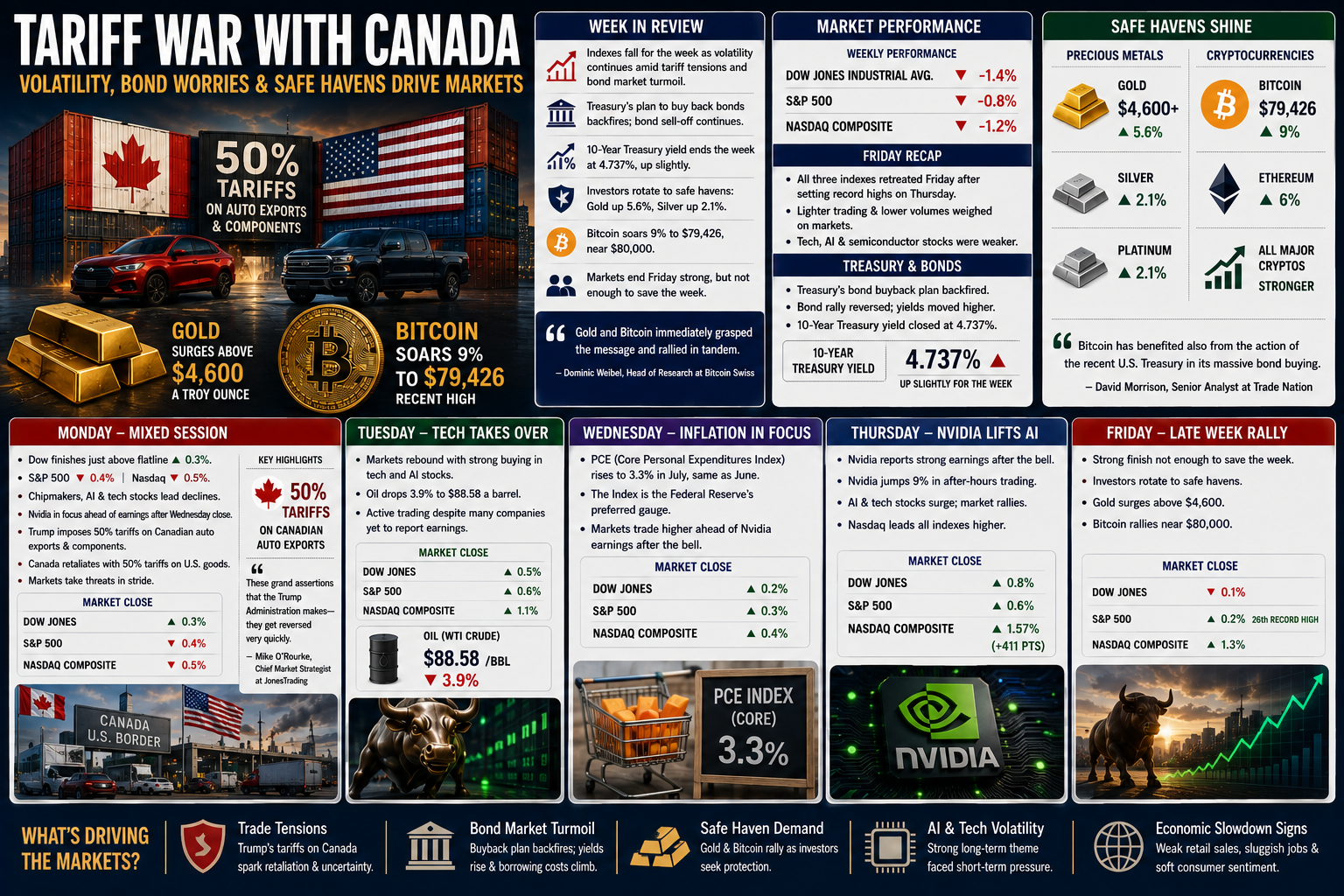
A good ending Friday to a ‘topsy–turvey’ market week was not enough to salvage the indexes. All the three ‘barometers’ were off with The Dow Jones Industrial Average and S&P 500 down 1.4% and 0,8% respectively. The heavy–tech Nasdaq Composite led the fall–off, down 1.2% as tech and AI and semiconductor stocks were weaker in lighter trading and lower volumes. Secretary of the Treasury Scott Bessent’s attempt to “buy–back” bonds to sure–up the sliding bond market backfired. “By week’s end the bond rally turned, defying the Treasury Secretary’s radical ill–timed plan. “The roughly $31.5 trillion U.S. Treasury market is regarded as the world’s biggest and most important bond market.” The 10–year Treasury bond yield finished Friday at 4.737 according to TradeWeb, up slightly for the week. Bitcoin and precious metals came ’alive’ as both sectors soared higher at week’s end with gold jumping above $4.600 a troy ounce. Investors and traders ‘wary of the Treasury’s plans to expand the bond buyback abruptly swung into gold and bitcoin, driving both to large gains. “Gold and Bitcoin immediately grasped the message and rallied in tandem,” said Dominic Weibel, head of research at Bitcoin Swiss. Many investors rotated to ‘safer havens’ as the continued bond sell–off threatened, weakening the dollar. Gold was up 5.6% for the week, with silver and platinum up 2.1%, benefiting all precious metals. Likewise crypto currencies were stronger with bitcoin soaring 9% to a recent high of $79,426, a level not seen since May of 2026 settling near $80,000 a coin according to Coindesk data. All crypto currencies were stronger buoyed by its leader… Bitcoin. “Bitcoin has benefited also from the action of the recent U.S. Treasury in its massive bond buying,” said David Morrison, senior analyst at Trade Nation.
Monday’s market was mixed as both the S&P 500 and tech–heavy Nasdaq fell, while the ‘blue–chip’ Dow Jones Industrial Average finished just above flatline, up 0.3%. Chipmakers, artificial intelligence, and related technology stocks led a downward session, as market focus centered on Nvidia as the giant AI leader is due to release 2nd quarter results after Wednesday’s closing. A seven day stretch of declining AI and semiconductor stocks have stalled what was a streaking market. President Trump’s stinging imposition of 50% tariffs on Canadian exports of automobiles and components has dampened U.S. Canadian relations. Canada Premier Mark Carey has retaliated (tit–for–tat) imposing 50% tariffs on U.S. goods to counter U.S. intentions. Investors and traders took the threats in stride. “These grand assertions that the Trump Administration makes–they get reversed very quickly,” said Mike O’Rourke, chief market strategist at JonesTrading. He added, “From a market perspective, they tend to get ignored.” Secretary of the Treasury John Bessent announced; “A plan to inflict an economic D–Day on Iran, sanctioning more than 60 entities, individuals and vessels across the world that would enable the regime to procure nuclear and missile technology.” The aggressive move comes after the Trump Administration has eased back on the use of the military. The 10–year Treasury note slipped a bit to 4.703% from 4.737% on Friday’s close.
Tuesday market was the opposite of Monday as technology took over. Trading was active even as several large market performers have yet to release quarterly results. Investors turned to tech and AI stocks, seemingly assured that the future growth and earnings would not disappoint. Oil dropped 3.9% to $88.58 a barrel. Wednesday’s release of the PCE (Core Personal Expenditures Index) came in as expected, rising to 3.3% in July, same as June. “The Index is the Federal Reserve’s preferred gauge.” After the bell Nvidia released strong earnings, and sales numbers, boosting the stock 9% on Thursday, and giving the entire AI and related techs great optimism. The Nasdaq Composite led the indexes, up 1.57%, or 411 points.
RUMBLINGS ON THE STREET
Lawrence Gillam, chief income strategist for LPL Financial, WSJ – “[Referencing the Treasury’s buyback of bonds]: ”This is a band–aid. This doesn’t really fix the problem.”
Scott Davis, Melius Research, Barron’s – “Coming out of Covid–19 we went into a period of rolling recession. Now in the industrial world, we’re coming into an era of rolling revenues.”
Ole Hansen, head of commodity strategy at Saxo Bank, WSJ – “Gold’s ability to rally despite historically elevated long end yields suggests investors are looking beyond the traditional opportunity–cost relationship and focusing instead on the sustainability of government borrowing.”