September 8, 2026
Bonus Content: Amazon’s Cargo Crash Did Not Move Its Stock. That Is the Story.
Is the AI Boom Opening a New Resource Window?
The biggest AI stories are getting almost too big.
Anthropic is reportedly moving toward a blockbuster public debut. OpenAI has been discussed in trillion-dollar terms. Nvidia has already become the most valuable company on Earth.
Exciting? Absolutely.
Accessible? Not always.
By the time most retail investors hear about the biggest AI names, the early money has often already been made by venture funds, institutions, and insiders with access long before the public market arrives.
But AI still has bottlenecks. And bottlenecks can create new openings.
AI desperately needs data centers. Those data centers need electricity, cooling, transformers, substations, grid upgrades, and millions of pounds of copper. One Microsoft data center reportedly used more than 4.8 million pounds of copper. Now thousands more data centers are planned.
That is why the resource layer behind AI is worth a closer look.
One small North American copper story may give retail investors a more accessible angle on the AI buildout while the market is still focused on trillion-dollar tech names.
The mega-cap AI trade may already feel crowded.
But there are still ways to follow the next phase.
Amazon’s Cargo Crash Did Not Move Its Stock
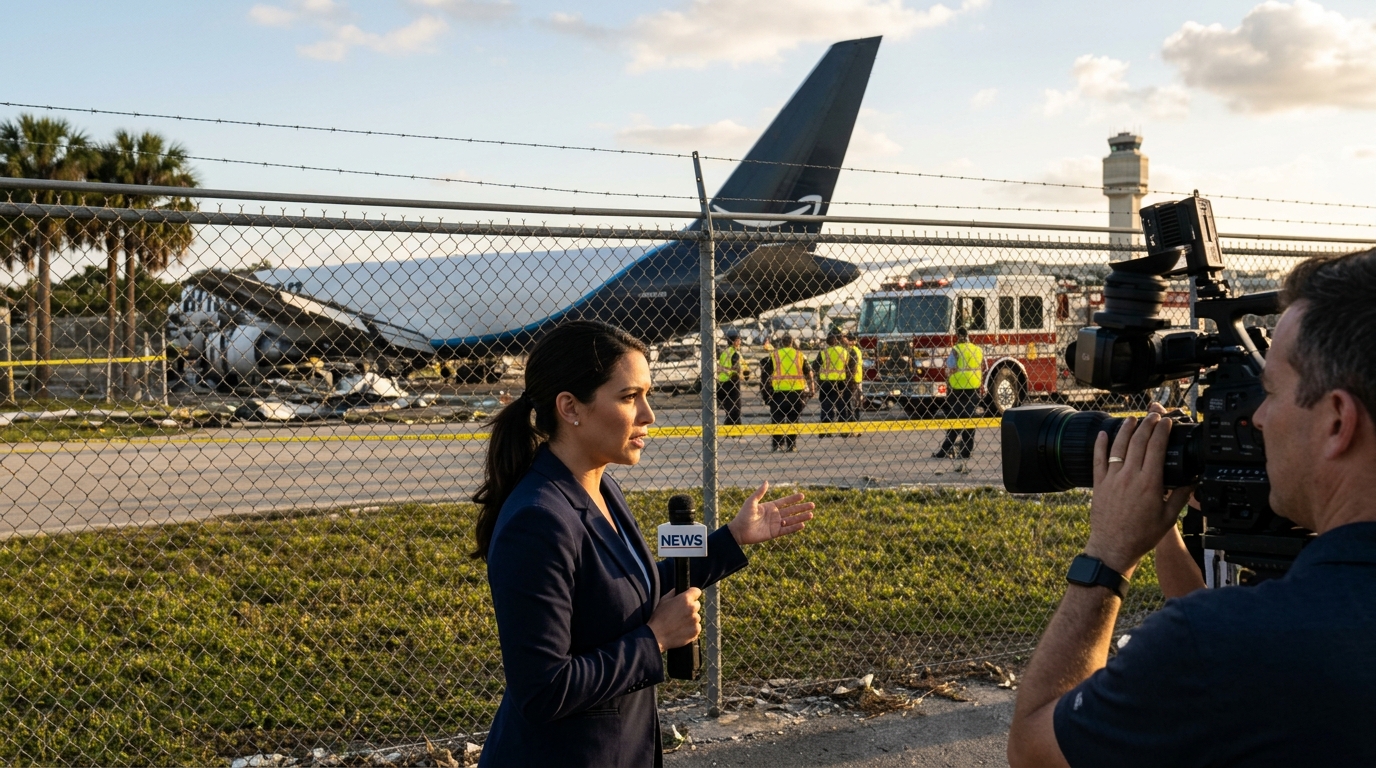
An NTSB investigation is underway after an Amazon Air cargo plane overran a runway at Miami International Airport on Sunday, leaving five people dead and five injured. The Boeing 767-300 overran the runway and crashed into vehicles both inside and outside the airport boundary.
AMZN closed the next trading session down just 0.15%. For a fatal accident carrying the Amazon brand, that is not a muted reaction. It is no reaction at all. The question worth posing is whether the options market agrees with that verdict, or whether it has simply not caught up yet.
The Structure of the Accident
Amazon confirmed the flight was operated by 21 Air, a US cargo carrier that flies 767 freighters. Amazon does not hold its own air operator certificate; the Prime Air network is flown by contracted operators, of which 21 Air is one. The flight had been operated by 21 Air, a cargo carrier based in North Carolina. The FAA confirmed the Boeing 767-300 departed from San Juan, Puerto Rico. The aircraft is about 32 years old.
Federal investigators spent Monday determining whether the plane touched down too late to stop safely. Video of the landing appears to show the Boeing 767 remaining airborne well down the runway before touching down. Aviation experts said investigators will seek to determine exactly where the plane landed, whether it was beyond the normal touchdown zone, and why the pilots did not abandon the landing.
Why AMZN Barely Moved: The Math
Amazon reported Q2 2026 earnings of $5.75 a share on revenue of $200.6 billion, ahead of Wall Street estimates. Revenue rose 20% year over year and operating income climbed 43% to $27.5 billion. AWS revenue rose about 37% year over year, its fastest pace in 18 quarters, as cloud and AI demand strengthened. Against that scale, logistics liability tied to a contracted carrier registers as rounding error.
This is not about callousness. It is about revenue mix. Air cargo is a delivery cost center, not a revenue driver. The contracted-operator model creates legal distance between Amazon and the aircraft operator. Litigation exposure from a contracted cargo accident, however tragic, does not register as a company-level risk event on Amazon’s scale.
Options Market Analysis
AMZN’s options market is pricing the accident as a non-event, consistent with the equity response. On the most recent full trading day before Labor Day, AMZN shares reached a daily high of $261.12 and a low of $255.29, ending at $258.51. That roughly $6 intraday range reflects sector rotation and macro drift, not accident-related fear premium.
With the next earnings date still broadly expected in late October, the term structure carries a visible earnings bump in October expiry. Near-term September options carry no measurable spike in put-side skew attributable to the Miami event. IV rank for AMZN entering this week sits in a moderate range, consistent with the post-earnings cooldown following the July beat. The put-call flow remains call-leaning, unchanged from pre-accident positioning.
Structured Trade Framework
Bull case: If you believe the accident carries no lasting liability or reputational weight on AMZN’s core business, a defined-risk structure such as a bull call spread in the October expiry targets a retest of the $270–$275 range, with max loss capped at the debit paid.
Bear case: For traders expecting regulatory scrutiny of Amazon Air’s contractor oversight to broaden, a modest put spread in the $245–$250 range through October expiry defines risk while capturing a potential 5–8% drawdown scenario. The probability is low but the cost of protection is commensurately small given current IV levels.
Neutral case: A short iron condor centered around current price, using the $250/$260/$260/$270 strikes in October expiry, harvests the modest IV premium while defining max loss on both wings. This structure suits traders who believe the accident has been fully discounted and no new catalyst emerges before earnings.
Risk Factors
The NTSB investigation is open-ended. Investigators have said they will examine factors including speed and braking, weather and wind, and the aircraft’s mechanical condition. If that work reveals systemic maintenance or scheduling failures within Amazon’s contracted network, congressional attention could follow. Aviation experts also noted that Miami International Airport is not equipped with runway arresting systems that the FAA says have been installed at more than 120 airports nationwide. That detail could broaden the liability picture beyond 21 Air alone.
Action Checklist
- Monitor NTSB updates for flight data recorder findings as they are released
- Watch for any Amazon statement addressing contractor oversight or fleet safety audits
- Check October put-side skew daily for any adjustment of accident-linked downside risk
- Track 21 Air and ATSG for contract-level fallout; Amazon already owns about 19.5% of ATSG, which has been one of Amazon’s primary air transportation providers since 2016
- Flag late October earnings expectations as the next hard volatility event; structure positions to expire before or after, not across it