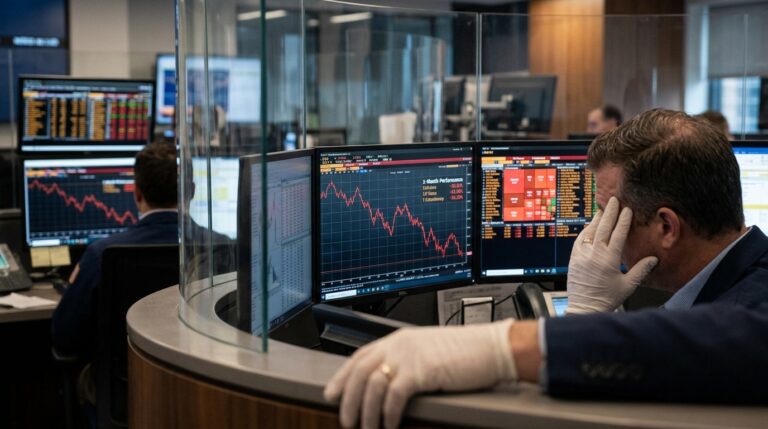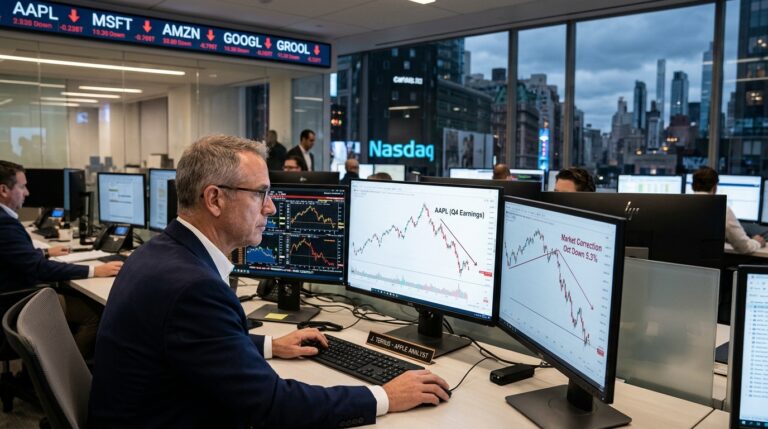
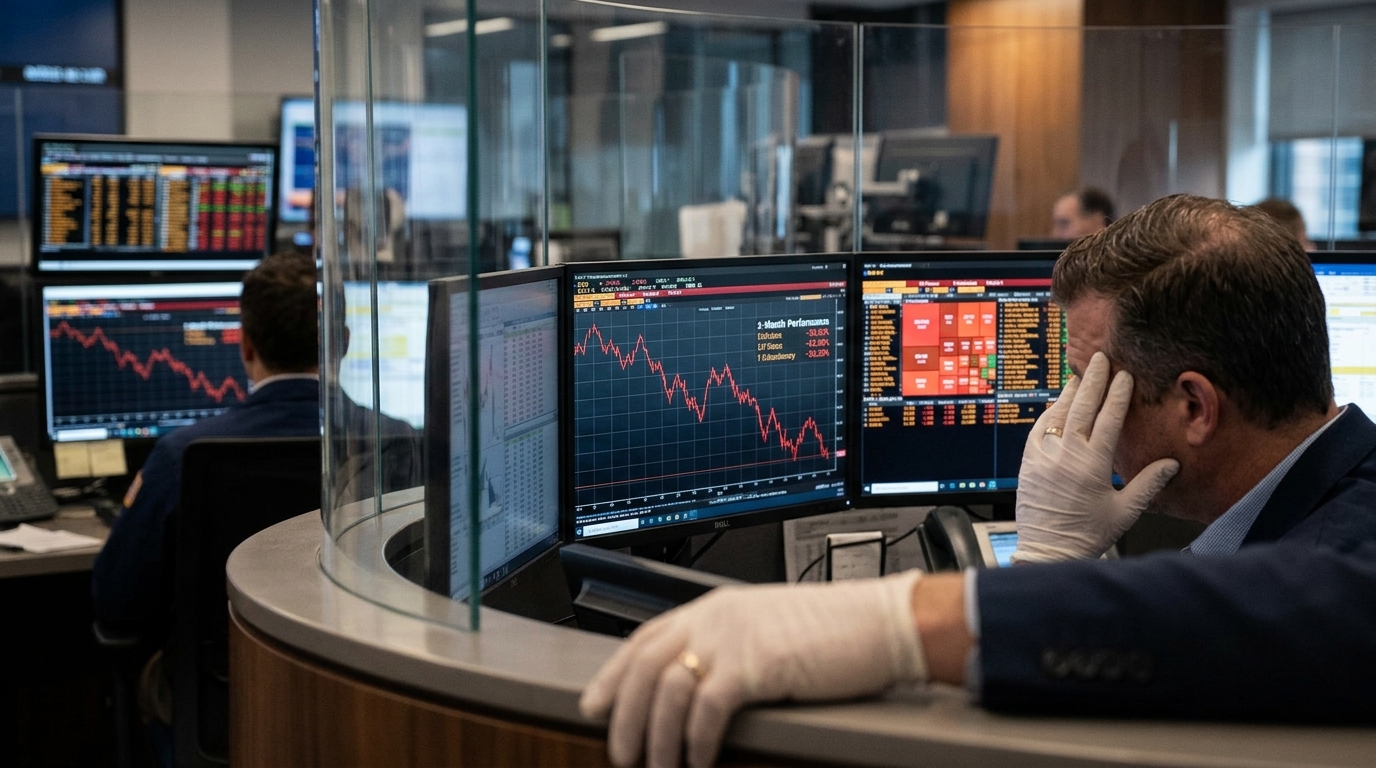
The question hanging over the Nasdaq 100 all year finally got a hard answer on Friday. Disappointing tech results spurred the worst drop for stocks since June, with the Nasdaq 100 sinking 3.5% and briefly crossing the threshold of a technical correction. The S&P 500 fell 1.8%, breaching its 100-day moving average. For month-end, that is not a mood. It is a closing statement.
The Nasdaq 100 fell as much as 4.5% intraday to complete a more than 10% drop from its most recent peak, the third such correction of 2026, following an earlier selloff at the outbreak of the Iran war and a semiconductor rout over the summer. Tech stocks plunged Friday, erasing more than $1 trillion in value. The VIX closed at 19.42, up 12.91% from the prior session.
What Actually Moved
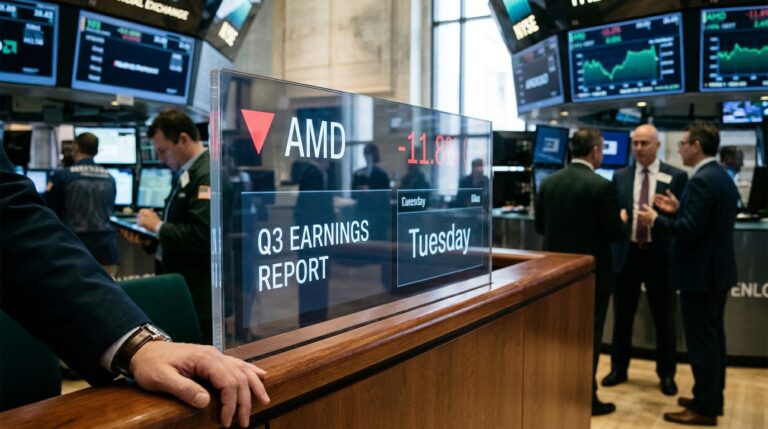
Intel plunged 28.6%, its worst day since 1974, on a weak fourth-quarter profit forecast and a cash-flow warning. Nvidia fell 4.2%, AMD fell 10.9%, and Amazon slipped after a profit miss, a day after Alphabet logged its worst day on record. Dell Technologies fell roughly 11%. Nvidia, with little PC exposure, held up better than the group, dropping about 4%.
Intel shares plummeted after the chipmaker issued weaker-than-expected guidance tied to a shutdown at its Kiryat Gat, Israel facility and ongoing softness in the PC market. Even so, Intel’s outlook handed the stock its worst day in more than half a century.
Why It Happened
The earnings misses were the trigger. The fuel is something older and harder to extinguish.
Alphabet reported earnings of $2.67 per share, down 7% year over year, its first combined top- and bottom-line miss since Q4 2022, with negative free cash flow of $9.07 billion and Q3 capital expenditures of $51.4 billion. Long-term debt jumped to $125.1 billion from $21.6 billion the year prior, a sharp rise in borrowing to fund AI initiatives. For the twelve months ended September 30, Amazon’s free cash flow was negative $42.4 billion, compared with positive $14.8 billion a year earlier. The businesses are growing. The cash is gone.
As the central businesses of America’s technology giants show signs of slowing, investors are sharpening their scrutiny of whether the huge sums being poured into AI will pay off. “We’re moving out of the hopes and dreams phase of the AI trade and into the ‘show me’ phase,” said Joe Tigay at Equity Armor Investments.
What the Market May Be Missing
The Nasdaq 100 is in correction, but it is not in ruins. The correction is real; the apocalypse is premature. What the headlines miss is that the selloff is revealing a split, not a collapse.
Capital did not leave equities on Friday. Much of it rotated, and it rotated toward sectors with cleaner balance sheets and no exposure to data-center debt.
Neoclouds, the infrastructure companies behind AI datacenters, are under particular scrutiny over their debt levels. CoreWeave, whose bond yields have surged, is the poster child of that worry, with shares down 37% in October. The concern now is that the AI infrastructure buildout is a leveraged bet, and the AI infrastructure buildout is pushing free cash flows into negative territory and relies on substantial borrowing.
Risks and Counterpoints
The bearish case is straightforward: major tech firms are increasingly using debt to fund AI expansion, with JPMorgan predicting $900 billion in global AI capital expenditure by 2026. If the revenue from that spending arrives later than the debt service, the math turns ugly fast.
The bullish case is nearly as simple. One bad quarterly headline does not erase that gap.
What to Watch Next
A December hike would raise the cost of the debt financing the entire AI buildout depends on. Watch the November 10 CPI reading closely. Watch whether Nvidia’s next quarterly guidance confirms or dims the demand picture. And watch whether biotech and homebuilders continue to attract the capital leaving tech, because that rotation, more than any single earnings miss, is the signal worth reading.