The autonomous delivery industry has a number it keeps quoting: $1 per order. That figure appears in investor decks, Barclays research, and management commentary alike. What gets less airtime is where costs actually sit right now, and why closing the gap depends on variables none of the major platforms fully control.
Start with the baseline. In markets where autonomous delivery is already operational, per-order costs run between $5 and $7, according to a Barclays analysis published in April 2026 and summarized by PYMNTS. That is already $3 to $4 cheaper than dispatching a human courier in high-labor-cost cities. The structural logic is sound: eliminate the driver, and the math shifts dramatically. The problem is that eliminating the driver is not the same as eliminating the cost.
What the Numbers Actually Show
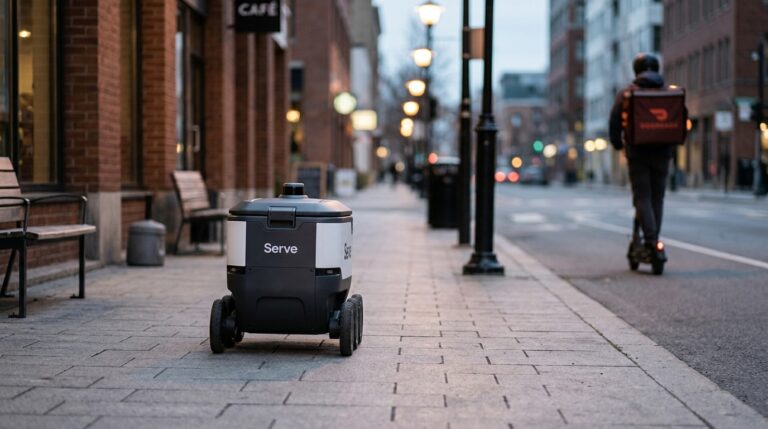
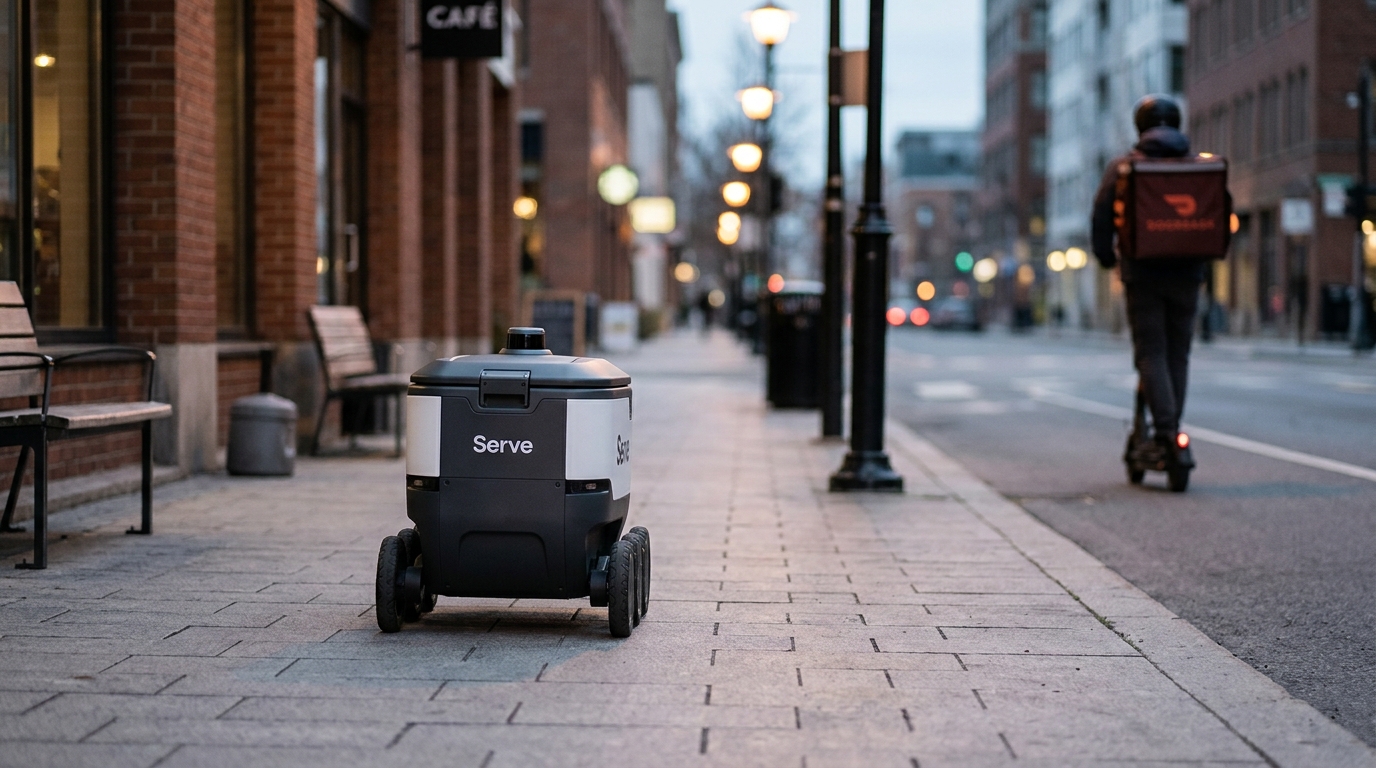
Serve Robotics (SERV) operates one of the largest autonomous sidewalk delivery fleets in the United States. As of September 2026, the company says it has deployed more than 2,000 robots across 44 active cities, has completed over 1.8 million deliveries, and has maintained a 99.8% delivery completion rate. Second-quarter 2026 revenue was $3.2 million, a 404% year-over-year increase. But only 792 robots were daily-active on average during Q2, and the company revised its full-year 2026 revenue guidance to a range of $9 to $10 million from its prior outlook of roughly $26 million.
That guidance cut is the single most important data point in the autonomous delivery story right now. It isolates the real bottleneck: utilization, not hardware. Serve has said its Gen-3 robots are manufactured at roughly one-third the cost of Gen-2 units, enabled by scaled manufacturing through Magna International. The hardware problem is largely solved. The utilization problem is not.
DoorDash’s Parallel Bet
DoorDash is running a different architecture. Its Dot robot, launched in September 2025, integrates into what the company calls an Autonomous Delivery Platform: an AI dispatcher that matches each order to the optimal delivery method in real time, whether that is a human Dasher, Dot on the road, a drone, or a Coco sidewalk robot. DoorDash also launched a collaboration with the City of Fremont tied to Fremont Restaurant Week in March 2026.
Barclays projects $16 billion in annual global profits unlocked at scale, assuming roughly $4 in savings per order at long-run penetration. But the bank sees autonomous delivery at less than 1% of all food orders today, reaching only 10% by 2035. That timeline compresses the profit case considerably.
Where the Trade Sits
BCG put a clear number on the robotaxi-adjacent cost trajectory in March 2026: a viable path to $0.80 per kilometer in the U.S. For last-mile delivery, mature operations could reach $0.30 to $0.50 per mile under optimistic assumptions. Tesla has publicly discussed long-run operating costs in the $0.20 per mile range for Cybercab, and the company opened paid Cybercab rides to the public in Austin on September 4, 2026. Those figures assume high daily utilization, dense urban deployment, and minimal remote-operator overhead.
SERV’s guidance revision proves that assumption is fragile. New robots are inefficient in unfamiliar territory. Per-delivery cost declines sequentially only as robots accumulate route familiarity in a given neighborhood. Scale the fleet before density supports it, and unit economics deteriorate before they improve.
The $1 delivery is not a technology question. It is a density question. And density requires volume commitments from platforms that are still treating robotics as a cost reduction experiment rather than core infrastructure.
Options Market Angle
SERV’s implied volatility remains elevated against its $9 to $10 million guidance range. The broader point is unchanged: the stock’s valuation is implicitly pricing a future that requires utilization improvements the Q2 active-robot count did not confirm. For traders expecting a continued utilization ramp, a defined-risk bull spread on SERV above key support offers participation without full exposure to cash-burn risk. For those skeptical that platform volume recovers before 2027, a put spread structure captures downside if guidance narrows further. Neutral positioning via a short strangle reflects the reality that the $1 target is not this year’s news.
Action Checklist
- Track SERV’s Q3 2026 daily active robot count against the Q2 average of 792. That single metric determines whether unit economics improve or deteriorate.
- Monitor DoorDash Adjusted EBITDA margin guidance for any disclosure on Dot’s cost-per-delivery contribution versus human Dasher baseline.
- Watch Barclays for updated fleet penetration estimates as year-end deployment figures from Serve, DoorDash, and other autonomy operators come in.
- If you believe density improves in H1 2027: defined-risk bull spread on SERV. If guidance misses again: put spread through next earnings. Neutral on the $1 timeline itself.