
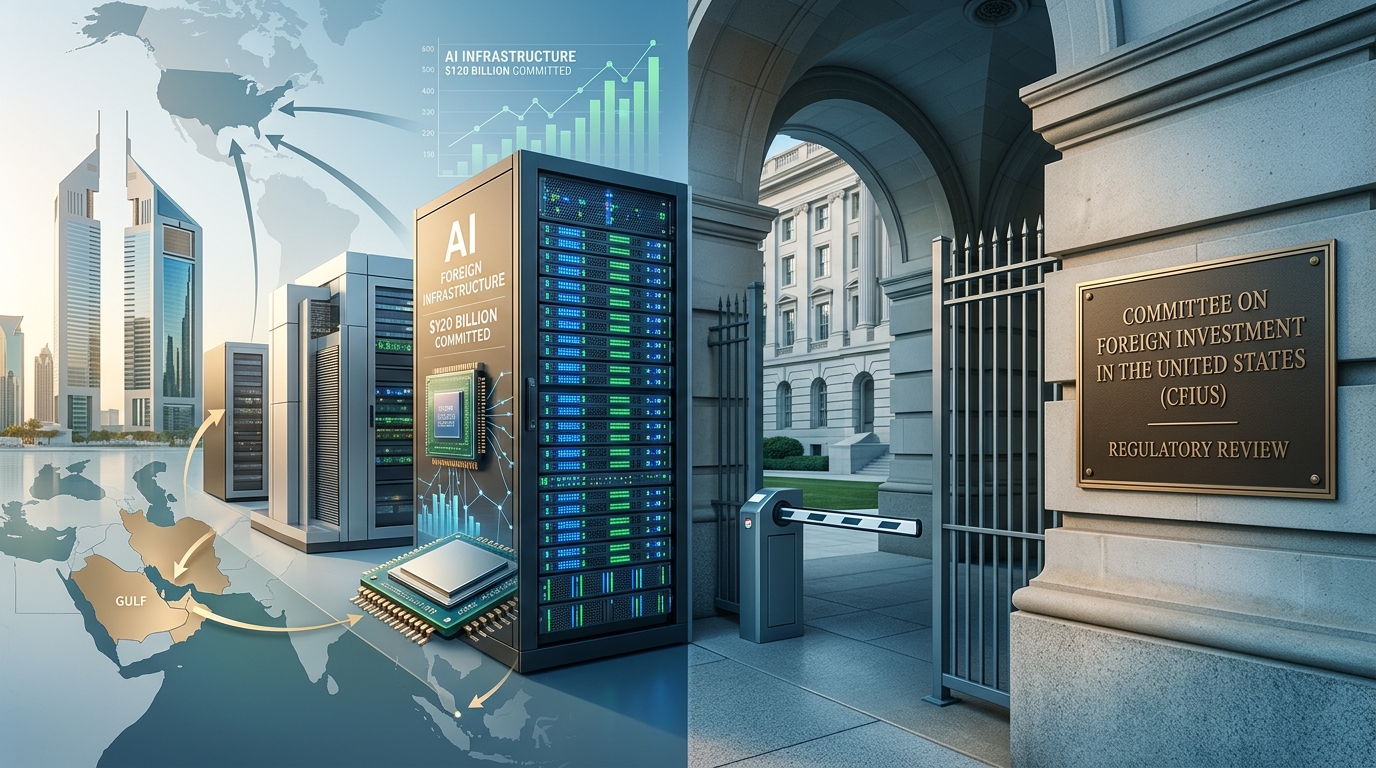
The numbers are not subtle. Sovereign wealth funds from Norway, the UAE, Saudi Arabia, and Singapore collectively held over $15 trillion in assets as of year-end 2025 and deployed a reported $66 billion into AI and digital infrastructure in that year alone. Their committed capital toward AI infrastructure buildout spanning data centers, compute networks, and semiconductor-linked assets is estimated to cross $120 billion through 2025 and 2026. That is not a portfolio tilt. That is a structural repositioning, and it is landing squarely on U.S. tech.
Saudi Arabia’s Public Investment Fund, the UAE’s Mubadala, and ADIA have made large-scale, long-term investments in data centers and AI computing infrastructure. Unlike other major markets, where private operators must secure tenants before committing capital, the Gulf has developed a structure in which sovereign wealth fund financing absorbs a substantial share of initial construction risk. Saudi Arabia’s HUMAIN alone commits more than $100 billion across 11 data centers totaling 2.2 gigawatts with hundreds of thousands of Nvidia GPUs. The deal architecture runs straight through U.S. chipmakers, hyperscalers, and infrastructure platforms.
For traders, the more actionable question is not whether the capital arrives. It is what shape it takes when it does.
Data centers may fall within CFIUS’s jurisdiction on multiple grounds, particularly where they host sensitive personal data or support government or defense customers. SWF investments can attract heightened scrutiny, especially where the fund is owned or controlled by a foreign government. The America First Investment Policy memorandum mandates tighter controls over investments from adversarial nations and expands CFIUS authority to include investments into U.S. greenfields. At the same time, the policy memo emphasizes that the U.S. welcomes passive investment in cutting-edge businesses from all foreign investors, including sovereign wealth funds.
That carve-out for passive investment is the pivot point. SWFs that invest indirectly in data centers as limited partners may choose to structure investments to be sufficiently passive to limit CFIUS jurisdiction. In practice, that means Gulf funds write large checks, take no board seats, and stay away from anything that looks like operational access. The sovereignty of the technology stays nominally domestic. The capital does not.
In 2026, Treasury proposed a Known Investor Program that may streamline filing processes and offer benefits for certain foreign investors that frequently file with CFIUS. “The increase in non-notified inquiries reflects a fundamental shift from rules-based compliance to discretionary, intelligence-driven enforcement,” one legal briefing noted this summer. That means deal certainty is lower, and timelines are longer, even for allied-nation funds.
The 2026 deal landscape reflects a sustained reallocation away from traditional equities toward alternative assets and long-duration infrastructure. GIC led several marquee transactions in the $2 billion to $4 billion range. The companies capturing this capital: data center platforms, power infrastructure operators, and semiconductor supply chains with exposure to Gulf compute buildouts.
The market implication is specific. Sovereign buyers are price-insensitive and horizon-agnostic. When they accumulate a position in an infrastructure platform or a chip supplier, they do not react to earnings misses the way a hedge fund does. They compress volatility in those names and provide a floor. That is not a reason to blindly follow them in. It is a reason to understand the ownership structure before the next selloff tests it.